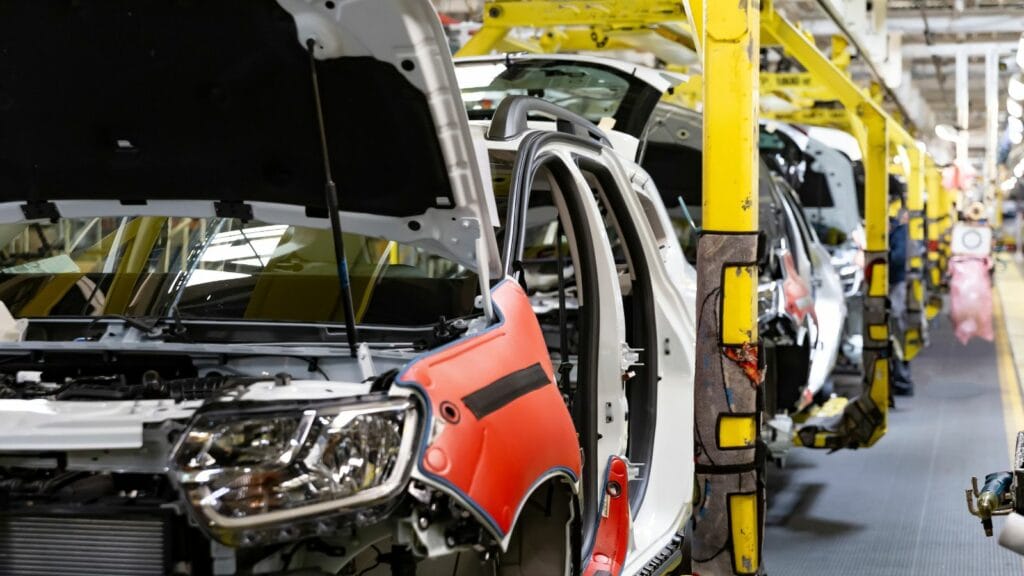
Donald Trump’s latest threat to walk away from the United States-Mexico-Canada Agreement is aimed at Canada and Mexico, but a new trade analysis suggests the sharpest political pain could land much closer to home. The North American auto industry is not built around three separate national markets. It is a shared production machine, with parts, vehicles, steel, electronics, and finished goods moving across borders before reaching dealers and consumers.
That makes the USMCA fight especially risky for states that helped power Trump’s political coalition. Michigan, Indiana, Kentucky, Texas, and other export-heavy states sell billions of dollars in goods to Canada and Mexico every year. If the agreement becomes a bargaining chip, the warning is clear: the fallout may not stop at the border.
A Threat Aimed Abroad Could Rebound at Home
Trump’s warning that he is “not looking to renew” USMCA lands at a sensitive moment. The agreement came into force in 2020 and is now approaching its scheduled six-year review, where the three countries must decide whether to extend the pact, keep it under annual review, or allow uncertainty to build toward possible expiration. For businesses, that review is not just diplomatic housekeeping. It shapes investment decisions, plant planning, sourcing contracts, and hiring.
The political framing is simple: Trump argues that Canada and Mexico need the U.S. market more than the U.S. needs them. The economic reality is messier. U.S. companies also rely heavily on those two markets as buyers, suppliers, and production partners. In 2025, the United States exported hundreds of billions of dollars in goods to each neighbour. Threatening the pact may sound like leverage, but for states that ship deeply into North America, it also creates risk.
The New Analysis Points to Trump-Friendly States
The Peterson Institute for International Economics looked at which U.S. states and product categories would be most exposed if USMCA termination became a real possibility. Its conclusion was politically awkward for Trump: several of the states with the largest exposure to Canada and Mexico are states he carried in 2024. The analysis highlighted nine states where exports to Canada and Mexico topped $2,000 per person, including Texas, Michigan, Indiana, Kentucky, Iowa, Arizona, and North Dakota.
That matters because trade pain rarely arrives as an abstract national statistic. It shows up through quieter local channels: a parts supplier delaying a shift, a trucking firm losing cross-border volume, a farmer facing retaliation, or a plant manager freezing a planned upgrade. Michigan alone sent an estimated $37.8 billion in exports to Canada and Mexico in 2025. Indiana sent $20.6 billion, while Kentucky sent $12.3 billion. Those are not small border-state footnotes. They are major pieces of state economies.
Michigan Would Be Near the Center of the Shock
Michigan is the clearest example of why a USMCA rupture could boomerang. The state’s economy is tied to vehicles, parts, tooling, engineering, logistics, and the Detroit-Windsor corridor. Cars and components do not simply move from one country to another in a straight line. A single vehicle can rely on parts and subassemblies that cross the border more than once before final assembly, which is why sudden tariffs or rule changes can ripple quickly through production schedules.
For Michigan workers, this is not a theoretical debate about trade architecture. It touches plants, suppliers, rail yards, parts warehouses, and dealerships. A tariff fight could raise costs for companies that already operate on tight production timelines. It could also weaken demand if higher costs are passed to consumers. Even if the U.S. administration’s goal is to pull more production into America, automakers cannot rebuild complex supplier networks overnight. The near-term disruption would likely hit existing operations first.
Indiana and Kentucky Face a Parts-Chain Problem
Indiana and Kentucky often receive less attention than Michigan in auto trade debates, but both are deeply exposed to North American manufacturing. Indiana has a large base of vehicle, engine, transmission, recreational vehicle, and parts production. Kentucky is home to major auto assembly operations and a network of suppliers that feed the broader regional system. When Canada and Mexico buy U.S. parts, machinery, and finished goods, states like these are part of the story.
The risk is that tariffs or retaliation would not only affect finished vehicles. Auto supply chains are layered. A producer in Indiana may sell a component that goes to another plant, becomes part of a larger system, and later returns inside a completed vehicle. A Kentucky plant may depend on inputs priced under USMCA assumptions. Once uncertainty enters those assumptions, companies may delay investments, adjust sourcing, or build in higher risk premiums. That is how trade threats become local business headaches.
Auto Parts Are the Pressure Point
The most striking product category in the new analysis is auto parts. U.S. exports of vehicle parts and accessories to Canada and Mexico reached about $32.7 billion in 2025, representing more than three-quarters of total U.S. exports in that category. Passenger vehicles and goods-transport vehicles were also major export categories. In plain terms, Canada and Mexico are not just foreign competitors in autos. They are two of the biggest customers for U.S.-made auto products.
That gives Canada and Mexico potential leverage if the U.S. escalates. Retaliation does not have to hit every sector equally to be painful. Targeted tariffs on politically sensitive products can put pressure on state leaders, business groups, and members of Congress. Auto parts are especially vulnerable because they are central to production and highly visible in job-heavy regions. If Washington threatens the trade framework, Ottawa and Mexico City would likely study which U.S. export categories create the most political pressure.
The Supply Chain Was Designed Around Certainty
USMCA did not create North American auto integration from scratch. It updated rules that had been developing since the Auto Pact, NAFTA, and decades of cross-border manufacturing. The current agreement tightened auto rules of origin, requiring a higher share of vehicle content to come from North America for duty-free treatment. It also added labour-value rules meant to push more high-wage production into the region. Those provisions were supposed to make North America more competitive, not less stable.
That is why the threat of non-renewal is different from a normal policy dispute. Automakers can adapt to gradual rule changes, but they struggle with uncertainty over whether the entire framework will remain dependable. A plant decision may involve billions of dollars and a decade-long payback window. If companies fear annual reviews, sudden tariff threats, or fragmented bilateral deals, they may become more cautious. In manufacturing, hesitation can be costly because investment delayed today often means capacity lost tomorrow.
Consumers Could See the Cost Before Factories See the Gain
Supporters of tougher tariffs often argue that higher import costs will force companies to build more in the United States. The problem is timing. Building new plants, qualifying suppliers, training workers, and shifting tooling can take years. Vehicle prices, however, can react much faster. If tariffs raise costs on components, finished vehicles, steel, aluminum, or electronics, automakers may have to absorb thinner margins or pass costs to buyers.
That matters in an auto market already strained by affordability. Families shopping for a pickup, SUV, or commuter car are sensitive to monthly payments, interest rates, insurance, and repair costs. Even modest price increases can push buyers into the used market or delay purchases altogether. Lower demand can then reduce production volume, which can hurt the very workers tariffs are meant to protect. The danger is not just higher sticker prices. It is a chain reaction through dealers, lenders, suppliers, and factories.
Canada and Mexico Are Not Passive Targets
The trade dispute is often framed as Washington applying pressure and its neighbours reacting. But Canada and Mexico have their own tools. Canada is a major buyer of U.S. vehicles, agricultural goods, machinery, energy products, and manufactured inputs. Mexico is one of the largest U.S. trading partners and a major destination for American exports. Both countries can respond selectively if they believe the U.S. is threatening the core trade bargain.
That does not mean either country wants a trade war. Canada has already signalled that bilateral arrangements may sit alongside the trilateral USMCA review, while Mexico has been engaged in talks with U.S. officials over trade rules and compliance. Still, the basic leverage is obvious. If Washington puts the agreement at risk, Canada and Mexico can look for pressure points in U.S. states where exports matter most. That is why the Peterson analysis is so politically important: it maps where retaliation would bite.
The Bigger Risk May Be Uncertainty, Not Immediate Termination
Outright termination of USMCA remains unlikely in the near term, and the new analysis makes that clear. The more realistic danger is a long period of annual reviews, threats, partial side deals, and unresolved disputes. That kind of uncertainty may not generate a single dramatic factory closure headline, but it can slowly weaken investment confidence. Companies do not need a trade agreement to disappear before they begin planning around the risk that it might.
For the auto industry, that uncertainty comes at a difficult time. Automakers are already navigating electric vehicle investment, battery sourcing, labour costs, Chinese competition, tariffs, and shifting consumer demand. The strongest version of North American manufacturing would require stability, predictable rules, and coordinated investment. Trump’s threat may be designed to extract concessions, but the warning from trade analysts is blunt: the states most exposed to blowback include the same industrial states his political movement claims to defend.

Alanna Rosen is an experienced content writer that focuses on many EV and educational content. Her articles are regularly published on Get CyberTrucked and syndicated on large publications.