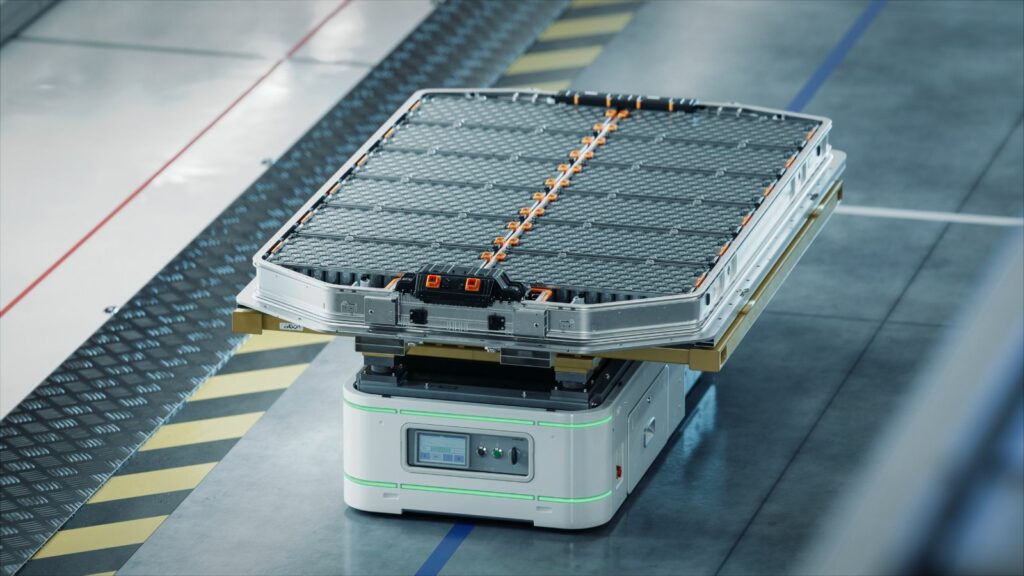
A small batch of Arkansas lithium has now travelled much farther down the battery supply chain than the raw mineral itself. Standard Lithium says battery-quality lithium carbonate produced from its South West Arkansas project was supplied to Canadian battery-materials specialist Nano One Materials, which converted it into lithium iron phosphate cathode active material and then built coin cells for electrochemical testing.
The experiment involved only about one kilogram of lithium carbonate, so it was not a commercial manufacturing run. Yet the result connects several pieces North America has been trying to assemble locally: domestic lithium extraction, battery-grade refining, cathode production and cell fabrication. For an LFP industry still overwhelmingly concentrated in China, that makes the test more significant than its physical size suggests.
One Kilogram of Arkansas Lithium Made the Journey Into a Battery Cell
Standard Lithium supplied Nano One with approximately one kilogram of battery-quality lithium carbonate made using brine and the process flowsheet developed for the South West Arkansas project. Nano One then fed the material into its patented One-Pot process, producing lithium iron phosphate, or LFP, cathode active material. That material was subsequently incorporated into coin cells for electrochemical testing. Standard Lithium reported that the resulting cathode material displayed the desired chemical and physical characteristics as well as the intended particle morphology.
The important part is the sequence. Lithium projects commonly demonstrate that they can recover or purify a mineral, but battery manufacturers ultimately need highly consistent material that survives several additional processing stages. In this case, Arkansas-derived lithium moved from an upstream development project into cathode material and then an operating electrochemical cell. It does not establish mass-production readiness, but it gives Standard Lithium another practical data point showing that its proposed lithium product can function in a downstream battery-material process.
The 155 mAh/g Result Gives the Test Technical Weight
Initial electrochemical testing produced a first-discharge result of approximately 155 milliamp-hours per gram, according to Standard Lithium. That figure is meaningful because lithium iron phosphate has a theoretical specific capacity of roughly 170 mAh/g. Published battery research has shown practical LFP capacities commonly falling below that theoretical ceiling, with commercial carbon-coated LFP historically operating in roughly the 120-to-160 mAh/g range depending on material design, testing conditions and other variables.
That places the reported Arkansas-derived material within a technically credible range for an initial test. Still, 155 mAh/g should not be mistaken for proof that commercially manufactured batteries using the material will achieve identical performance. Coin cells are valuable for evaluating chemistry and electrode materials under controlled conditions, but automakers and energy-storage customers require substantially broader qualification covering cycle life, rate capability, temperature behaviour, consistency and larger-format cells. The milestone therefore validates an important step rather than completing the qualification journey.
Arkansas Is Sitting Above an Unusually Large Lithium Opportunity
The experiment draws additional attention because South West Arkansas lies within the Smackover Formation, an underground geological system already associated with decades of oil, gas and bromine activity. A U.S. Geological Survey-led assessment estimated that Smackover brines beneath southern Arkansas contain between 5.1 million and 19 million metric tons of lithium in place. The researchers stressed that this calculation is a geological resource estimate and does not determine how much can ultimately be recovered economically.
The scale nevertheless explains the industrial interest surrounding the region. USGS researchers also estimated that about 5,000 metric tons of dissolved lithium were brought to the surface in southern Arkansas during 2022 in brines associated with existing oil, gas and bromine operations. Instead of developing a conventional hard-rock lithium mine, companies including Standard Lithium are pursuing methods that separate lithium from underground saltwater. Arkansas therefore offers an unusual combination: a potentially enormous resource alongside an established brine-processing industry and experienced industrial workforce.
Nano One Provides the Canadian Midstream Link
For Nano One, the test fits directly into a strategy built around producing cathode active material closer to where batteries will eventually be manufactured. The Vancouver-headquartered company develops its battery-material technology in Burnaby, British Columbia, while operating an LFP production facility in Candiac, Quebec. Its One-Pot technology is designed to combine steps normally associated with precursor and cathode production, allowing different lithium inputs to be converted into finished cathode active material through a shorter processing route.
Nano One is also expanding the physical capacity behind that strategy. In July 2026, the company said its existing Candiac line had capacity of roughly 200 tonnes per year and supported customer sampling, product validation and smaller-volume opportunities. An expansion is intended to bring total capacity to approximately 800 tonnes annually, with commissioning targeted for the first half of 2027. As of mid-July, detailed engineering was 85% complete, while about 95% of equipment by procurement value was being sourced from Canada, the United States and Europe.
LFP’s China Concentration Explains Why the Test Matters
LFP is no longer a niche battery chemistry. The International Energy Agency estimates that LFP batteries represented more than 55% of EV battery capacity deployed worldwide in 2025, rising from nearly half the market a year earlier. The chemistry has gained ground partly because it avoids nickel and cobalt and can offer attractive costs, durability and safety characteristics for mass-market vehicles, stationary storage and other applications where maximum energy density is not always the highest priority.
The geographic concentration behind that growth is striking. The IEA reported that more than 98% of LFP cathode material and LFP battery cells were produced in China in 2024. More broadly, China accounted for about 85% of global cathode active-material production across major EV battery chemistries in 2025. That means simply producing lithium in North America does not create a self-contained battery supply chain. The mineral still needs local processing into cathode material before regional cell factories can meaningfully reduce their dependence on overseas midstream suppliers.
South West Arkansas Is Being Designed on a Much Larger Scale
The kilogram-scale battery test ultimately matters only if the South West Arkansas project progresses into commercial production. Smackover Lithium, the partnership developing the project, is owned 55% by Standard Lithium and 45% by Equinor. Its current first-phase design calls for approximately 22,500 tonnes of battery-quality lithium carbonate production annually over a modeled operating life of at least 20 years. Standard Lithium’s August 2026 update says first commercial production is now targeted for 2029.
The project’s definitive feasibility work estimated capital expenditure of approximately US$1.45 billion. It calculated an unlevered pre-tax net present value of US$1.7 billion and a 20.2% internal rate of return, although those figures depend on assumptions that include a long-term lithium carbonate price of US$22,400 per tonne. The project also carries significant technical scale-up ambitions. Standard Lithium reported in August that its Arkansas demonstration operation had processed one million barrels of Smackover brine and completed more than 15,000 direct-lithium-extraction cycles during six years of operation.
Governments Are Treating the Supply Chain as a Strategic Asset
Public funding on both sides of the border illustrates how battery materials have become tied to industrial and national-security policy. The U.S. Department of Energy is providing US$225 million toward the South West Arkansas project’s central processing facility. DOE’s 2026 environmental review described a proposed operation producing a nominal 22,500 metric tons of battery-quality lithium carbonate annually and concluded that the federally supported project would not create significant adverse environmental impacts requiring a full environmental impact statement.
Nano One has attracted government backing of its own. The U.S. Department of Defense awarded the Canadian company US$12.9 million in 2024 to help increase LFP cathode-material production capabilities in Quebec and British Columbia. The Pentagon noted that Canada has been considered a domestic source for Defense Production Act purposes since 1992. Ottawa has also participated: Natural Resources Canada announced another C$4.3 million for Nano One’s LFP commercialization work in April 2026, building on a C$5-million contribution announced in 2025.
A Successful Cell Test Still Leaves the Hardest Commercial Questions Ahead
The Arkansas-to-LFP-cell demonstration closes a technical loop, but several much larger loops remain open. Standard Lithium said on August 10 that two major prerequisites for a final investment decision had been completed: key construction contracts were in place and the project’s federal environmental review had concluded. The remaining priorities were securing additional customer commitments and completing project financing. The company continued to target a final investment decision and the start of construction during 2026.
There is already one significant customer agreement. Smackover Lithium signed a binding deal to supply Trafigura with 8,000 metric tons of lithium carbonate annually for 10 years once commercial production begins. But financing and building a US$1.45-billion project, scaling direct lithium extraction and repeatedly producing battery-grade material at thousands of tonnes per year are challenges far beyond a one-kilogram experiment. The latest test therefore represents evidence of compatibility rather than proof of commercial success. Its larger significance is that a North American chain—from Arkansas brine to Canadian cathode technology to a functioning LFP cell—has now been demonstrated in miniature.
