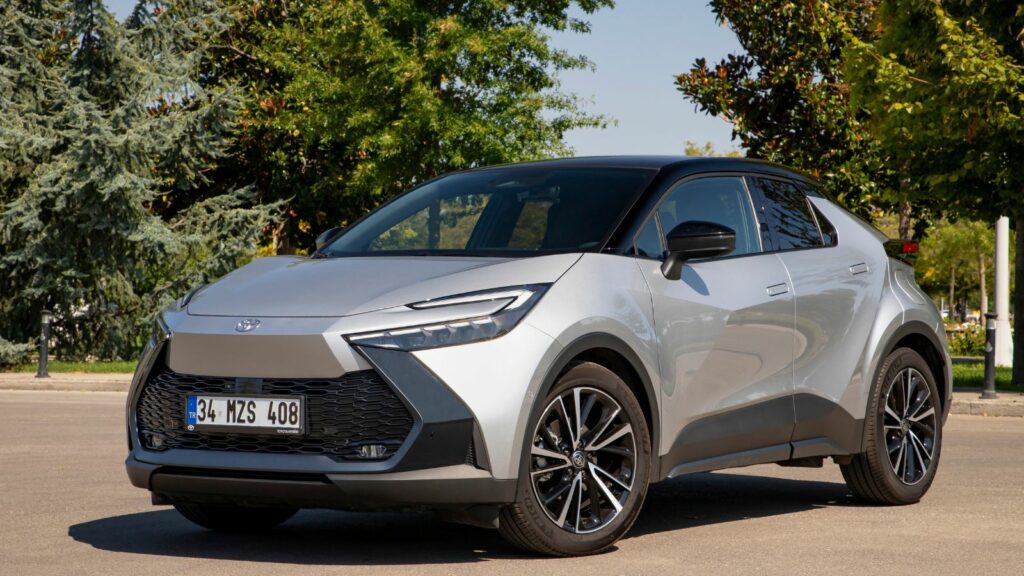
Toyota is bringing one of its most distinctive nameplates back to Canada, but the new C-HR has almost nothing mechanically in common with the gasoline-powered crossover Canadians once knew. The 2026 Toyota C-HR is now fully electric, starts at an MSRP of $44,900 and offers an NRCan-estimated driving range of up to 496 kilometres in its most efficient configuration.
That combination puts Toyota into a particularly competitive part of the Canadian EV market, where price, winter usability and charging access can matter as much as horsepower. Buyers can choose between a front-wheel-drive model designed to maximize range and more powerful all-wheel-drive versions. A 77-kWh battery, native NACS charging port and extensive standard technology give the revived C-HR a much bigger role than simply replacing the quirky crossover that disappeared several years ago.
A Familiar Name Returns as a Very Different C-HR
The C-HR badge first appeared in Canadian showrooms for the 2018 model year, attached to a boldly styled gasoline-powered compact crossover. That version was offered only with front-wheel drive in Canada and eventually disappeared after the 2022 model year, with Toyota directing small-SUV buyers toward the more conventional Corolla Cross. The absence did not last. Toyota has revived the name for 2026, although the transformation is substantial enough that returning owners may find little beyond the badge itself familiar. Instead of an internal-combustion drivetrain, the new Canadian C-HR is exclusively a battery-electric vehicle.
Toyota developed the new model on its dedicated e-TNGA electric-vehicle architecture, the same broader platform family supporting other battery-electric products from the company. The design still embraces the unconventional personality associated with the earlier C-HR, including a coupe-like roofline, wide stance and sharply angled rear bodywork. At 4,520 millimetres long with a 2,750-mm wheelbase, it remains relatively compact. The important change is its purpose: instead of being an unusual alternative within Toyota’s gasoline crossover range, it is now the least-expensive battery-electric model in Toyota Canada’s lineup and a potentially important entry point for households considering their first full EV.
The $44,900 Starting Price Is the Big Canadian Hook
The headline number is $44,900, which is the Canadian MSRP for the front-wheel-drive C-HR SE. Toyota’s published pricing puts the XSE AWD at $49,950, while the better-equipped XSE Premium AWD carries a $54,400 MSRP. Buyers should distinguish those sticker prices from the amount that ultimately appears on a purchase agreement. Toyota originally calculated an estimated vehicle price of $48,300 for the SE after freight, preparation and certain maximum fees, while excluding taxes, licensing, registration and insurance. In other words, “below $45,000” accurately describes the starting MSRP rather than an all-in drive-away price.
The timing also puts the C-HR into Canada’s new Electric Vehicle Affordability Program. In 2026, qualifying battery-electric purchases can receive up to $5,000, with the federal program generally requiring eligible transactions for imported EVs to have a final transaction value of $50,000 or less. Transport Canada’s vehicle list includes the 2026 C-HR SE FWD and XSE AWD. However, transaction eligibility still depends on the specific deal, meaning added packages and some fees can matter. That makes the inexpensive SE especially significant: Toyota has positioned it close enough to the federal threshold to compete for value-conscious EV shoppers without requiring them to start with a stripped-down specialty model.
496 KM Gives the Base Model a Real Range Argument
Range is arguably where the C-HR SE makes its strongest case. Its 77-kWh lithium-ion battery delivers an NRCan-estimated 496 kilometres on a full charge under specified test conditions. The front-wheel-drive model produces 221 horsepower and rides on 18-inch wheels, avoiding the additional motor and larger-wheel penalty associated with the more powerful versions. The resulting figure is notable because it approaches the psychological 500-km mark while keeping the starting MSRP below $45,000. Toyota’s own larger 2026 bZ, for comparison, was launched with up to 486 kilometres of range and a higher $45,990 starting MSRP.
The comparison becomes even tighter against another newly redesigned Japanese EV. Nissan lists the 2026 Leaf S Plus at $44,998 with an estimated 488 kilometres from its 75-kWh battery. That means Toyota and Nissan are effectively competing within a few dollars and kilometres of one another at the entry level. Still, 496 kilometres should not be interpreted as a guaranteed Canadian winter figure. Toyota specifies that its range ratings are achieved under ideal conditions, generally around 20°C to 30°C. Natural Resources Canada says EV range can fall by roughly 25% to 30% in extreme cold, depending on conditions, heating demand and vehicle characteristics. For Canadians, the rated number is therefore best treated as a comparison benchmark rather than a promise for every January drive.
NACS and 30-Minute Fast Charging Address Road-Trip Anxiety
Toyota has also made a significant change at the charge port. Every Canadian C-HR uses the North American Charging System connector, or NACS, rather than relying solely on the CCS connector traditionally fitted to many non-Tesla EVs. That gives the vehicle access to a wider and rapidly expanding charging ecosystem without forcing owners to depend on an adapter for compatible NACS locations. Toyota additionally equips the C-HR with a dual-voltage 120V/240V charging cable, allowing owners to use basic household power when necessary or a more practical Level 2 setup at home.
For faster stops, Toyota says the C-HR can move from 10% to 80% battery charge in approximately 30 minutes under ideal DC fast-charging conditions. An 11-kW onboard AC charger handles Level 2 charging, while battery preconditioning can warm or cool the pack toward an appropriate temperature before a fast-charging session. That feature has particular relevance in Canada because a cold battery can accept energy more slowly. The system can be activated manually, while automatic preconditioning tied to navigation requires the applicable connected-service functionality. Charging times will still vary with temperature, charger performance, battery state and other factors, but the hardware addresses several of the inconveniences that historically made longer winter EV journeys harder to plan.
AWD Turns the C-HR From Efficient to Surprisingly Quick
Choosing all-wheel drive changes the character of the C-HR considerably. Instead of the SE’s 221-horsepower front-drive setup, the XSE uses electric motors at the front and rear axles for a combined 338 horsepower. Toyota estimates that configuration can accelerate from zero to 100 km/h in approximately 5.2 seconds. That is brisk performance for a small Toyota crossover and dramatically different from the original Canadian C-HR, which prioritized styling and urban usability rather than outright speed. The underfloor battery also lowers the vehicle’s centre of gravity, while Toyota specifically tuned the springs, dampers and anti-roll bars around the electric platform.
Extra performance comes with a predictable range trade-off. The XSE AWD on 18-inch wheels is rated at 452 kilometres, 44 kilometres less than the front-drive SE. Moving to the XSE Premium and its 20-inch wheels lowers the estimate again to 438 kilometres. The choice therefore becomes unusually clear. Drivers prioritizing maximum distance and price have a strong incentive to select the SE, while the XSE gives Canadians all-wheel drive and an additional 117 horsepower while retaining more than 450 kilometres of rated range. Steering-wheel paddles also provide four selectable levels of regenerative braking, allowing drivers to alter how aggressively the vehicle slows and recovers energy when lifting off the accelerator.
The Cabin Makes the Entry Model Feel Less Like a Price Leader
Toyota has avoided making the $44,900 C-HR SE look like an obvious compromise model inside. Standard equipment includes a 14-inch Toyota Multimedia touchscreen, a digital instrument display, two wireless smartphone chargers, heated front seats, a heated steering wheel, rain-sensing wipers, power liftgate and multiple USB-C connections. Toyota Safety Sense 3.0 is also standard, accompanied by technologies such as blind-spot monitoring and front and rear parking assistance with automatic braking. Higher trims add features including a panoramic-view monitor, driver memory settings, synthetic-suede upholstery and additional driver-assistance technology.
Practicality is respectable despite the coupe-inspired profile. Toyota quotes up to 720 litres of cargo room behind the rear seats and as much as 1,685 litres when the 60/40-split rear seatbacks are folded. Buyers also receive Toyota’s standard 36-month/60,000-km basic warranty, while BEV-specific components and the electric-vehicle battery receive coverage for eight years or 160,000 kilometres, subject to warranty terms. Combined with the C-HR’s price and range, those details make the vehicle more than a design exercise. Toyota is entering a Canadian EV market in which the new Nissan Leaf sits at virtually the same starting price, forcing mainstream brands to deliver usable range, substantial equipment and convenient charging without pushing buyers deep into premium-car territory.
