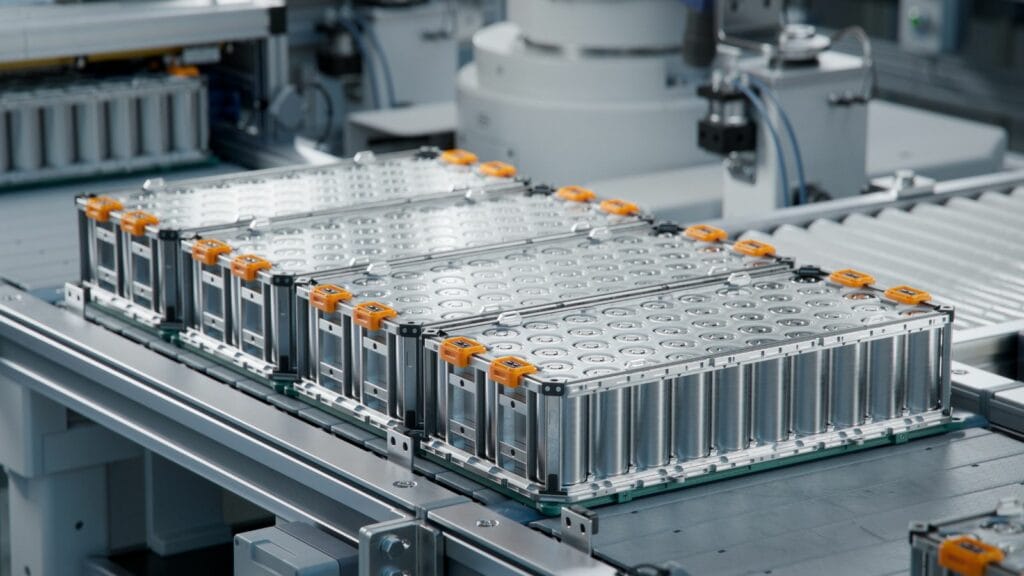
Electrovaya’s long-planned U.S. battery factory is moving into one of its most consequential stages yet. The Canadian lithium-ion battery company says the major cell-manufacturing equipment for its Jamestown, New York, facility has been built, while an approximately eight-week factory-acceptance-testing program is set to put the complete cell assembly line through its paces in Korea before shipment. The milestone does not mean commercial cell production has begun, but it moves the project closer to installation and commissioning in New York. Electrovaya has already been assembling battery systems at Jamestown, and the next phase would give the company something strategically different: its own U.S.-based lithium-ion cell production at a time when customers, governments and industrial buyers are placing greater weight on domestic supply chains.
The Cell Line Is Moving From Construction to Testing
Electrovaya’s latest update marks a transition from ordering and building machinery to demonstrating that the machinery can operate as an integrated manufacturing line. The company reported that construction of the major cell-manufacturing equipment has been completed and that it expects an approximately eight-week factory-acceptance-testing program at its equipment supplier in Korea. During those tests, the complete cell assembly line is expected to be assembled and operated before it is shipped across the Pacific to Jamestown. That distinction matters because a battery factory depends on many pieces of equipment working together consistently, not simply arriving individually at the plant.
Members of Electrovaya’s Jamestown operations team are also expected to participate in the testing. That gives the employees who will ultimately run the equipment an early opportunity to become familiar with the system before installation in New York. Once the equipment passes that stage, the challenge moves to transportation, installation, commissioning and production ramp-up. Electrovaya’s disclosures currently contemplate cell production beginning around the end of calendar 2026 or the first quarter of 2027, making the upcoming tests a key checkpoint in that timetable.
Jamestown Is Already More Than an Empty Factory
The planned cell line is not arriving at an unused shell. Electrovaya began battery-system assembly operations at Jamestown in May 2025, allowing the site to take on manufacturing work well before domestic cell production was ready. That phased approach gives the company a functioning U.S. operating base while the much more capital-intensive cell-manufacturing equipment is installed. Electrovaya had previously disclosed more than $40 million in capital-equipment orders connected with the expansion, underscoring how much larger the cell-production phase is than basic pack or system assembly.
The Jamestown property covers about 52 acres and includes a roughly 137,000-square-foot manufacturing building. Electrovaya calls it its first gigafactory, while its two Canadian locations remain focused on areas including research, engineering and commercialization. At the New York site, dry-room construction has now been completed, although electrical and HVAC infrastructure upgrades were still underway in the company’s August update. Those less-visible building systems are essential parts of the manufacturing transition, meaning the project is progressing on several fronts even before the Korean-built production line arrives.
The Production Timeline Has Become More Realistic — and More Cautious
Large industrial projects rarely advance in a perfectly straight line, and Electrovaya’s Jamestown schedule has evolved. When battery-system assembly started in May 2025, the company was targeting full lithium-ion cell and module commercial production around mid-2026. Its newest disclosure is more cautious, identifying the possible start of cell production around the end of calendar 2026 or the first quarter of 2027. The difference is worth acknowledging because it illustrates how equipment construction, infrastructure work, international shipment and commissioning can stretch an ambitious factory timetable.
At the same time, the latest update provides more tangible evidence behind the revised schedule. The dry room is complete, major cell equipment has been constructed, and the entire assembly line is moving toward factory-acceptance testing. Instead of simply providing a future production date, Electrovaya can now identify specific physical steps remaining before manufacturing begins. For investors and customers, that makes the next milestones easier to track: complete the Korea testing, ship the equipment, install it in Jamestown, commission the system and then demonstrate that it can produce cells reliably at commercial scale.
A Nearly $51 Million U.S. Loan Is Financing the Expansion
Electrovaya’s U.S. expansion is backed by substantial public-sector financing. The Export-Import Bank of the United States approved a $50.8 million direct loan under its Make More in America initiative to support the Jamestown buildout. The funding is intended for equipment, engineering and setup costs associated with cell and module manufacturing. By fiscal 2025, Electrovaya had begun drawing on that facility and said it had placed more than $40 million in advanced-equipment orders. The financing has therefore moved beyond an announcement and into actual deployment for the factory.
New York State has also supported the project. When Jamestown was selected, state officials described incentives of up to $4 million through performance-based Excelsior Jobs Program tax credits and $2.5 million in regional capital funding. The New York Power Authority separately approved more than 1.5 megawatts of low-cost hydropower. The original project envisioned as many as 250 jobs and more than one gigawatt-hour of annual battery output when fully developed. Those early projections remain ambitions rather than guarantees, but they show why local and federal agencies have treated the factory as an industrial-development project rather than simply another warehouse.
Electrovaya Is Entering the Ramp With a Stronger Financial Base
The timing of the Jamestown buildout is significant because Electrovaya’s operating results have strengthened while the company is committing capital to U.S. manufacturing. For its fiscal third quarter ended June 30, 2026, Electrovaya reported revenue of $17.7 million, up about 3% from a year earlier. Revenue for the first nine months of the fiscal year reached $51.3 million, an increase of roughly 18%. More striking was profitability: quarterly gross margin reached a company record of 34.9%, compared with 30.8% a year earlier.
Adjusted EBITDA reached $3.7 million for the quarter, also a company record, while the adjusted EBITDA margin exceeded 20% for the first time. Electrovaya reported a $0.3 million quarterly net profit and said it had remained profitable for six consecutive quarters. The balance sheet also showed $13.1 million of unrestricted cash at quarter-end. Those figures do not eliminate the financial risks of commissioning a new factory, but they place the company in a stronger operating position than a manufacturer attempting a major expansion while still generating persistent losses.
The Factory Is Being Built for More Than Forklift Batteries
Electrovaya built much of its commercial base around heavy-duty material-handling equipment, where batteries face frequent charging cycles and demanding operating schedules. The company now sees Jamestown as a platform for a broader group of industrial markets. Its August update identified energy storage, robotics, defense and other mission-critical applications as areas that could use the facility’s future capacity. Commercial deliveries for robotics and defense applications were already underway, including the company’s first 800-volt systems for a hybrid-drive defense application.
That diversification could become important as the factory scales. Electrovaya says its battery technology has been deployed across more than 35,000 systems in demanding industrial environments, providing a sizeable installed base from which to expand. It has also completed UL 2580 certification for six models of next-generation high-voltage systems intended for integrated material-handling vehicles operating outdoors. Rather than betting Jamestown entirely on passenger electric vehicles — a market already crowded with enormous global suppliers — Electrovaya is positioning the facility around specialized applications where battery life, reliability and high utilization can matter as much as headline cost per kilowatt-hour.
Amazon Adds a Large Potential Demand Channel
One of the more consequential commercial developments arrived shortly before Electrovaya’s latest factory update. In July 2026, the company announced an agreement with Amazon providing a framework for continued deployment of Electrovaya’s Infinity Battery Technology in Amazon material-handling operations and possible expansion into robotics and stationary energy storage. The associated warrant arrangement allows Amazon to acquire up to 13.88 million Electrovaya shares, with full vesting tied to cumulative future purchases of US$280 million. Importantly, those purchases are not guaranteed and remain subject to Amazon’s normal procurement processes.
That qualification is essential, but the agreement still illustrates why additional manufacturing capacity could matter. A warehouse customer operating at Amazon’s scale can create substantial volume if deployment broadens, while robotics and energy-storage applications could add entirely different sources of demand. Electrovaya has said it expects the expanded relationship could support its existing material-handling business from fiscal 2027 onward. For Jamestown, the strategic question is therefore not only whether the plant can manufacture cells successfully, but whether major customers ultimately convert commercial interest into enough recurring orders to keep that capacity productively utilized.
Data Centres Could Become Another Major Market
Electrovaya is simultaneously targeting a rapidly expanding energy-storage segment. In July it launched ElvaPulse 1500, a stationary system housed in a modular 20-foot enclosure and built around a 1,500-volt DC architecture. Electrovaya says the configuration can provide about 2.88 megawatt-hours of nominal energy and up to roughly seven megawatts of configurable continuous power. The platform is aimed at high-power applications including data centres, microgrids, industrial power management and other mission-critical infrastructure.
The company has begun UL 1973 and UL 9540 certification work and is targeting completion during the first quarter of 2027, with initial commercial deliveries planned for the second quarter of 2027 from Jamestown. Electrovaya has also said it is talking with hyperscale customers, data-centre developers and major energy companies. None of those discussions should be treated as booked revenue, but the potential scale explains why the company believes the Jamestown expansion could become strategically important. Successful deployment of even part of a large stationary-storage pipeline could consume far more manufacturing capacity than smaller specialized industrial programs.
The Technology Strategy Extends Beyond Today’s Lithium-Ion Cells
While the factory is designed around commercial lithium-ion production, Electrovaya continues to spend resources on technologies intended to improve future performance. The company reported in August that its solid-state development program is producing approximately one-amp-hour cells and is working toward cells of roughly five amp-hours. It is also developing a next-generation ceramic separator that, at pilot scale, has demonstrated performance comparable with the company’s existing separator while reducing thickness by about 25%, according to Electrovaya.
Another development program involves niobium-oxide technology designed for very rapid charging. Electrovaya says it commissioned a 24-volt module intended to support charge and discharge rates of up to 20C. These programs remain at various stages of development and should not be confused with the commercial production line heading for Jamestown. Their relevance is longer term: a manufacturing company gains more strategic value from a factory when it can improve the products moving through it over time. Electrovaya’s challenge will be translating promising laboratory and pilot-scale work into technologies that can eventually be manufactured reliably, competitively and in meaningful volume.
The Next Test Is Execution, Not Announcements
The Jamestown project is visibly closer to cell production than it was a year ago, but the hardest proof still lies ahead. Factory-acceptance testing in Korea must be completed, equipment must reach New York, installation and commissioning must proceed successfully, and Electrovaya must then ramp production without unacceptable quality problems or cost overruns. The company itself lists potential delays in Jamestown’s ramp-up, trade conditions, customer ordering patterns and the availability of tax incentives among factors that could cause results to differ from current expectations.
There is also a broader commercial reality. Electrovaya recently lowered its normalized fiscal 2026 revenue outlook to approximately $70 million to $73 million after some customer programs moved later than anticipated, including about $5 million of high-voltage deliveries expected in early fiscal 2027. That does not negate the factory’s progress, but it reinforces why manufacturing capacity and demand must grow together. The Korea tests are therefore an important milestone rather than a finish line. If the line passes, ships, installs and ramps successfully, Electrovaya will have taken the much larger step from assembling U.S. battery systems to producing the cells that sit at their core.
