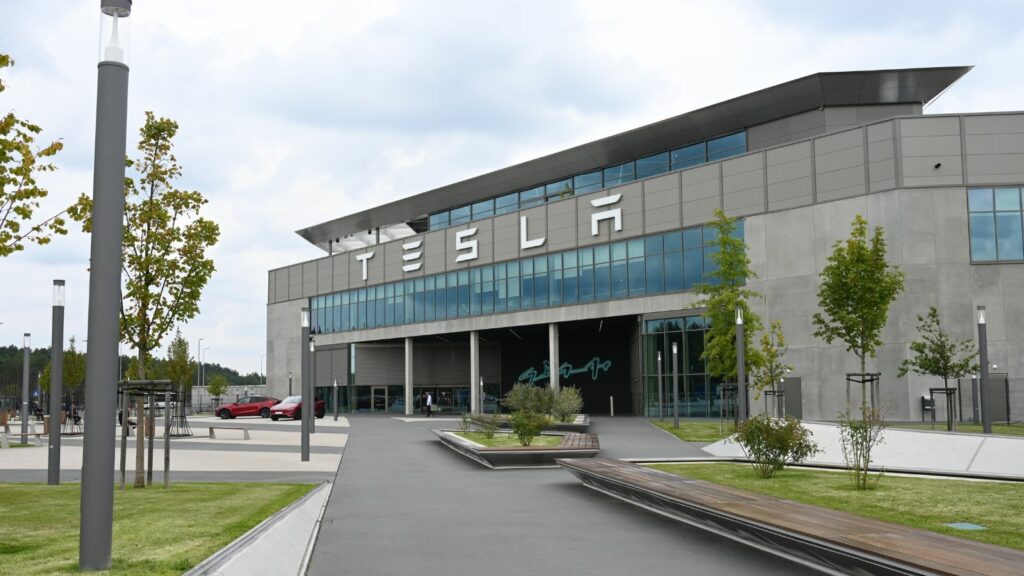
Tesla has added another important fast-charging stop to Atlantic Canada’s electric-vehicle network, opening an eight-stall V4 Supercharger in Moncton, New Brunswick. Located at 50 Granite Drive in the Granite Centre, just off the Trans-Canada Highway, the station gives local drivers and long-distance travellers another high-powered option along one of the region’s busiest transportation corridors.
The opening also arrives as New Brunswick is putting new public money into EV infrastructure and Canada’s electric-vehicle market shows signs of recovering from a difficult 2025. Beyond the eight chargers themselves, the Moncton project illustrates how the charging landscape is changing: faster hardware, longer cables, greater access for non-Tesla vehicles and a gradual transition toward a common North American charging standard.
Moncton Gets Its Seventh Tesla Supercharger Location
The new Granite Centre station officially opened with eight V4 charging posts, making Moncton the seventh New Brunswick community with an operating Tesla Supercharger location. Construction had started in 2025 at the Granite Drive property, and the choice of site is notable because it sits just off the Trans-Canada Highway. That positioning makes the chargers useful not only to Moncton-area owners but also to motorists moving through southeastern New Brunswick on longer trips.
Before Moncton came online, Tesla’s New Brunswick network included sites in Aulac, Lincoln, Quispamsis, Saint-Léonard, Salisbury and Woodstock. The geographic spread matters in a province where intercity travel can quickly turn charging availability into a practical concern. Rather than serving only urban commuters, sites near major highways can function as refuelling stops for people travelling between communities, heading toward Nova Scotia or Prince Edward Island, or crossing New Brunswick on longer Atlantic Canadian journeys.
V4 Hardware Brings Faster Charging and Longer Cables
The V4 hardware is a significant part of the Moncton story. Tesla says North American V4 Superchargers can deliver as much as 325 kilowatts to the Cybertruck, while Model S, Model 3, Model X and Model Y vehicles can receive up to 250 kW. Actual charging speed can be lower because the vehicle and charger continuously determine an appropriate rate based on factors including battery temperature, state of charge, vehicle configuration and station conditions.
V4 posts also use longer charging cables than earlier Tesla hardware. That might sound like a small engineering detail, but it becomes increasingly important as more vehicle brands gain access to Tesla’s network. Charge ports appear in different places on different EVs, and short cables designed around Tesla’s traditional port placement can make parking awkward. Tesla says its latest V4 posts are designed so the cable can reach EVs while they remain in the appropriate charging stall, reducing one of the practical obstacles to opening the network more broadly.
The Station Is Useful to More Than Tesla Drivers
Tesla’s charging system is no longer exclusively a Tesla ecosystem in North America. A growing group of automakers has been granted access to compatible NACS Superchargers, generally through manufacturer-approved adapters for CCS-equipped vehicles. Newer vehicles that arrive with a native NACS port can connect without an adapter. Tesla identifies manufacturers including Ford, General Motors, Hyundai, Kia, Mercedes-Benz, Rivian, Volvo, Toyota, Volkswagen and several others as having access to participating NACS locations.
That makes a newly built V4 station more consequential than an eight-stall Tesla-only facility would have been several years ago. The connector originally developed by Tesla has been standardized through SAE as J3400, helping turn it into an industry-wide North American format. Compatibility still depends on the vehicle and specific Supercharger site, so drivers must confirm access before travelling. Even so, every newly accessible V4 location potentially adds capacity for a much larger pool of EV owners rather than one brand’s customer base alone.
New Brunswick’s Time-Based Pricing Remains an Unusual Detail
One feature separates the Moncton station from most Tesla Superchargers elsewhere in Canada: charging is billed according to time rather than strictly by the kilowatt-hour of electricity delivered. At opening, reported Tesla-owner rates ranged from $0.35 per minute at charging speeds up to 60 kW to $1.85 per minute when the vehicle was drawing more than 180 kW. Reported non-Tesla rates ranged from $0.50 to $2.60 per minute across the corresponding power bands.
That pricing structure makes charging speed especially relevant to the final bill. A vehicle that can sustain a strong charging rate may receive considerably more energy during a given number of minutes than one charging slowly because of a cold battery or high state of charge. New Brunswick’s broader charging network is itself moving toward energy-based billing. NB Power has said some of its higher-capacity chargers are temporarily operated under hourly pricing while it seeks regulatory approval for a new energy-based pricing model.
Fredericton Could Soon Push the Provincial Total Higher
Moncton is not expected to be the final addition to Tesla’s New Brunswick map. A new Supercharger project at Regent Mall in Fredericton entered construction in August, putting the provincial capital in line to become Tesla’s eighth Supercharger location in the province if the site opens as planned. Taken together, the projects suggest a shift from a sparse collection of strategic highway chargers toward a denser network connecting more of New Brunswick’s major population and travel corridors.
That density can matter as much as maximum charging speed. An EV trip becomes easier when drivers have alternatives if one station is busy, unavailable or poorly positioned for a particular route. Additional locations also create more flexibility around charging stops: a traveller may be able to continue to the next city instead of stopping early simply because it contains the only reliable fast charger. Moncton’s eight stalls therefore add both physical charging capacity and another option in the broader route-planning equation.
New Brunswick Is Investing Millions in the Wider Charging Network
Tesla’s private investment is arriving alongside a sizeable provincial push. On August 4, New Brunswick announced nearly $64 million for 72 projects through its 2026-27 Climate Change Fund, with more than $6 million directed toward three initiatives involving EV charging. The largest component is a $5-million expansion of the eCharge network that is expected to add 16 fast chargers providing 29 charging ports, with an emphasis on areas where private investment may not yet have a strong commercial case.
The province is also spending on charging infrastructure for government fleets and provincial parks. That mix highlights two distinct approaches to building an EV network. Private operators naturally favour sites where traffic and utilization can support investment, while government-supported programs can address geographic gaps that may take longer to become profitable. For New Brunswick motorists, the practical result could be a network in which Tesla, NB Power and other charging providers increasingly overlap rather than leaving large stretches dependent on a single operator.
EV Registrations Have Started Growing Again in Canada
The new infrastructure is arriving during a complicated period for EV demand. Statistics Canada recorded 43,113 new zero-emission vehicle registrations nationally during the first quarter of 2026. ZEVs represented 10.8 per cent of all new motor-vehicle registrations, and their registrations rose 15.8 per cent from the first quarter of 2025. It was the first year-over-year increase since the fourth quarter of 2024 and followed the February launch of the federal Electric Vehicle Affordability Program.
The rebound matters for charging investment because infrastructure and vehicle adoption reinforce one another. Drivers are more comfortable choosing an EV when dependable fast charging exists along the routes they actually use, while charging operators have a stronger business case when more EVs are on the road. One quarter does not settle the long-term trajectory of the Canadian market, particularly after the sharp slowdown experienced in 2025. It does, however, provide a stronger demand backdrop for new sites such as Moncton.
One Station Adds to a Much Larger Charging Buildout
Seen nationally, eight chargers in Moncton are a small addition to a rapidly expanding infrastructure system. The federal government said in February that more than 30,000 chargers had been installed with support from its Zero Emission Vehicle Infrastructure Program. Ottawa has committed more than $1.2 billion to charging and refuelling infrastructure since 2016, while an expanded Canada Infrastructure Bank initiative is intended to support thousands of additional public fast-charging stations.
The significance of Moncton is therefore less about transforming Atlantic Canada with a single opening and more about filling another gap in an increasingly interconnected network. It combines highway access, V4 hardware, compatibility with a growing number of non-Tesla vehicles and eight additional fast-charging stalls in one location. For Atlantic Canadian EV travel, progress is likely to look exactly like this: individual sites opening one by one until long-distance charging becomes less of a special planning exercise and more like an ordinary part of the road network.
