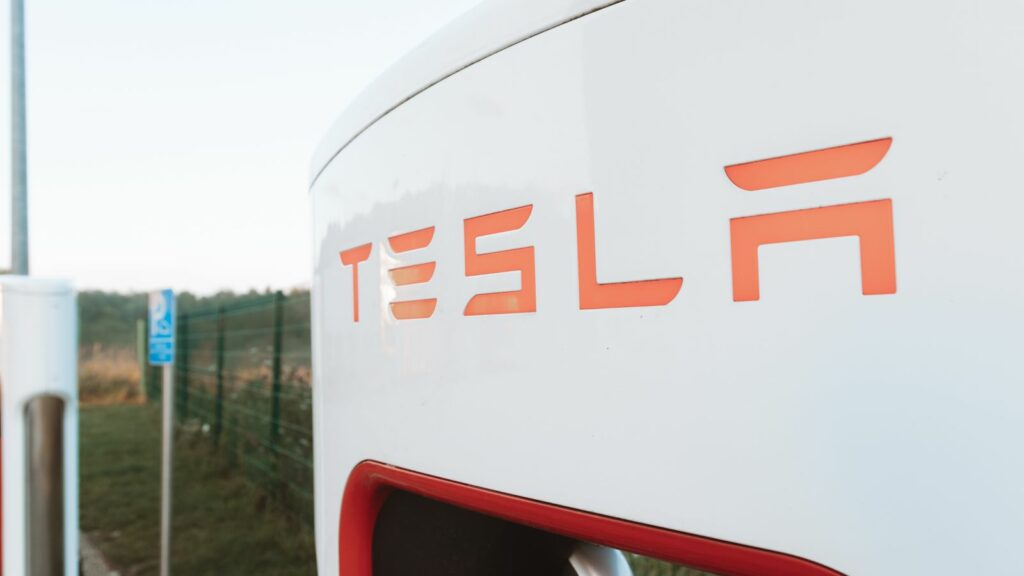
Vancouver Island’s electric-vehicle charging map has gained another important pin. Tesla has opened an eight-stall V4 Supercharger at Northridge Village in north Nanaimo, giving the city its third Supercharger location and lifting Tesla’s island network to nine stations and 96 charging stalls.
The new site at 5800 Turner Road is capable of delivering up to 325 kW and represents more than another place to plug in. Nanaimo sits near the geographic centre of much of the island’s highway travel, making additional capacity particularly useful for drivers heading between Greater Victoria, the central island, Campbell River and the west coast. With newer stations also operating in places such as Comox, Campbell River, Port Alberni and Tofino, Tesla’s Vancouver Island network is becoming both larger and more geographically useful.
Eight V4 Chargers Arrive in North Nanaimo
The newest Nanaimo Supercharger opened at Northridge Village after construction began in April 2026. Located at 5800 Turner Road, the installation consists of eight V4 charging posts rated for speeds of up to 325 kW. The shopping-centre setting is practical rather than glamorous, but that is part of what makes the location useful. Charging sessions can overlap with a grocery run, a meal or another errand instead of requiring drivers to wait at an isolated roadside site. The location also strengthens charging availability in north Nanaimo, an area close to major commercial destinations and routes used by travellers moving through the central island.
Drive Tesla reported that launch pricing for Tesla owners was $0.21 per kWh during off-peak periods and $0.29 per kWh between 8 a.m. and 10 p.m. Non-Tesla pricing was reported at $0.30 per kWh off-peak and $0.40 during daytime hours. Those rates are best viewed as a snapshot rather than a permanent tariff because Supercharger prices can change. The important structural change is the extra capacity: eight additional fast-charging spaces can make a noticeable difference when weekend traffic, holiday travel or local demand sends several EVs toward the same charging stop.
Nanaimo Now Has 28 Tesla Supercharger Stalls
The Turner Road opening gives Nanaimo three distinct Tesla Supercharger sites with a combined 28 stalls. The oldest of the three is at Woodgrove Centre, where eight Superchargers provide up to 150 kW. Country Club Centre later added 12 stalls capable of up to 250 kW, and the new Northridge Village location contributes another eight posts with a site rating of up to 325 kW. The result is an unusually dense concentration of Tesla fast-charging capacity for one Vancouver Island community and a clear progression through several generations of Supercharger technology.
Country Club Centre was itself a significant milestone when it opened in 2023. Its 12 V3 stalls represented the island’s first Tesla V3 Supercharger installation and substantially increased Nanaimo’s charging capacity beyond the older Woodgrove site. Three years later, the city has added V4 hardware as well. For drivers, that progression matters more than the technology labels suggest. Multiple locations provide alternatives when one site is crowded, inconveniently located or temporarily unavailable. A family stopping near Woodgrove may choose the original station, while someone travelling through north Nanaimo can now charge at Turner Road without making the same detour. Redundancy is becoming almost as important as outright charging speed.
Nine Island Stations Now Add Up to 96 Stalls
Tesla’s Vancouver Island footprint now stretches well beyond Victoria and Nanaimo. The nine operating sites include a 16-stall station at Victoria’s Uptown shopping centre, 16 stalls at Sandown Park near Sidney, Nanaimo’s three locations with 28 stalls combined, eight stalls in Port Alberni, 12 in Tofino, eight in Comox and eight in Campbell River. Together, those installations total 96 Supercharger stalls. Their maximum advertised charging rates range from 72 kW at the older Victoria installation to as much as 325 kW at several of the newest V4 locations.
The geography is just as significant as the total. Port Alberni and Tofino extend Tesla fast charging toward Vancouver Island’s west coast, while Comox and Campbell River push reliable Supercharger access farther north. Sidney adds capacity near the Saanich Peninsula and ferry connections, while Nanaimo functions as a mid-island junction. A few years ago, an EV road trip on the island required more deliberate planning around a relatively small number of high-speed charging locations. Ninety-six Tesla stalls do not eliminate every geographic gap, but the network now offers far more routing flexibility and backup options. That change can matter on an island where long distances, ferry schedules and seasonal tourism can all influence where and when drivers need to recharge.
V4 Hardware Is Designed for More Than Teslas
The Turner Road installation also reflects Tesla’s broader transition from a charging network built mainly around its own vehicles to infrastructure increasingly usable by other EV brands. Tesla says its V4 charging posts use a longer cable than earlier designs, an important detail because non-Tesla vehicles place their charge ports in many different locations. A cable that comfortably reaches a Tesla’s charging inlet may not work as neatly with an SUV or pickup whose port sits near a front fender. Longer cables reduce the likelihood that a vehicle has to park awkwardly or occupy an adjacent charging space simply to reach the connector.
Tesla’s North American connector has also become standardized as SAE J3400, commonly still called NACS. The company lists a growing group of manufacturers whose vehicles can access compatible Superchargers, including Ford, General Motors, Hyundai, Kia, Rivian, Mercedes-Benz, Volvo, Volkswagen, BMW, Toyota and others. Some newer EVs incorporate the connector directly, while compatible CCS1 vehicles may require an approved NACS DC adapter. Tesla advises drivers to confirm vehicle and station compatibility in its app because access can vary by site and model. The practical effect is that new Supercharger capacity can increasingly serve a wider EV population instead of functioning as infrastructure for one automaker alone.
A 325-kW Charger Does Not Mean Every Vehicle Gets 325 kW
The headline charging figure at Turner Road deserves some context. Tesla lists V4 Superchargers at up to 325 kW in North America, but the vehicle determines how much of that power can actually be accepted. Tesla says Model S, Model 3, Model X and Model Y can charge at up to 250 kW on V4 equipment, while Cybertruck can reach up to 325 kW. Other manufacturers impose their own battery and charging limits. In other words, the charger’s maximum rating should not be interpreted as the speed every EV will experience after plugging in.
Charging speed also changes during an individual session. Batteries typically accept their highest power at lower states of charge and then reduce the rate as they fill. Temperature, battery condition, vehicle configuration and other factors can affect the result as well. Tesla estimates that compatible vehicles can add substantial driving range during a 15-minute Supercharger stop, including up to 322 kilometres for some Model S configurations and up to 261 kilometres for some Model Y configurations, but those are maximum estimates rather than guarantees. For road-trip drivers, this helps explain why a brief stop at a high-powered charger can be efficient while waiting to reach 100% may take disproportionately longer.
The Expansion Comes as B.C.’s EV Fleet Keeps Growing
Tesla’s additional Vancouver Island capacity arrives in a province that already has one of Canada’s largest electric-vehicle markets. British Columbia reported 228,647 registered light-duty zero-emission vehicles at the end of 2025, when ZEVs represented 17.9% of new light-duty vehicle sales. Transport Canada data showed the province’s electric-vehicle share of new light-duty registrations climbing to 20.8% in the first quarter of 2026, compared with 11.7% nationally. By April, the B.C. government said more than 238,000 light-duty ZEVs were registered in the province.
The public charging system has been expanding alongside that fleet. Provincial figures indicated more than 8,900 public charging ports were available by spring 2026, including thousands of Level 2 locations and more than 2,300 fast-charging ports. BC Hydro has also been adding high-powered hubs and says it intends to expand its own public network to 3,500 charging ports by 2035 through a roughly $700-million investment. Against that backdrop, Tesla’s 96 Vancouver Island stalls are only one piece of the province’s charging infrastructure. Their importance comes from how they complement other public networks and add high-speed options along routes where EV drivers increasingly expect the same basic reliability they once expected from fuel stations.
The Next Challenge Is Filling the Remaining Geographic Gaps
Reaching 96 stalls changes the nature of Tesla’s Vancouver Island challenge. The network is no longer concentrated almost entirely around the island’s southern and central population centres. Campbell River now has an eight-stall 325-kW Supercharger, helping extend coverage farther north, while Tofino and Port Alberni give west-coast travel considerably more support. Yet large stretches of northern and western Vancouver Island remain less densely served than the Nanaimo-to-Victoria corridor. For those communities, another charger can have a much larger effect on trip planning than adding capacity in a city that already has several stations.
Tesla’s community voting program provides clues about where the network could develop next, although a voting candidate should not be mistaken for a confirmed construction project. Tesla allows participants to cast five votes during each three-month voting cycle and says winning locations become candidates for future Superchargers. The latest Canadian voting round reported by Drive Tesla includes Vancouver Island candidates such as Langford, Duncan, Campbell River, Port McNeill and Port Hardy, while Ucluelet previously won a Supercharger vote and has been identified as a future-network location. No firm opening date has been announced for Ucluelet. The broader direction, however, is clear: as the busiest island corridors gain redundancy, expansion attention can increasingly move toward communities where fast-charging choices remain limited.
