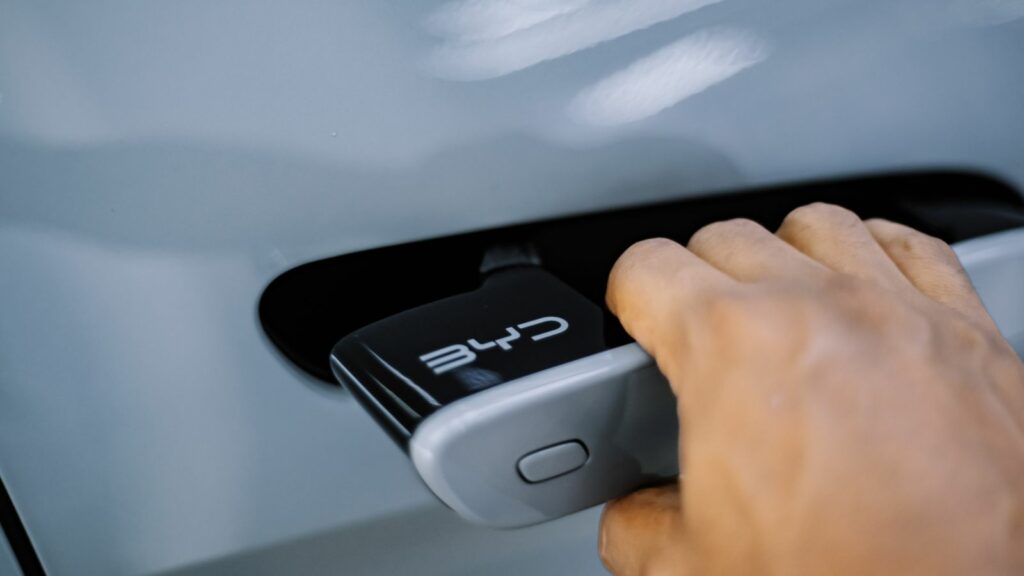
BYD has made its Canadian ambitions harder to dismiss. The Chinese electric-vehicle giant now has a dedicated Canadian website carrying a prominent “COMING SOON” message, while giving its new 1,500-kW FLASH Charging technology unusually prominent billing. The page arrives as BYD builds a Canadian management team and prepares dealer and charging-infrastructure strategies.
Still, the distinction between preparation and a commercial launch matters. BYD has not announced Canadian vehicle prices, a passenger-vehicle lineup, dealer locations or an on-sale date. Its own Canadian legal terms say transactions, reservations and deposits are not yet available. For now, the website offers the clearest official preview yet of how one of the world’s largest electrified-vehicle manufacturers may introduce itself to Canadian consumers.
The “Coming Soon” Message Is a Significant Canadian Signal
BYD’s Canadian web presence is no longer simply a corporate page explaining what the company does elsewhere. Canada is now listed in the automaker’s American Region, and the dedicated page prominently displays “COMING SOON.” BYD Canada Company Limited is identified as the website operator, with a business address on Travail Road in Markham, Ontario. English and French versions are available, creating the basic digital infrastructure expected of an automaker preparing for a national consumer market.
That does not mean Canadians can order a BYD today. The company’s Canadian terms explicitly state that the website does not currently allow purchases, leases, financing applications, reservations, pre-orders or deposits. More importantly, BYD warns that vehicles and features shown online may be international or pre-production versions and may never be offered in Canada. The same terms nevertheless state that BYD vehicles will be sold in Canada through approved, independently operated dealers.
BYD Is Hiring the People Needed to Build a Car Business
The website is arriving alongside something more difficult to dismiss as a branding exercise: BYD is recruiting people to build a Canadian passenger-vehicle operation. Recent Toronto-area postings include senior positions covering sales, dealer-network development, aftersales and charging infrastructure. One Head of Sales posting describes the role as emphasizing market entry, dealer-network development and strategic growth while leading a nationwide sales strategy for BYD passenger vehicles in Canada.
The detail in those postings provides a useful glimpse behind the “Coming Soon” screen. BYD wants managers capable of identifying and recruiting dealer partners, negotiating agreements, overseeing dealership construction, coordinating vehicle allocation and helping execute product launches. A separate infrastructure position is responsible for supporting charging-network expansion across Canada and working with local partners on deployment. Recent reporting identified 11 Canadian management openings in total. That resembles the organizational groundwork of a new automaker operation rather than a simple market-research exercise.
The 1,500-kW Number Represents Megawatt-Class Charging
The eye-catching figure on BYD’s Canadian page is 1,500 kW, or 1.5 megawatts, of maximum charging power through a single connector. That is more than four times the 350-kW rating commonly associated with some of today’s high-power public fast chargers. BYD unveiled the latest FLASH Charging system alongside its second-generation Blade Battery in March 2026, describing the two technologies as an integrated approach rather than a charger that can deliver the same result to any EV.
BYD says a compatible vehicle and battery can move from 10% to 70% state of charge in five minutes and reach 97% in nine minutes under stated conditions. The distinction between peak charger capability and sustained battery intake is important. A 1,500-kW maximum rating does not mean 1.5 megawatts flows continuously for nine minutes, nor would an existing Canadian EV automatically charge at that rate. The vehicle, battery, thermal-management system and charging hardware all have to support the necessary power.
BYD Is Putting Cold-Weather Charging Front and Centre
One specification on the Canadian website feels particularly deliberate. BYD says that at minus 30 degrees Celsius, a compatible second-generation Blade Battery can charge from 20% to 97% in 12 minutes—only three minutes longer than its stated warm-weather benchmark. Cold-weather charging is hardly an academic concern in Canada, where drivers in many regions can face sustained sub-zero temperatures and where battery conditioning can become an important part of winter road-trip planning.
Those figures remain manufacturer claims rather than a guarantee of what every Canadian owner would experience. BYD itself cautions that advertised performance is measured under controlled conditions and that weather, vehicle load, tire pressure, driving behaviour and other variables can alter real-world results. Independent battery research also shows why extremely fast charging is technically demanding: high charging rates require careful management of ion transport, temperature and degradation mechanisms. Canadian buyers would ultimately need locally certified vehicles and independent testing before the headline winter figures could be treated as typical everyday performance.
Blade Battery 2.0 Is Just as Important as the Charger
The charger may attract the biggest number, but BYD’s second-generation Blade Battery is the other half of the system. The company says six years of development went into the new battery, with energy density improved by about 5% compared with the first generation. BYD has also developed new internal ion-transport pathways and thermal-management techniques intended to control heat while allowing far higher charging rates. That helps explain why plugging an older EV into a FLASH station would not suddenly reproduce the advertised five- or nine-minute results.
Battery durability is the more complicated question. BYD says its second-generation design underwent demanding safety and fast-charging tests, including nail-penetration testing after hundreds of high-speed charging cycles. Academic work on extreme fast charging nevertheless emphasizes the balance among charge rate, energy density and long-term cycle life. Processes such as lithium plating and accelerated electrode degradation can become concerns at high charging rates. BYD’s laboratory results are noteworthy, but long-term real-world fleet data will ultimately provide the more meaningful durability test.
Stationary Batteries Could Make 1.5-Megawatt Charging More Practical
Delivering 1.5 megawatts at a vehicle connector creates a second challenge: the electricity has to come from somewhere. BYD’s answer is not simply to demand that every charging site draw the entire peak load directly from the local grid. Its FLASH stations can incorporate high-capacity stationary energy storage that charges more gradually, holds energy on site and then releases it quickly when a compatible vehicle arrives.
The concept effectively gives the charging location an energy reservoir between the electrical network and the vehicle. That could be especially useful where the local transformer or distribution connection cannot economically supply enormous instantaneous loads. Research into ultra-fast charging reaches a similar conclusion: megawatt-level stations can create challenges involving peak demand, voltage quality and infrastructure capacity, while batteries, intelligent energy management and grid upgrades can mitigate those pressures. None of that makes Canadian deployment automatic. Every site would still face utility requirements, construction costs, electrical codes and local grid conditions before a FLASH station could operate at its full capability.
BYD Is Showing That FLASH Charging Is More Than a Prototype
The speed of BYD’s Chinese infrastructure rollout gives the charging announcement considerably more weight. When the second-generation system was presented in March 2026, BYD said 4,239 FLASH Charging stations were already installed across China. On August 28, the company marked the opening of its 10,000th station in Shenzhen, meaning the network more than doubled in less than six months. BYD continues to target 20,000 Chinese FLASH stations by the end of 2026.
The company is also beginning to take the system abroad. BYD has said FLASH Charging will receive an international rollout, with initial stations already appearing in markets such as the United Kingdom and additional deployment plans emerging elsewhere. That makes its presence on the Canadian website especially noteworthy. What has not appeared is equally important: BYD has not published a Canadian FLASH-station count, construction timetable or first-site location. Its Canadian infrastructure hiring suggests local planning is underway, but the technology’s Canadian rollout remains unannounced.
Canada Already Has More Than One Million Plug-In Vehicles
If BYD does enter Canada at scale, it would arrive in an EV market that is still growing despite recent policy and sales volatility. Statistics Canada reported that 21,876 zero-emission vehicles were sold nationally in June 2026, up 56.1% from June 2025. Battery-electric and plug-in hybrid vehicles together accounted for 11.5% of new-vehicle sales that month, compared with 7.9% a year earlier.
The installed base is much larger. Transport Canada’s EV dashboard counted about 1.08 million light-duty battery-electric and plug-in hybrid vehicles in operation as of its latest 2026 reporting, supported by 39,220 public charging ports. Of those, 8,479 were Level 3 fast-charging ports and 30,741 were Level 2. BYD would therefore not be introducing fast charging to an empty market. The strategic question is whether a proprietary high-power ecosystem can offer a meaningful advantage while remaining convenient for Canadian drivers who already rely on established public charging networks and multiple vehicle brands.
Canada’s New China-EV Rules Have Changed the Commercial Equation
BYD’s timing also coincides with a major change in Canadian trade policy. Effective March 1, 2026, Canada implemented an initial annual quota allowing 49,000 eligible electric vehicles originating in China to enter at the normal 6.1% most-favoured-nation tariff. The previous 100% surtax on Chinese-made EVs was repealed as part of the new arrangement. During the first six-month quota period, ending August 31, the available quantity was 24,500 vehicles and access was administered on a first-come, first-served basis.
That makes importing Chinese-built passenger EVs considerably more commercially realistic than it was under the 100% surtax, but the quota is not an automatic green light for BYD. Importers need shipment-specific permits, quantities are controlled, and vehicles must still satisfy Canadian certification and safety requirements. Ottawa has also described the arrangement as “managed market entry.” No official evidence accompanying BYD’s new website identifies the company’s quota allocation, Canadian volumes or certified launch models. Trade access has opened a door; BYD still has to walk through it.
The Biggest Canadian Details Are Still Missing
What is confirmed now forms a fairly substantial list. BYD has a Canadian passenger-vehicle website with a “Coming Soon” message. BYD Canada Company Limited operates it. The company says its vehicles will ultimately be sold through approved Canadian dealers. It is recruiting executives to establish sales, dealer and charging operations, and it is deliberately showcasing second-generation Blade Battery and 1,500-kW FLASH Charging technology to Canadian visitors. Globally, BYD also has enormous scale, having delivered more than 4.6 million vehicles in 2025 and reporting cumulative global new-energy-vehicle sales above 17.3 million by July 2026.
What remains unknown may matter even more to prospective customers. BYD has not formally published its Canadian passenger-vehicle lineup, MSRPs, dealer locations, warranty terms, retail opening date or a Canadian FLASH Charging deployment schedule. That restraint is important because inaccurate claims about BYD’s Canadian launch plans have circulated before. For now, “Coming Soon” should be read literally: preparations are visible, but the full Canadian launch has not arrived.
