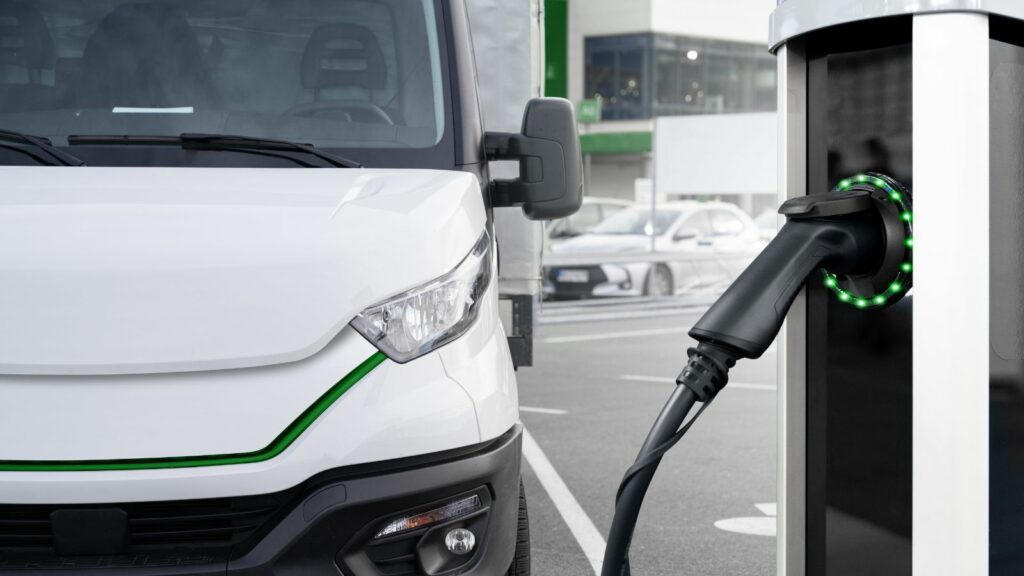
A freight route stretching from British Columbia to Mexico is becoming the testing ground for one of North America’s most ambitious efforts to make long-haul trucking cleaner. British Columbia has joined California, Oregon, Washington and Baja California in the new BC2BC Zero-Emission Vehicle Corridor, a cross-border initiative designed to support battery-electric and hydrogen trucks along the West Coast.
Launched at the Port of Long Beach on August 26, the plan starts with 20 electric-truck charging locations and three hydrogen stations along a corridor handling nearly 10,000 trucks on an average day. The larger challenge is not simply installing chargers. Governments must make equipment, power supply, station spacing and technical standards work together across two international borders. For B.C., that could turn an existing north-south trade artery into a practical zero-emission freight route.
A Five-Government Freight Partnership Takes Shape
The BC2BC initiative brings together British Columbia, Washington, Oregon, California and Mexico’s Baja California government around a common objective: create infrastructure that allows zero-emission commercial trucks to move continuously between Vancouver and northern Mexico. Officials formally launched the effort during a zero-emission truck showcase at the Port of Long Beach, where vehicles from Volvo, Tesla and ZM Trucks were among those displayed. Commercial and infrastructure participants included Volvo Group North America, Southern California Edison, Tesla, EV Realty and King Fio Trucking.
What governments announced, however, is better understood as a coordinated framework than a completed construction program. The five jurisdictions issued a statement of principles calling for aligned planning, technology and interoperable infrastructure. A series of technical meetings is expected to work through standards and implementation. The initial concept includes 20 electric charging locations and three hydrogen-fuelling locations, but detailed sites, power levels and a final construction timetable have not yet been publicly established.
I-5 Carries the Kind of Freight That Makes Electrification Difficult
The scale of Interstate 5 explains why governments are focusing so much attention on one highway. The main U.S. portion stretches about 1,381 miles between the Canadian and Mexican borders and carries close to 10,000 trucks per day on average. Traffic can reach considerably higher levels on busy sections, while roughly 550 miles of the route pass through urban areas. Agricultural products, lumber, imported consumer goods and containers from major ports all move through the corridor.
That traffic also makes I-5 an unusually valuable laboratory for zero-emission trucking. Passenger EV drivers can often adjust a trip around whatever chargers are available. Freight carriers operate under tighter constraints. A tractor pulling a loaded trailer must accommodate driver hours, delivery windows, vehicle range and lengthy periods of high-speed operation. One poorly located or congested charging station can interfere with an entire schedule. A continuous Vancouver-to-Baja network therefore matters less as a symbolic line on a map than as a way of giving fleets predictable places to refuel throughout a working route.
British Columbia Has Its Own Reasons to Make Heavy Trucks Cleaner
Participation fits into B.C.’s existing transportation and emissions strategy. Transportation has historically represented roughly 40% of the province’s greenhouse-gas emissions, making it one of the largest pieces of the provincial climate challenge. B.C.’s Clean Transportation Action Plan has been designed around reducing transportation-sector emissions by 27% to 32% by 2030 through measures that include cleaner fuels, more efficient travel and greater adoption of zero-emission vehicles.
Heavy commercial vehicles are particularly important because replacing a commuter car and replacing a Class 8 tractor are fundamentally different projects. The province has been developing medium- and heavy-duty zero-emission policies while seeking alignment with leading jurisdictions such as California. It also has programs supporting commercial battery-electric and hydrogen vehicles and infrastructure. Joining BC2BC adds a cross-border dimension: a truck purchased by a B.C. fleet becomes considerably more useful if compatible charging exists not merely around Vancouver, but throughout Washington, Oregon and California as well.
Truck Charging Requires an Entirely Different Scale of Electricity
The biggest engineering challenge may be hidden behind the charging plug. Heavy electric trucks contain much larger batteries than passenger vehicles and have far less time available for leisurely charging. Research from the U.S. National Renewable Energy Laboratory notes that a Class 8 truck may require at least 350 kilowatts through one connector for practical high-power charging. When several trucks charge simultaneously, a major commercial station could eventually require 20 megawatts of electrical capacity or more.
That is why a truck corridor cannot simply install larger versions of conventional highway EV chargers. Utilities may need new substations, transmission or distribution upgrades, large parking areas and sophisticated systems for managing electricity demand. The emerging Megawatt Charging System standard is being developed for power levels reaching as high as 3.75 MW through a single connector. Earlier UC Davis research also found that strategically spaced high-power charging could make shorter-range electric tractors more practical by allowing charging to coincide with required rest periods. Infrastructure planning, in other words, can influence which trucks fleets are willing to buy.
Common Standards Could Be as Important as the Number of Stations
Cross-border freight only works when infrastructure is dependable after a truck crosses into the next jurisdiction. BC2BC therefore puts considerable emphasis on interoperability rather than allowing five governments to develop isolated systems. Officials intend to coordinate equipment guidance, infrastructure planning, station placement and technical standards so fleet operators do not encounter a different charging environment every few hundred kilometres.
For trucking companies, predictability has direct financial value. A tractor earns money when it is moving cargo, so charging availability affects route planning, driver utilization and equipment productivity. Volvo Group has argued that coordinated charging infrastructure and standards can give operators greater confidence to make long-term zero-emission investments. The concept is similar to other infrastructure that freight businesses largely take for granted today: diesel pumps, road clearances and border procedures must all work consistently enough that dispatchers can build schedules around them. Electric trucking will need the same kind of routine reliability before it becomes ordinary rather than experimental.
The Real Test Will Come When Fleets Can Run the Whole Route
Officials involved in the project have discussed enabling Class 8 electric trucks to travel the entire West Coast corridor as soon as 2030. Reaching that point will require much more than the initial 20 charging sites. California transportation officials have indicated that the ultimate network could eventually involve hundreds of chargers, although the final scale and investment requirement have not yet been determined.
There are already signs that fleets can operate zero-emission trucks when infrastructure fits the job. IMC Logistics, a drayage company serving the Port of Long Beach, told the Los Angeles Times that 56 vehicles in its roughly 200-truck fleet were zero-emission, using both battery-electric and hydrogen technology. Its experience illustrates the next stage of the transition: moving beyond small demonstrations and making charging part of normal dispatch planning. If BC2BC succeeds, a Canadian truck leaving the Vancouver region could eventually travel deep into the U.S. West Coast freight system without diesel being the default option. That would be a significant change for one of North America’s busiest trade corridors.
