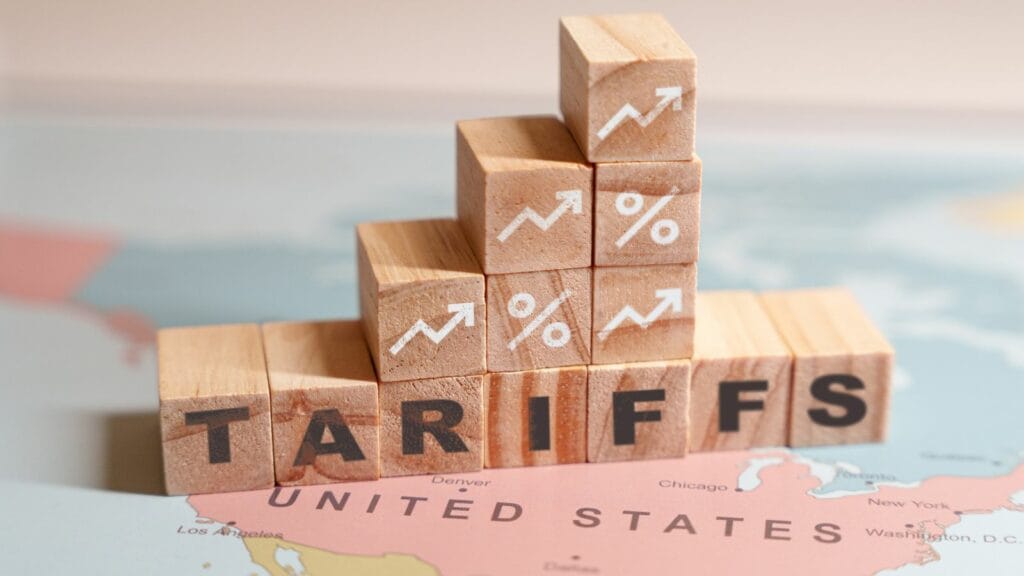
Canada’s latest retaliation against Donald Trump’s trade offensive is doing more than putting a tax on American-made goods. Ottawa is deliberately thinking about where those goods come from and which U.S. communities could feel the pressure most sharply.
Industry Minister Mélanie Joly has acknowledged that product selection is intended to put pressure on particular American states, turning trade policy into a political message that can travel from factory floors, farms and fishing docks to Washington. Yet Ottawa’s strategy has an important qualification: officials say the tariff package was primarily constructed to match U.S. measures and defend Canadian industries, rather than simply copying an electoral map. That combination—economic retaliation with geographically concentrated consequences—helps explain why products ranging from lobster and cheese to appliances, metals and transportation equipment have suddenly become pieces in a much larger Canada-U.S. confrontation.
Ottawa’s Retaliation Is Built to Match Washington Dollar for Dollar
The scale of Canada’s response leaves little doubt that Ottawa wants Washington to feel a measurable economic consequence. The federal government says the United States imposed a 50% tariff on C$27.6 billion of Canadian goods beginning August 22. Canada responded by announcing counter-tariffs covering the same value of U.S. imports, using rates of 15%, 25% and 50% depending on the product. The measures are scheduled to take effect September 8.
The list reaches deeply into everyday commerce. Steel, aluminum derivatives, dairy products, appliances, agricultural equipment, pulp and paper products, electronics, furniture and clothing are among the affected categories. Ottawa describes the approach as “dollar-for-dollar, rate-for-rate,” but the selection of products adds another dimension. Rather than spreading the retaliation evenly across everything Canada buys from the United States, the government has concentrated duties in industries where American producers and their communities could quickly notice lost Canadian sales.
Joly Has Openly Linked Product Choices to Pressure on U.S. States
The political component is not merely an interpretation made by outside economists. Joly publicly said Canada was selecting products that would target U.S. states and create political pressure. That acknowledgment matters because retaliatory trade policy is often designed around a simple calculation: a tariff becomes more influential when businesses affected by it begin calling governors, senators, representatives and the White House demanding a solution.
Ottawa has nevertheless drawn a distinction between applying state-level pressure and constructing the entire package around congressional races. A senior Canadian official told The Washington Post that the tariffs were selected primarily to match the American measures, support Canadian industries and pressure U.S. supply chains. Electoral consequences were described as secondary. In practice, both ideas can operate simultaneously. A tariff on a politically visible regional product can defend a Canadian competitor while also ensuring that the economic pain generated by the dispute is concentrated somewhere Washington cannot easily ignore.
The Timing Gives the Tariffs Added Political Weight
Canada’s new duties are scheduled to begin September 8, placing their economic effects unusually close to the November U.S. midterm elections. Trade specialists have noted that timing is difficult to separate from the political environment. Businesses hit by tariffs do not need months to understand what has happened; cancelled orders, delayed purchases and shrinking margins can turn an abstract international dispute into a local political concern almost immediately.
The effects will also be uneven. Analysts say manufacturing-heavy states such as Michigan and Indiana could be more exposed than agricultural regions whose biggest exports happen to fall outside Canada’s new tariff list. Wisconsin, Ohio, Maine and Vermont also appear prominently in discussions of vulnerable industries. The strategy therefore creates multiple pressure points rather than one national shock. A dairy processor in Wisconsin, a lobster operation in Maine and an auto supplier in Michigan may have little in common commercially, but each can suddenly acquire the same incentive: persuade U.S. policymakers to reduce the trade barriers provoking Canadian retaliation.
Maine Lobster Shows How a National Trade Fight Becomes Local
Few products illustrate Ottawa’s approach more clearly than American lobster. Canada plans to apply a 25% tariff to affected U.S. lobster imports, immediately giving the broader dispute a distinctly regional dimension. Maine is especially significant because lobster is not simply another export there. The industry is tied to coastal communities, small businesses, local identity and one of the most recognizable economic symbols associated with the state.
There is also a political backdrop. Republican Senator Susan Collins is fighting a competitive re-election contest, making economic disruption in Maine more politically sensitive than it might otherwise be. Trade experts have described lobster as precisely the kind of product capable of converting a distant international disagreement into an issue residents discuss at docks, processing facilities and local businesses. Other states, including Massachusetts, Alaska and Florida, export seafood to Canada as well, but Maine provides the clearest example of how a carefully selected tariff can create a geographically concentrated constituency with an interest in ending the dispute.
Dairy Tariffs Put Wisconsin and Vermont in the Crosshairs
Dairy provides another powerful state-level pressure point. Canada’s new measures include tariffs on American dairy products such as cheese, creating particular exposure for producers in states where agricultural processing remains economically and culturally important. Wisconsin immediately stands out because of the scale and visibility of its dairy industry. Vermont is smaller, but its reliance on the Canadian market makes the relationship especially important to some exporters.
CBS News reported that Canadian buyers account for roughly 80% of Vermont’s cheese and milk exports, illustrating how even a relatively small state can become disproportionately exposed when a major neighbouring market introduces new barriers. This is where Ottawa’s approach differs from a blanket tariff intended merely to reduce imports. Concentrated exposure can generate concentrated political pressure. A company losing an important foreign customer is more likely to contact elected officials than a company experiencing a barely noticeable nationwide decline. For Canada, that reaction is part of the potential negotiating value of the measures.
Michigan and Indiana Face the Manufacturing Side of the Strategy
The Midwest presents a different vulnerability. Michigan and Indiana sit inside manufacturing networks that have evolved around decades of relatively open North American trade. Canada’s new tariffs touch appliances, metals, industrial equipment and transportation-related products, meaning the dispute can travel through factories and suppliers rather than farms or fishing communities. Michigan’s relationship with Ontario is particularly difficult to separate into clean national categories because components routinely move across the border during production.
Trade specialists describe that integration as a constant flow of parts and finished goods. Wisconsin and Ohio also export substantial automotive products to Canada. The more integrated the supply chain, the harder it becomes to impose tariffs without creating secondary costs. An American supplier can lose Canadian orders, while a Canadian manufacturer may simultaneously face higher costs finding substitutes. Ottawa is betting that U.S. manufacturers confronted with those disruptions will become another source of pressure on Washington, even as Canadian policymakers try to limit the domestic damage caused by their own retaliation.
Canada Used a Similar Political Playbook During Trump’s First Term
There is precedent for turning ordinary consumer products into politically strategic tariff targets. When the first Trump administration imposed steel and aluminum tariffs in 2018, Canada retaliated against C$16.6 billion of American imports. The official list included products such as yogurt, whiskey, ketchup, prepared foods and numerous consumer goods alongside metals. Some selections attracted attention because their production was concentrated in politically influential states.
American yogurt from Wisconsin was widely cited because the state was home to then-House Speaker Paul Ryan. Whiskey drew attention to Kentucky, represented by then-Senate Republican leader Mitch McConnell. The broader principle was familiar to trade strategists: retaliation does not have to cripple an entire national economy to create leverage. It can instead impose enough concentrated pain that affected industries demand political action. Research examining the 2018 trade conflict later found that retaliatory tariffs were associated with weaker Republican electoral performance in counties particularly exposed to foreign retaliation, showing why policymakers pay attention to geographic targeting.
Canada Has Leverage Because So Many States Depend on Its Market
The strategy works only because Canada remains an enormous customer for American businesses. U.S. government data show that American goods exports to Canada totaled approximately US$333.6 billion in 2025. Total bilateral goods trade reached about US$715.5 billion, underscoring how deeply companies on both sides of the border depend on commercial relationships that usually attract little public attention until tariffs interrupt them.
Canada is also the leading export market for more than two dozen U.S. states. That gives Ottawa an unusual ability to translate federal trade retaliation into local economic consequences across a large portion of the country. For some manufacturers, farms and processors, Canada is not a distant secondary destination; it is the most natural foreign customer because trucks can reach Canadian buyers within hours. That geography gives Ottawa leverage but also creates danger. Every disrupted American exporter may have a Canadian customer facing the same uncertainty, which explains why policymakers have tried to select targets rather than simply shutting down cross-border commerce indiscriminately.
The Strategy Carries Costs for Canadians Too
Retaliatory tariffs are not free punishment imposed exclusively on the exporting country. Canadian importers generally encounter the tariff first, and some portion of the additional cost can ultimately reach businesses and consumers through higher prices. Oxford Economics estimated that the latest Canadian measures could add about 0.3 percentage points to inflation in 2027 while producing a similarly sized drag on economic growth. That is not a forecast of economic collapse, but it illustrates the trade-off behind retaliation.
Ottawa appears well aware of the risk. Alongside the tariff announcement, the federal government unveiled C$7.5 billion in new and expanded assistance for affected businesses and workers, on top of almost C$25 billion in previously announced tariff-related supports. Measures include liquidity programs, regional assistance, retraining and employment supports. The scale of that package reveals an uncomfortable reality: Canada is attempting to inflict enough pressure to influence American decisions while simultaneously spending billions to cushion Canadians from the consequences of doing so.
The Real Target Is Political Pressure That Brings Washington Back to the Table
Ottawa’s ultimate objective is not to make American cheese, lobster or appliances permanently expensive. Counter-tariffs are leverage. The government wants businesses, workers and elected officials in affected states to conclude that the costs of Washington’s trade strategy exceed whatever political benefit the Trump administration believes it is receiving. That pressure becomes more useful when it comes from several states and industries at once.
Whether the tactic succeeds remains uncertain. The United States could respond with another round of tariffs, prolonging a cycle in which each government tries to impose more pain than it absorbs. Alternatively, companies caught in the middle could intensify lobbying for a negotiated settlement before the September 8 measures become entrenched. What is already clear is that Canada’s response cannot be understood simply as a tax on American imports. The geographic origin of those imports matters. Ottawa is trying to make the consequences visible in particular communities—and, from there, politically visible in Washington.
