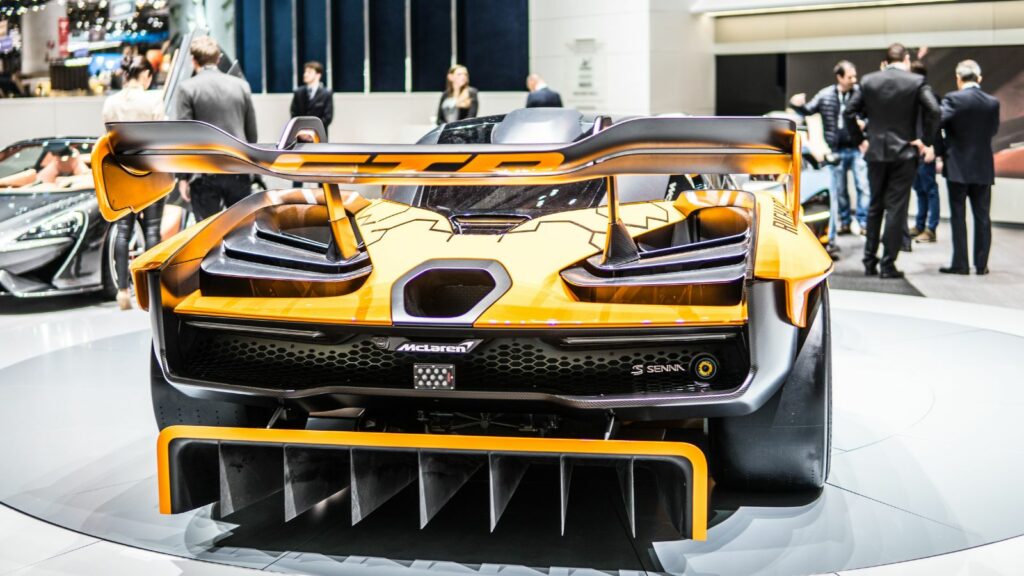
A rare Canadian-market McLaren Senna has turned the closing stretch of an online auction into a multimillion-dollar contest. The 2019 hypercar, chassis #232 of just 500 road-going Sennas produced, crossed the US$1.925-million mark as bidding intensified ahead of its scheduled September 6 close on Bring a Trailer. By the latest verification, the figure had already climbed further to US$1.975 million.
The numbers are eye-catching, but this car has more working in its favour than low production alone. Originally delivered in Vancouver, it combines unusually low mileage, extensive documentation and an exceptionally rare McLaren Special Operations colour. As collectors debate how much modern hypercars will ultimately be worth, this Canadian-connected Senna is providing a very public test of what buyers will pay for rarity, provenance and specification.
The US$1.925-Million Mark Was Only a Snapshot
Bidding at US$1.925 million was already significant, putting the Senna deep into territory occupied by some of the most valuable modern collectible cars. Yet the auction was still moving. During verification on September 6, the live Bring a Trailer listing showed a US$1.975-million bid, with the scheduled close set for 10 a.m. Pacific Time. That means the figure in the headline represents an important moment in the bidding battle rather than a final sale price.
The platform also uses an anti-sniping system: a bid received during the last two minutes extends the auction until two minutes pass without another bid. For a car worth nearly US$2 million, that rule can turn a scheduled closing minute into a prolonged contest between determined buyers. At the latest captured point, the listing had attracted more than 22,000 views, nearly 2,000 watchers and more than 30 bids, showing that the drama extends well beyond the handful of people financially capable of taking the car home.
Its Story Began in Vancouver
This Senna has a genuine Canadian-market history rather than a loose connection created by a brief registration. McLaren Vancouver previously described chassis SBM15ACAXKW800232 as an original local Vancouver delivery and said it had been looked after by the dealership from new. When advertised there earlier in 2026, the car showed 2,252 kilometres and carried an asking price of C$1,299,888 before taxes and applicable charges.
The current seller subsequently acquired the vehicle from its original owner through McLaren Vancouver and imported it into the United States in 2026. That continuity matters in the collector-car world. Buyers spending seven figures often want to know not just how a vehicle looks today, but where it was sold, who serviced it and whether its history can be reconstructed through paperwork. This example is now offered with service records dating back to new, along with its manuals and accessories. For a modern hypercar packed with complex mechanical, hydraulic and electronic systems, that paper trail can be nearly as important as a spotless paint finish.
Atlantic Blue Makes This Senna Especially Unusual
Production of 500 cars already makes every road-going Senna scarce, but #232 adds another layer of exclusivity through its McLaren Special Operations specification. The car is finished in MSO Atlantic Blue metallic, contrasted with McLaren Orange detailing and exposed matte carbon fibre. McLaren Vancouver described it as one of only two Sennas produced in that colour worldwide and the sole example originally delivered to North America.
That distinction helps explain why two superficially similar Sennas can receive very different reactions from collectors. McLaren Special Operations allowed wealthy buyers to personalize cars with bespoke paints, carbon-fibre treatments, graphics and interior details, making some individual configurations substantially harder to duplicate than the 500-car production figure suggests. On #232, orange accents appear on exterior aerodynamic components and inside the cabin, where orange six-point harnesses contrast with black Alcantara and exposed carbon fibre. Even the quarter-panel graphics identify the car as “P15-232,” tying the specification directly to its production number and giving the vehicle a recognizable identity beyond its VIN.
Performance Still Looks Extreme Years Later
The Senna was not developed primarily as a luxury object. McLaren designed it as an uncompromising road-legal car capable of delivering exceptional circuit performance, and its basic specifications remain formidable. Its 3,994-cc twin-turbocharged V8 produces 800 metric horsepower, or 789 bhp, along with 800 Nm — 590 lb-ft — of torque. Power reaches the rear wheels through a seven-speed dual-clutch transmission.
McLaren quotes a 0-to-100-km/h time of 2.8 seconds, 0 to 200 km/h in 6.8 seconds and a maximum speed of 335 km/h, or 208 mph. Just as important is the weight. The lightest dry specification was only 1,198 kilograms, giving the car a power-to-weight ratio that McLaren listed at 668 PS per tonne. Those figures help explain why the Senna continues to command attention nearly a decade after its 2017 unveiling. Modern hybrid hypercars can produce substantially more peak power, but the Senna’s appeal was built around minimizing weight and maximizing communication between the driver, chassis and road rather than simply chasing the largest horsepower number.
Aerodynamics Were Allowed to Dictate the Shape
The Senna’s appearance has always been unconventional, largely because aerodynamic performance was given priority over traditional supercar proportions. The car uses McLaren’s carbon-fibre MonoCage III structure, extensive openings and air channels, a double-element rear diffuser and an electronically controlled rear wing. That wing is not merely decorative; it changes position according to driving conditions and can contribute to braking as an airbrake.
Chassis #232 retains the model’s equally serious hardware underneath. It uses 19-inch front and 20-inch rear centre-lock wheels fitted with wide performance tyres, along with carbon-ceramic brake discs measuring 390 mm at both ends. McLaren’s RaceActive Chassis Control II system combines adaptive damping and hydraulic control intended to reconcile road use with extreme circuit capability. The result was never meant to be a traditional grand tourer. Even the distinctive glazed door sections serve a purpose by improving visibility toward the pavement and apex of a corner. The Senna’s unusual shape is therefore part of its engineering story, not simply an attempt to look dramatic.
Low Mileage Has Not Meant a Missing History
The digital odometer shows roughly 1,600 miles, or about 2,575 kilometres, making this a lightly used example even by exotic-car standards. Bring a Trailer says approximately 80 of those miles were accumulated under the current owner. The exterior is also covered by clear XPEL paint-protection film, an increasingly common measure on high-value cars where stone chips can become expensive cosmetic issues.
More important for a buyer is what accompanies those miles. The sale includes service records from new, English and French owner’s manuals, two factory keys, a car cover and a collection of original tools and accessories. The U.S. Carfax report cited by the auction shows no accidents or damage. The seller also states that the remaining McLaren Ultimate Extended Warranty is transferable to a private buyer in North America through February 25, 2027, subject to applicable terms and transfer requirements. Taken together, the mileage and documentation help explain why the car can appeal both to a collector seeking preservation and to an owner who actually intends to drive it.
Crossing the Border Adds Another Layer to the Sale
The car’s move from Canada to the United States is one of the more unusual elements prospective buyers have been examining. The auction states that #232 was imported in 2026 through a registered importer and now carries a clean Montana title. McLaren Vancouver also performed work related to the import process, including enabling the dashboard “BRAKE” warning indicator that had been configured differently for the Canadian market.
U.S. federal rules make documentation important when a Canadian-certified vehicle enters the country. The National Highway Traffic Safety Administration maintains specific guidance for importing Canadian vehicles, including circumstances where a registered importer, an HS-7 declaration and compliance work may be required. One auction commenter specifically asked about Customs and NHTSA paperwork, illustrating how sophisticated bidders scrutinize more than horsepower and paint. The seller has stated that the vehicle completed the federalization process. For any eventual purchaser, retaining the supporting import documents alongside the service history would help preserve the clear provenance expected of a car that may change hands internationally again.
The Senna Name Carries More Than Marketing Weight
McLaren attached one of motorsport’s most important names to this car. Ayrton Senna raced for McLaren from 1988 through 1993, winning Formula One Drivers’ Championships in 1988, 1990 and 1991. He scored 35 of his 41 career Grand Prix victories while driving for the team. The partnership’s most dominant season came immediately: Senna and teammate Alain Prost won 15 of the 16 Formula One races held in 1988.
The road car was conceived around a similarly relentless pursuit of performance. McLaren unveiled the Senna in late 2017 and limited production to 500 examples, all of which had already been allocated when the model was announced. The original U.K. price started at £750,000 including taxes. Naming a road car after a driver with Senna’s reputation created an unusually high expectation, but it also gave the model an identity that extends beyond its technical specifications. For collectors decades from now, that direct connection to McLaren’s most celebrated racing era may remain one of the model’s strongest intangible assets.
Recent Sales Show Why This Bid Stands Out
The broader Senna market provides useful perspective on a bid approaching US$2 million. CLASSIC.COM currently places its benchmark for the standard Senna at roughly US$1.325 million and calculates an average sale price of approximately US$1.335 million. The database also records a much higher peak transaction of US$3.02 million in January 2023, demonstrating how particular examples can depart dramatically from the average.
More recent transactions underline the spread. An 8,000-mile 2019 Senna finished in MSO Papaya Spark sold on Bring a Trailer for US$1.36 million in February 2026. Another low-mileage example brought US$1.415 million on the same platform in 2022, while CLASSIC.COM records a 206-mile Senna selling for US$1.76 million in May 2026. Against those numbers, the US$1.925-million stage — and the subsequent US$1.975-million live bid — puts this Canadian-market car in elevated company. Mileage alone cannot explain that premium. Colour rarity, provenance, documentation and individual specification are clearly part of the bidding equation.
The Final Number Could Become a Useful Market Signal
Whatever happens at the close, this sale offers a useful glimpse into how collectors are treating the Senna less than a decade after production began. There are only 500 standard road cars, yet that does not make them interchangeable. Buyers can distinguish between ordinary specifications and unusual MSO builds, between heavily used and low-mileage cars, and between examples carrying extensive records versus those with complicated histories. Chassis #232 checks several of the boxes that tend to attract serious collectors simultaneously.
Still, an auction bid is not a permanent valuation guide for every Senna. A US$1.975-million bid on a rare Atlantic Blue, Vancouver-delivered example does not automatically make a higher-mileage car in a common specification worth the same amount. That is precisely why the closing result matters. If bidding remains near US$2 million or goes higher, it would show that buyers are prepared to pay a substantial premium over broader market benchmarks for the right combination of rarity and provenance. Until the bidding officially stops, however, the only certainty is that US$1.925 million was not the ceiling.
