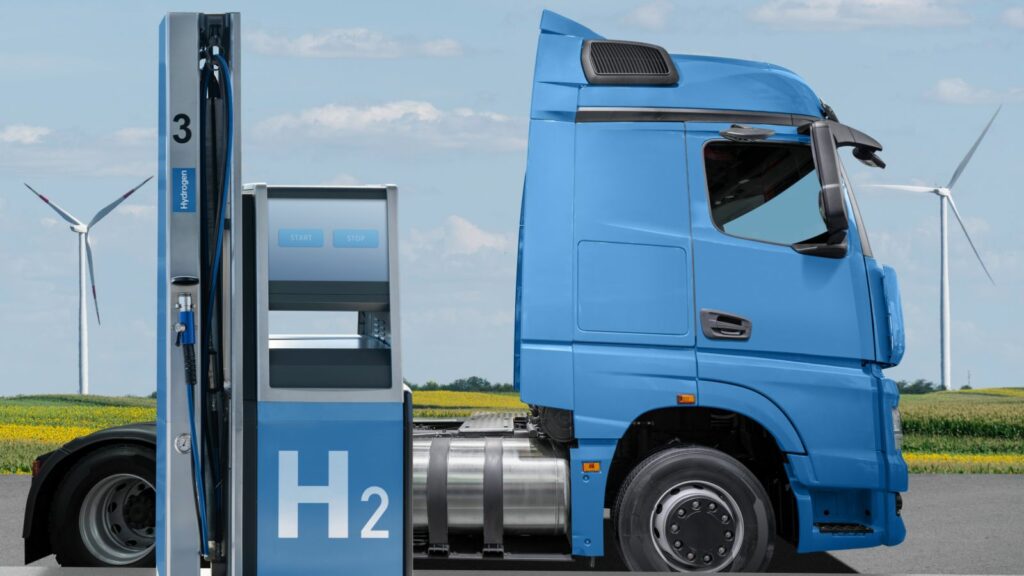
Hydrogen has spent years trying to prove it belongs in the future of road transport. Toyota and IVECO are now putting that argument back into the spotlight with a heavy-duty fuel-cell truck designed to travel more than 900 kilometres between refuelling stops.
The next-generation IVECO S-eWay Fuel Cell will use Toyota technology producing a combined 300 kW, with the companies targeting longer range, greater durability and a smaller supporting battery than the previous generation. It arrives as battery-electric trucks are becoming increasingly capable themselves, creating a much more complicated contest than a simple hydrogen-versus-battery debate. For freight operators, the real questions involve uptime, payload, energy costs, charging or refuelling availability and how quickly each technology can become economically practical at fleet scale.
A 900-Kilometre Hydrogen Truck Moves Closer to the Road
Toyota and IVECO announced their expanded collaboration in September 2026 through EMPOWER, a European Union-backed program developing zero-emission heavy-duty vehicles. Toyota is responsible for supplying the fuel-cell system, while IVECO is leading development, integration and validation of the truck itself. The new S-eWay Fuel Cell is expected to deliver more than 900 kilometres of driving range, substantially extending the practical operating window of a hydrogen tractor. Its Toyota fuel-cell systems have a combined output of 300 kW, while the companies are targeting an operating life exceeding 25,000 hours.
IVECO has also reduced the truck’s weight and simplified its energy-management architecture. One of the more important changes is that the supporting battery requires only about half the capacity used by the preceding generation. That matters because a fuel-cell truck is still an electric vehicle: hydrogen feeds the fuel-cell stack, which produces electricity for the drivetrain, while a battery handles functions such as energy buffering and regenerative braking. Validation is scheduled to begin in the fourth quarter of 2026, with on-road testing planned for the first half of 2027. Those dates are important—the 900-kilometre figure represents a development target entering validation, rather than a fleet-wide real-world result already accumulated over years of customer service.
Toyota Is Building More Than One Hydrogen-Truck Experiment
The IVECO project is part of a much broader Toyota effort to reposition fuel cells around commercial vehicles, where high mileage and frequent use could potentially make hydrogen more attractive than it has been in passenger cars. Toyota’s third-generation fuel-cell system was developed specifically with demanding commercial applications in mind. The company says durability can reach twice that of its previous-generation technology, while fuel efficiency has improved by roughly 20%, supporting a similar improvement in cruising range. Toyota has also been working to cut manufacturing costs and make the system compact enough for several vehicle classes.
That strategy has accelerated during 2026. In September, Toyota and Scania announced that Toyota’s third-generation systems would be installed in 40 heavy-duty Scania vehicles for testing with selected operators. Earlier in the year, Toyota and Isuzu also announced work on a next-generation light-duty fuel-cell truck, with production targeted for fiscal 2027. The pattern is significant. Toyota is not betting solely on one hydrogen flagship. It is trying to place its fuel-cell technology inside vehicles built by several established commercial-vehicle manufacturers, allowing real freight fleets to determine which routes and duty cycles make economic sense.
Battery-Electric Trucks Have Already Raised the Bar
Hydrogen’s 900-kilometre range sounds particularly striking when compared with the size of batteries required in today’s long-haul electric trucks. Mercedes-Benz’s eActros 600, for example, carries three battery packs providing 621 kWh of installed capacity and is designed to travel around 500 kilometres without intermediate charging under realistic 40-tonne operating conditions. That is well short of the proposed IVECO fuel-cell truck’s single-fill range, but the comparison changes when charging is incorporated into a driver’s working day.
Mercedes says the eActros 600 can exceed 1,000 kilometres of daily travel when charging is available during statutory driver breaks. Customer deliveries began in December 2024, meaning battery-electric long-haul trucks have moved beyond prototype demonstrations into ordinary fleet operations. The wider European market is still young: ICCT data show that roughly 3,400 of the approximately 146,000 heavy trucks sold in the EU during the first half of 2026 were zero-emission models, equivalent to about 2.3%. Yet that share rose from approximately 1.4% a year earlier. Hydrogen therefore is not entering an empty market. It is trying to catch battery trucks while battery range, charging speeds and production volumes are continuing to improve.
Refuelling Speed Remains Hydrogen’s Strongest Argument
Long-distance trucking is fundamentally an uptime business. A tractor that spends less time moving freight has fewer productive hours available to recover its purchase cost, driver wages and financing. That is where hydrogen continues to offer an appealing theoretical advantage. Toyota has separately demonstrated high-flow hydrogen-refuelling concepts under which a 40-tonne truck could receive enough hydrogen for approximately 600 kilometres in eight minutes or 900 kilometres in about 12 minutes. Those figures describe the refuelling technology being developed rather than a confirmed refuelling time for the new IVECO truck, but they illustrate the operational target.
Toyota’s North American Class 8 work presents a similar picture. The company says a heavy fuel-cell truck can carry roughly 70 kilograms of hydrogen, refuel in around 15 to 20 minutes and achieve as much as 500 miles—roughly 805 kilometres—of range. A fleet moving between ports, warehouses and distribution centres could potentially schedule those stops much like diesel refuelling today. Battery trucks can narrow that advantage through high-power and eventually megawatt-scale charging, particularly when drivers must stop anyway. Hydrogen’s value therefore depends less on a headline refuelling time than on whether stations can reliably dispense large quantities of competitively priced fuel throughout a fleet’s working day.
The Economics Still Give Battery Trucks a Major Advantage
Hydrogen’s biggest obstacle is not whether a fuel-cell truck can move a heavy trailer. It is whether the complete system can do so cheaply enough. The International Energy Agency estimates that battery-electric heavy trucks are about 55% more energy-efficient than equivalent diesel trucks, while fuel-cell electric trucks are about 30% more efficient than diesel. Electricity can travel relatively directly from the grid into a battery and then an electric motor. Hydrogen normally requires additional steps to produce, compress or transport the fuel before converting it back into electricity onboard the truck, creating additional energy losses.
That difference shows up in operating-cost projections. The IEA’s heavy-truck analysis expects fuel-cell trucks to remain more expensive to operate than battery-electric alternatives through 2030 in the major markets it examined, unless vehicle, infrastructure and hydrogen costs fall substantially. The conclusion is not universal, however. A peer-reviewed 2026 techno-economic study comparing several zero-carbon freight technologies found that fuel-cell trucks could become the more attractive zero-emission option for longer ranges above roughly 300 kilometres under its modelling assumptions. That disagreement is revealing rather than contradictory: electricity prices, hydrogen prices, annual mileage, charger utilization, payload requirements and financing assumptions can all change which technology looks strongest for a particular fleet.
Infrastructure Could Decide the Contest Before the Trucks Do
Europe is effectively preparing infrastructure for both pathways. Under the EU’s Alternative Fuels Infrastructure Regulation, publicly accessible charging pools dedicated to heavy vehicles are supposed to cover the TEN-T core network at intervals of no more than 60 kilometres by the end of 2030. The comprehensive network has a 100-kilometre target. Hydrogen stations, meanwhile, are supposed to be positioned no more than 200 kilometres apart along the TEN-T core network by the same deadline, with minimum capacity requirements and at least a 700-bar dispenser.
Building stations, however, does not automatically guarantee abundant low-carbon hydrogen. The IEA’s 2026 hydrogen review says global hydrogen production remains overwhelmingly dependent on unabated fossil fuels. Low-emissions hydrogen production reached almost one million tonnes in 2025 and was expected to exceed 1% of worldwide hydrogen output in 2026 for the first time. Costs, uncertain demand and infrastructure remain major barriers. That distinction matters for trucking because a fuel-cell vehicle has no carbon dioxide emissions from its tailpipe, but its overall climate impact depends heavily on how the hydrogen is produced. A 900-kilometre truck supplied with genuinely low-emissions hydrogen presents a very different emissions proposition from the same vehicle supplied from carbon-intensive production.
Real Fleet Operations Will Determine Whether Hydrogen Has Found Its Niche
Toyota already has smaller-scale evidence that fuel-cell freight can operate outside controlled test environments. In 2025, Toyota Motor Europe began using 40-tonne hydrogen trucks built with VDL and Toyota fuel-cell modules on logistics routes connecting Belgium with France, Germany and the Netherlands. Those trucks were designed for as much as 400 kilometres of real-world range. In the United States, Toyota announced a 2026 agreement involving 40 hydrogen Class 8 trucks operated with Hyroad Energy in Southern California, alongside development of Toyota’s own refuelling infrastructure. Those programs provide something laboratory testing cannot: information about maintenance, station reliability, scheduling, driver experience and actual fuel consumption.
The new IVECO project now raises the ambition considerably. If a truck capable of more than 900 kilometres can demonstrate acceptable durability, payload and running costs, hydrogen could strengthen its case for intensive long-haul routes where prolonged charging remains difficult. Battery-electric trucking, however, is advancing at the same time and has a fundamental efficiency advantage that directly affects operating costs. The emerging market may therefore be less about one technology eliminating the other and more about matching powertrains to routes. Battery trucks appear increasingly compelling where predictable charging can be built into operations; hydrogen’s opportunity lies in demonstrating that extra range and fast refuelling are valuable enough to justify a more expensive and complicated fuel ecosystem.
