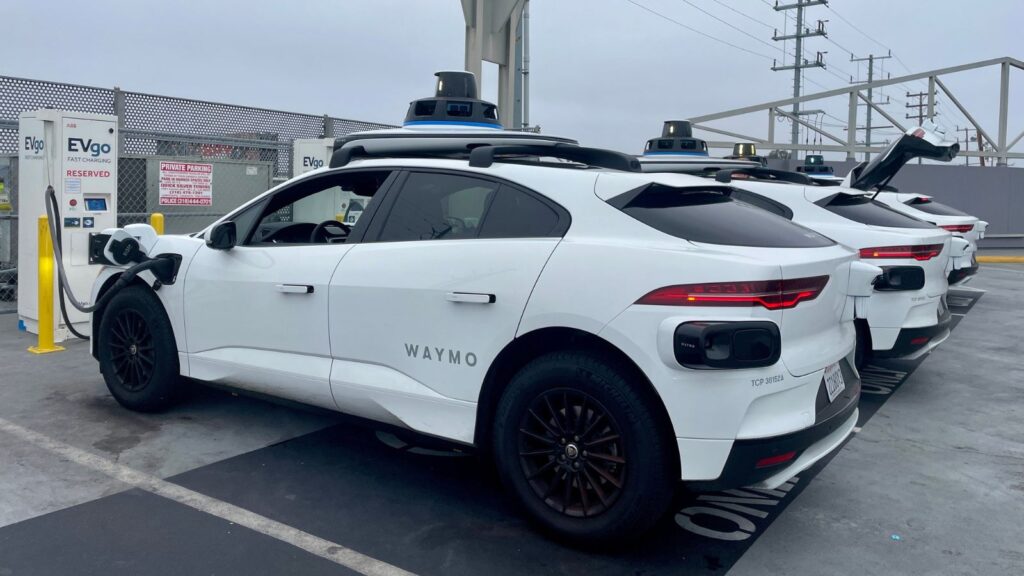
Las Vegas has become the latest proving ground for a transportation technology that is increasingly difficult to separate from the politics of global manufacturing. Waymo opened its fully autonomous service to public riders in the city on September 14, bringing its newest Ojai robotaxi onto streets around the Strip and nearby neighbourhoods.
The vehicle represents an unusual cross-border formula. Its electric platform is manufactured in China by Geely-owned Zeekr, while the sensors, computing systems and autonomous-driving technology are supplied and integrated by Waymo in the United States. That arrangement is helping Waymo expand rapidly, but it arrives just as Washington debates tougher restrictions on Chinese vehicles and Canada takes a notably different approach to Chinese EV imports.
Las Vegas Becomes Waymo’s 15th U.S. Market
Waymo’s Las Vegas opening pushes the Alphabet-owned company into its 15th U.S. metropolitan market and gives Nevada its first commercial Waymo operation. The initial rollout is deliberately contained. Waymo said the service covers nearly 24 square miles, with destinations including The Venetian and Allegiant Stadium, while local reporting places portions of the operating zone along Las Vegas Boulevard and into areas around Spring Valley and Winchester. More than 100,000 people had already expressed interest before public rides began.
The fleet is initially measured in dozens rather than thousands of vehicles, allowing Waymo to increase availability gradually as riders are admitted. Las Vegas is especially significant because it is one of the first markets where the newer Ojai will make up a majority of the Waymo fleet instead of the Jaguar I-PACE vehicles long associated with the service. Nevada regulators approved Waymo as an Autonomous Vehicle Network Company in August. That authorization covers Clark County, although servicing Harry Reid International Airport still requires separate airport approval.
The Ojai Is Chinese-Built, but Its Autonomous System Is Waymo’s
The vehicle carrying Las Vegas passengers began life under another name. Waymo developed it with Zeekr, the electric-vehicle brand controlled by China’s Geely Holding Group, after the companies announced their partnership in 2021. Previously known as the Zeekr RT, the vehicle was renamed Ojai ahead of commercial deployment. The underlying platform was designed for mobility services such as robotaxis, with the production vehicle manufactured in China before being shipped to the United States for Waymo integration.
What arrives on American streets is therefore not simply a Chinese robotaxi running Chinese autonomous software. Waymo’s sixth-generation Driver provides the automated-driving system. Its sensor package includes 13 cameras, four lidar units, six radar units and external audio receivers, with overlapping fields of view reaching as far as 500 metres in some conditions. Inside, the Ojai was designed around passengers rather than a conventional owner-driver. It has a flat floor, a low step-in height, large sliding doors, three screens, Braille markings and controls intended to make repeated ride-hailing use easier.
Waymo Has Carefully Separated the Chinese Chassis From the Connected Technology
That separation has become crucial because U.S. rules increasingly treat a connected car as much more than a piece of transportation equipment. The Commerce Department finalized regulations in January 2025 targeting vehicle-connectivity and automated-driving technology tied to China or Russia. Restrictions on covered software begin with model-year 2027 vehicles, while restrictions on specified connectivity hardware begin later. The government has cited risks ranging from the collection of sensitive location information to the possibility of remote manipulation.
Waymo says its Ojai configuration is designed around those restrictions. The Zeekr-built base vehicles are shipped without the Chinese connectivity equipment and autonomous-driving sensors that would otherwise create an obvious regulatory problem. They are then sent to Waymo’s integration operation in Mesa, Arizona, where Waymo and manufacturing partner Magna install the company’s computing, sensors and related equipment. A Waymo representative has said this configuration does not prevent the company from deploying the vehicle under the existing connected-vehicle rule. In practical terms, the body and EV platform may originate in China, while the digital driving system controlling the robotaxi does not.
Washington Is Now Debating Whether That Distinction Should Be Enough
The bigger risk for Waymo is that U.S. policy may move beyond examining where a vehicle’s software and communications hardware originate. Senators Elissa Slotkin of Michigan and Bernie Moreno of Ohio introduced the Connected Vehicle Security Act of 2026 in April, proposing restrictions that would reach Chinese-manufactured vehicles themselves as well as critical connected components. The legislation advanced unanimously out of the Senate Commerce Committee in July, although it has not yet completed the legislative process.
Pressure has also come from the auto industry. In September, the Alliance for Automotive Innovation urged congressional leaders to establish a permanent ban on Chinese connected vehicles, software and hardware before the end of the current Congress. That campaign exists alongside a more complicated message from the White House. President Donald Trump said in September that he could accept Chinese automakers building vehicles inside the United States if they employed American workers, while opposing Chinese vehicles manufactured in Mexico for export north. For Waymo, a broader manufacturing-origin ban could be far more consequential than the existing technology-focused rule.
Canada Is Moving in a Different Direction on Chinese EVs
North of the border, Chinese automotive policy has changed substantially. Canada introduced a 100% surtax on Chinese-made EVs in October 2024, closely aligning itself with the tougher trade approach then emerging in the United States. That policy was reversed under a new Canada-China arrangement in 2026. Beginning March 1, Canada established an initial annual quota allowing 49,000 Chinese-origin EVs to enter under the regular 6.1% most-favoured-nation tariff. The quota is scheduled to grow by 6.5% annually, and Ottawa described the initial volume as representing less than 3% of Canada’s new-vehicle market.
The commercial opening does not mean cybersecurity questions have disappeared. Transport Canada already maintains a vehicle cybersecurity strategy recognizing that connected and automated vehicles can create risks extending beyond the physical automobile. Parliamentarians have also demanded details about Ottawa’s work on a dedicated connected-vehicle policy, including how officials are addressing privacy, surveillance and national-security concerns surrounding Chinese technology. A Public Safety Canada document reported this year similarly warned that connected-vehicle data could hold intelligence value for foreign adversaries.
The Economics Explain Why Waymo Has Not Walked Away From Zeekr
Chinese manufacture presents Waymo with a trade-policy problem, yet the company continues bringing Ojai vehicles into the United States. Industry researchers tracking import records have estimated that thousands of Zeekr-built units have already arrived, with MoffettNathanson projecting that imports could reach about 5,000 vehicles by the end of 2026. TechCrunch reported in August that roughly 300 Ojais were already operating commercially at that point. Those numbers suggest that Waymo does not view the platform as a small experimental side project.
The attraction is cost and scalability. Waymo developed its sixth-generation Driver specifically to reduce hardware expense while retaining overlapping camera, lidar and radar coverage. The Ojai itself was designed to be cheaper to build, operate, clean and repair than the Jaguar-based robotaxis that preceded it. Chinese-built vehicles still face U.S. tariffs exceeding 100%, adding a substantial penalty before autonomous hardware is installed. Even so, Waymo has invested heavily in scaling the system. Its Mesa facility is designed eventually to integrate tens of thousands of autonomous vehicles annually, while a $16-billion funding round in February valued Waymo at $126 billion.
Safety Data Gives Waymo a Strong Argument, but Not a Free Pass
The policy debate surrounding the Ojai is unfolding while Waymo accumulates substantially more real-world experience than most autonomous-driving programs. An independent Insurance Institute for Highway Safety study published in July 2026 compared Waymo vehicles with human drivers in San Francisco, Phoenix, Los Angeles and Austin. After adjusting for reporting differences, researchers found that Waymo’s driverless vehicles were involved in 68% fewer crashes that would normally be reported to police. Injury-crash involvement was 81% lower, while single-vehicle crashes were 85% lower.
Those findings are important because they move the safety discussion beyond company advertising. Earlier peer-reviewed work using 56.7 million rider-only Waymo miles also found statistically significant reductions across several important crash categories compared with human benchmarks. Waymo’s own newer analysis covers more than 220 million fully autonomous miles and reports similarly large reductions in serious crashes. Still, IIHS researchers cautioned that federal automated-vehicle reporting systems need improvement as deployments expand. A safer statistical record does not eliminate the need for regulatory monitoring, especially when robotaxis begin entering unfamiliar cities at commercial scale.
Hyundai Gives Waymo a U.S.-Built Alternative as Policy Risk Grows
Waymo is not depending exclusively on Zeekr. Its sixth-generation Driver was deliberately engineered as a modular system that can operate on different vehicle platforms. The most important alternative is Hyundai’s IONIQ 5. Under a multi-year agreement, Waymo is integrating its autonomous system into IONIQ 5s assembled at Hyundai Motor Group Metaplant America in Georgia. Hyundai said recently that the first Waymo-destined vehicles are scheduled for delivery in the fourth quarter of 2026.
That gives Waymo something strategically valuable: a second large-scale vehicle source with a very different geopolitical profile. The company has already begun autonomous testing of IONIQ 5 vehicles with specialists present, while its Arizona operation is designed to accommodate multiple vehicle platforms. The combination reduces the risk that one supplier, one tariff decision or one congressional restriction determines the future of the entire fleet. It also illustrates where North America’s autonomous-vehicle industry may be heading. The software provider, vehicle assembler, battery supplier, sensor manufacturer and final integration facility no longer have to come from the same country—or even the same continent.
Las Vegas therefore represents more than another city appearing on Waymo’s service map. The Ojai demonstrates how deeply integrated American technology companies have become with the global EV supply chain, even while governments are trying to divide that supply chain along national-security lines.
For passengers, the distinction between a Chinese-built chassis and an American autonomous-driving system may barely register once the doors close and the vehicle pulls away. For policymakers, however, that distinction is rapidly becoming one of the central questions surrounding connected transportation. The United States is considering whether vehicle origin itself should trigger restrictions. Canada is reopening controlled access to Chinese EVs while examining cybersecurity safeguards. Waymo, meanwhile, is attempting to prove that hardware origin, software origin and data control can be separated. How regulators answer that argument could influence not only the future of the Ojai, but the shape of autonomous transportation across North America.
