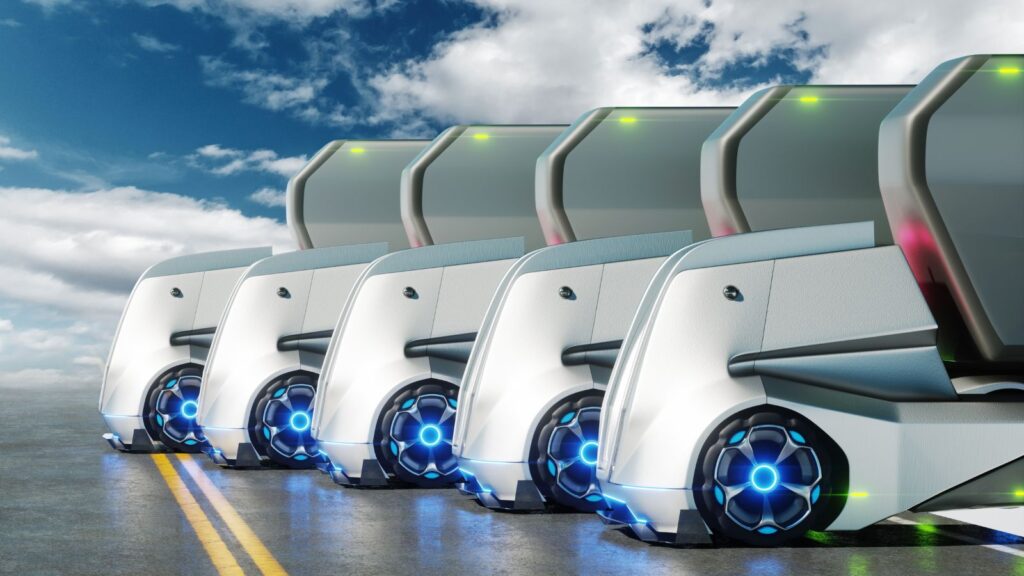
A truck without a cab, steering wheel or driver is no longer just circling a closed test track. Einride and Lidl have placed a cabless autonomous electric truck into regular logistics service on a public road in Germany, transporting goods between a Lidl distribution facility and a store under authorization from the country’s Federal Motor Transport Authority.
The deployment is significant because it shifts autonomous trucking further from demonstration toward everyday freight work. The vehicle operates at SAE Level 4, meaning the automated system performs the driving task without a human aboard while remaining restricted to an approved operating environment. As other autonomous-trucking companies expand their own commercial fleets, freight automation is beginning to look less like a distant experiment and more like an emerging part of the logistics industry.
A Cabless Truck Has Moved From Demonstration to Daily Work
The Einride vehicle now being used by Lidl is unusual even by autonomous-truck standards. Instead of taking a conventional tractor and removing the driver, the machine was designed without a traditional cab at all. There is no driver or safety operator sitting inside while it moves goods on its approved German route. Einride and Lidl say the truck is being integrated into daily logistics rather than operated solely as a technology demonstration, with freight moving between a Lidl distribution operation and one of the retailer’s stores.
That distinction matters. Autonomous-vehicle companies have spent years accumulating test kilometres, operating inside industrial sites and demonstrating vehicles on selected public roads. Regular commercial work creates a different set of pressures: schedules must be met, loading operations must line up with store demand and reliability matters every working day. Lidl and Einride are also planning to expand the initial operation toward a multi-stop “milk run” serving additional locations. For a grocery business built around keeping shelves stocked, that turns autonomy into an operational question rather than simply a technological one.
Level 4 Does Not Mean the Truck Can Drive Anywhere
The Level 4 designation attached to the Lidl truck is important, but it is frequently misunderstood. Under the SAE automation framework, Level 4 allows the automated driving system to perform the complete driving task without requiring a human driver to monitor the road or be ready to take control. The limitation is that the capability only applies within its defined operational design domain. That can include restrictions involving geography, road type, weather, speed or other operating conditions.
That makes the vehicle fundamentally different from both ordinary driver-assistance technology and the theoretical Level 5 vehicles that could drive virtually anywhere a person could. The Lidl operation is built around a defined route and an approved operating environment. German law similarly treats autonomous vehicles as systems operating within specifically designated areas rather than machines receiving unrestricted access to every public road. The distinction explains why freight is proving attractive for Level 4 technology: companies can carefully select repeatable routes where road characteristics, destinations and operating procedures are already well understood instead of immediately trying to automate every possible driving situation.
Grocery Distribution Gives Autonomous Trucks a Practical Test
Retail logistics offers a useful environment for testing whether autonomous freight can survive outside a controlled pilot. Grocery distribution involves recurring flows between warehouses, distribution centres and stores, often with relatively predictable demand and tightly managed schedules. Lidl already operates a large German logistics network, with more than 3,250 stores and 39 administrative and distribution centres in the country. A technology that works reliably on one route can therefore potentially be evaluated for additional repetitive movements elsewhere in the network.
The human side of that operation is less futuristic. Store employees still need products delivered at the expected time, warehouse teams still have loading schedules to manage and shoppers rarely think about the trucks behind the products on a supermarket shelf. That is precisely why the deployment is meaningful. Autonomous trucking becomes commercially relevant when it can fit into those ordinary routines without forcing the rest of the supply chain to reorganize around a science project. Lidl says the broader objective is dependable product availability, while the initial route is intended to show how autonomous vehicles can be integrated gradually into existing logistics operations.
Germany’s Regulatory Approval Raises the Significance
Operating a driverless truck on a German public road requires considerably more than demonstrating that the vehicle can steer and brake. Germany created a legal framework for autonomous vehicles operating in defined areas, and its rules spell out responsibilities for the vehicle, operator and technical supervision. An autonomous vehicle must be capable of completing the driving task inside its approved operating area without a person driving it, while the legal framework provides for technical supervision that can deactivate the vehicle or authorize certain manoeuvres when required.
The rules also require autonomous vehicles to be capable of placing themselves into a risk-minimizing state. Germany’s road traffic legislation describes that state as bringing the vehicle to a stop at the safest available location, with hazard lights activated, when continuing normally is not possible. The operating permit for the Lidl deployment was granted by the Federal Motor Transport Authority after a safety-validation process, according to the companies. Because this is the first German authorization of its kind for a cabless vehicle in regular operations, the permit may prove almost as important as the truck itself: commercial autonomy cannot scale without repeatable regulatory pathways.
A Severe Driver Shortage Strengthens the Business Case
Autonomous-truck developers are entering the market while European freight operators are struggling to recruit enough people. The International Road Transport Union estimated in its latest global driver-shortage work that Europe had roughly 502,000 unfilled truck-driving positions in 2025, equivalent to about 13% of required positions. Around 20% of the European driver workforce is expected to retire within five years, adding another demographic problem to an industry already finding younger recruits difficult to attract.
The consequences are affecting business rather than remaining a workforce statistic. IRU reported that around two-thirds of European road-transport operators surveyed had turned down contracts because they could not find enough drivers, while 65% identified the shortage as their biggest concern. Automation will not suddenly fill half a million vacancies, especially when Level 4 systems remain limited to carefully selected routes. It can, however, make repetitive freight movements candidates for automation while human drivers remain focused on routes, customers and driving environments that autonomous systems cannot yet handle. Lidl and Einride explicitly cite driver shortages and supply-chain continuity among the motivations behind their project.
The Economics Depend on Much More Than Removing a Driver
The financial case for autonomous freight is often reduced to driver wages, but real-world fleet economics are more complicated. Trucks must still be purchased, charged, maintained, loaded, unloaded and monitored. Routes must be planned around battery capacity and freight demand, while expensive equipment sitting idle produces little value. Einride’s model therefore combines autonomous vehicles with electric trucks, charging infrastructure and software intended to coordinate transportation demand, vehicle utilization and energy use.
Research conducted by Einride and Germany’s Fraunhofer ISI illustrates why fleet planning can matter as much as the vehicle. Researchers examined more than 38,000 real-world grocery shipments involving over 200 vehicles. In the optimized scenario, electric trucks could carry as much as 85% of the total payload, compared with 57% under a simpler one-for-one replacement strategy. The study also found that optimized planning could reduce fleet-level costs compared with an all-diesel baseline under the assumptions examined. Those results concerned electrification rather than proving that autonomous trucks are automatically cheaper, but they demonstrate the operational thinking behind Einride’s approach: automation only creates value if the entire transport system works efficiently around it.
Electric and Autonomous Freight Are Increasingly Developing Together
Einride is simultaneously betting on two major changes to trucking: removing tailpipe emissions through battery-electric vehicles and reducing dependence on an onboard driver through automation. The company reported in securities filings that by the end of 2025 its electric operations had accumulated more than 14 million miles and completed more than 450,000 shipments. It also reported more than 3,300 hours of driverless operation in contracted customer service by that point.
The autonomous side has continued growing. By June 30, 2026, Einride said contracted customer operations had exceeded 5,400 driverless hours, an increase of 64% from the earlier reported level, with six autonomous trucks deployed under its freight-capacity business. The numbers remain tiny compared with the scale of conventional European trucking, but they show the transition from prototype development toward accumulated operating experience. Germany alone moved 2.8 billion tonnes of freight by domestic trucks according to current Federal Statistical Office figures. Against a freight system of that size, even hundreds of autonomous trucks would initially represent a niche. The significance lies in whether operations can be replicated route by route.
Einride Is Not Alone in Moving Toward Commercial Driverless Freight
The acceleration is visible well beyond the Lidl project. In the United States, Aurora reported during the summer of 2026 that it had begun operating a new generation of autonomous trucks without a person behind the wheel and expected to finish the year with roughly 200 driverless trucks in service. Aurora uses conventional-looking heavy trucks equipped with its autonomous-driving technology, illustrating a different hardware strategy from Einride’s purpose-built cabless design.
Kodiak is advancing along another path. The company reported 35 customer-owned driverless vehicles at the end of the second quarter of 2026 and more than 40,000 cumulative hours of paid driverless operation. Much of its commercial driverless work has developed in industrial environments, while the company has been preparing for driverless long-haul highway operations. Chinese developer Pony.ai has also unveiled a new Level 4 electric robotruck while targeting expansion into Europe. These companies differ significantly in routes, hardware and business models, but together they show that autonomous trucking is becoming a competition over commercialization rather than simply who can demonstrate a self-driving prototype.
Trucking Jobs Are More Likely to Change in Stages Than Disappear Overnight
A truck with no cab makes the employment implications impossible to ignore. Yet research into autonomous freight suggests the transition is likely to be more complicated than replacing every driver with software. A 2026 University of California transportation study concluded that human teams are likely to remain important across driverless trucking, assisted driving and truck platooning. Those jobs can include testing systems, maintaining vehicles, preparing trucks before departure and supervising operations remotely.
Other research has highlighted the difficulty of assuming displaced drivers could simply move into equally attractive occupations. A 2023 study examining alternative jobs for heavy-truck drivers found that some scenarios involving displacement of 35% or more of the driving workforce could leave too few comparable alternatives, depending on the methodology and region. Many available alternatives also paid less than truck driving. That makes the pace and structure of automation important. Early deployments are concentrated in narrowly defined freight lanes rather than the entire occupation. Driver shortages may initially allow automation to absorb unmet demand, but large-scale adoption would eventually create harder questions about retraining, wages and who benefits from the productivity gains.
Safety Will Ultimately Be Decided by the Difficult Cases
A successful commercial launch does not prove that autonomous trucks are ready for every road. Public confidence will depend on what happens when conditions move away from the easy, repeatable parts of a route: unusual construction, emergency vehicles, bad weather, damaged road surfaces, unpredictable motorists or a technical failure. Research on autonomous-truck route risk has emphasized that traffic volumes, roadway conditions, regional differences and weather can materially change the difficulty of an operating environment.
That is why Level 4 systems are defined by boundaries rather than universal capability. Germany’s framework requires autonomous vehicles to operate within approved areas and includes provisions for collision avoidance, technical supervision and risk-minimizing stops. Academic research into safety assurance for automated systems has likewise warned about the danger of systems operating beyond the environments for which they were designed. For Einride and Lidl, the most important evidence will therefore accumulate quietly: ordinary deliveries completed repeatedly without incident. If that reliability holds as the operation expands from one connection toward multi-stop routes, the cabless truck could represent something larger than an unusual vehicle. It could mark the beginning of autonomous freight becoming routine.
