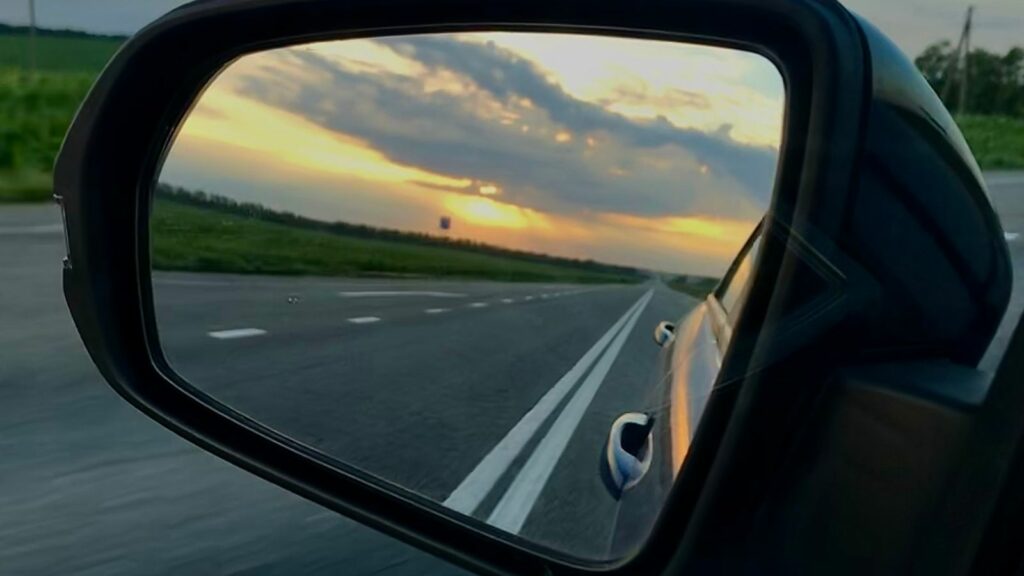
A rear-view mirror is one of the oldest pieces of technology inside a modern vehicle, but a Vancouver company believes it can make the familiar reflection feel considerably more three-dimensional. Metavista3D is showcasing its latest 3D eMirror technology in Detroit on September 15 and 16, placing a glasses-free spatial display directly in front of automakers, suppliers and display specialists gathered for the Society for Information Display’s Vehicle Displays & Interfaces Symposium.
Rather than presenting another conventional flat camera feed, the system is designed to show multiple perspectives of the road behind and alongside a vehicle, creating a sense of spatial depth without requiring special glasses. The demonstration arrives as automakers already experiment with camera mirrors, digital rear-view displays and smaller exterior camera pods—but also as regulators continue examining how far electronic systems can replace traditional glass.
Detroit Puts the Technology in Front of the Auto Industry
Metavista3D is showing the latest version of its 3D eMirror at Booth 613 inside Huntington Place, where the 33rd annual Vehicle Displays & Interfaces Symposium brings together vehicle manufacturers, Tier 1 suppliers, display companies and technology developers. That audience matters. Moving a display technology from an impressive demonstration into a production vehicle requires far more than building a convincing prototype. It needs automotive-grade hardware, dependable cameras, weather resistance, low latency, predictable performance and ultimately an automaker willing to engineer the system into a vehicle program.
Detroit is also familiar territory for the company’s technology. Metavista3D’s Swiss subsidiary, psHolix AG, won the event’s Best in Show award in 2023, when the Detroit chapter of the Society for Information Display says roughly 55 exhibitors participated. In 2025, Metavista3D chief technology officer Rolf-Dieter Naske returned to the symposium to discuss holographic automotive rear-view replacement systems. The 2026 appearance moves that work another step forward: from discussing the concept to displaying an updated eMirror development system to the companies that could eventually integrate it.
This Is More Than a Camera Feeding a Flat Screen
A normal camera-monitor system takes imagery from a camera outside the vehicle and places it on a two-dimensional screen. Metavista3D is trying to preserve something that can be lost in that conversion: spatial depth. Its eMirror uses autostereoscopic display technology, meaning the screen is designed to create three-dimensional imagery without glasses. Multiple perspectives of the scene are presented so that the view is intended to behave more like looking into physical space than watching an ordinary video monitor.
The underlying platform is based on what the company calls Super-Multiview technology. Metavista3D has previously demonstrated 13.3-inch 4K systems that can work with stereo cameras, as well as configurations using conventional single cameras combined with real-time 2D-to-3D processing. At CES 2026, one demonstration used an NVIDIA Jetson platform to process imagery from a mono camera, while another paired its display with a fixed-focus stereo camera. That flexibility could become important for automakers because a 3D mirror requiring an entirely new camera architecture would be harder and more expensive to integrate than software and display technology capable of working with existing hardware.
Depth Perception Is the Problem Metavista3D Wants to Solve
Replacing a mirror with a screen sounds straightforward until human vision enters the equation. A physical mirror retains many of the visual cues people instinctively use to judge where objects are in space. A conventional camera system instead transforms the outside world into an image captured by a lens and displayed on a flat panel. Research into camera-monitor systems has found that camera angle, field of view, visible portions of the vehicle and display positioning can all influence how drivers estimate the distance of vehicles behind them.
Metavista3D’s central pitch is that adding spatial depth could make an electronic rearward view feel more natural. The company also says its display architecture is designed to address the vergence-accommodation conflict associated with conventional stereoscopic displays. Academic vision research has repeatedly linked that conflict—where the eyes converge on apparent depth while focusing on the physical display surface—with visual discomfort and fatigue. That makes the concept technically interesting, but it is important to separate intent from proven automotive performance. Metavista3D says reduced blind spots and improved low-light visibility are development objectives that it plans to validate independently; it is not currently making verified performance claims for those benefits.
Automakers Have Already Started Replacing Reflections With Video
The eMirror is arriving after years of experimentation with electronic rear visibility. General Motors already offers a Rear Camera Mirror on selected GMC vehicles, allowing drivers to switch from a conventional reflected view to a camera-generated image that can provide a wider, less obstructed look behind the vehicle. This is particularly useful when passengers, cargo or the vehicle’s own bodywork interfere with the view through a traditional interior mirror. The system retains the ability to function as a conventional mirror, an approach that also helps it fit within existing U.S. regulatory requirements.
Outside North America, manufacturers have pushed the idea further. Audi has offered virtual exterior mirrors in markets where regulations allow them, replacing bulky mirror housings with compact cameras and placing the video images on displays near the doors. Audi has said the camera housings reduced the width of its e-tron by about 15 centimetres and lowered aerodynamic drag compared with conventional mirrors. That highlights another reason automakers remain interested in electronic mirrors: exterior mirrors create wind resistance, wind noise and styling constraints. For electric vehicles in particular, relatively small aerodynamic improvements can translate into additional driving range.
Regulation May Move More Slowly Than the Technology
The technical challenge is only part of the story. In the United States, Federal Motor Vehicle Safety Standard No. 111 continues to specify rear-view mirrors, which means automakers cannot simply remove required exterior mirrors from ordinary U.S.-market passenger vehicles and substitute cameras. NHTSA has been examining the issue for years after manufacturers petitioned for permission to use camera-monitor systems instead. As recently as 2025 and 2026, the agency’s regulatory work still included research comparing driver behaviour with cameras and traditional mirrors.
Industry standards are nevertheless becoming more mature. SAE International revised its J3155 recommended practice in April 2026, providing test protocols and performance requirements intended for camera-monitor systems that could replace required inside and outside mirrors in U.S.-market vehicles. Canada presents a similar hurdle. Current Canadian Motor Vehicle Safety Regulations specify mirror requirements for passenger cars and other vehicles under CMVSS 111, including an inside mirror and defined exterior-mirror requirements. The result is an unusual situation: display and camera technology can advance quickly, while the legal framework determining whether physical mirrors can actually disappear from mass-market vehicles moves much more cautiously.
Electronic Mirrors Still Have Human-Factors Problems to Solve
A successful digital mirror cannot merely produce a sharp image. It has to work instantly and predictably while the vehicle is moving through rain, darkness, glare, road spray and changing temperatures. Transport Canada already cautions that rain, darkness, glare and dirt can reduce the effectiveness of ordinary rear cameras. Exterior electronic-mirror cameras face comparable environmental challenges, while a screen introduces additional considerations such as brightness, viewing angle, display failure and the amount of time required for a driver’s eyes to refocus.
Researchers are also studying where digital-mirror displays should physically sit. Recent ergonomics work has found advantages to placing camera-monitor screens close to the locations where drivers already expect mirrors to be, while also limiting how far the eyes must move away from the forward roadway. Other research has shown that camera viewing angles can alter drivers’ rear-distance estimates. NHTSA’s own research has examined eye-glance behaviour and driving performance when drivers use cameras instead of conventional mirrors. A spatial eMirror may eventually help with some depth-related limitations, but it would still have to demonstrate that the complete camera, processing and display system works safely under demanding real-world conditions.
The Next Test Is Whether Automakers See a Production Case
Metavista3D’s Detroit appearance should therefore be viewed as a technology-development milestone rather than the announcement of a production vehicle. The company says it plans to meet automakers, Tier 1 suppliers, display manufacturers and technology partners at the symposium to discuss integration and commercialization. It also says the eMirror has moved from a concept and technical presentation into an active development program. An international patent application covering autostereoscopic spatial display technology for vehicles was filed in February 2026.
There are still substantial steps between that point and a showroom. Metavista3D says it has no NHTSA application pending for the eMirror, and its own announcement carefully avoids claiming independently verified safety or visibility improvements. That restraint matters in a field where drivers would depend on the display every time they changed lanes or checked traffic behind them. Yet the broader direction of automotive design is clear: cameras and screens are taking over functions once performed entirely by glass and reflection. If spatial displays can preserve depth while meeting automotive reliability, human-factors and regulatory standards, the humble rear-view mirror could become another piece of the cockpit that increasingly behaves like a computer display.
