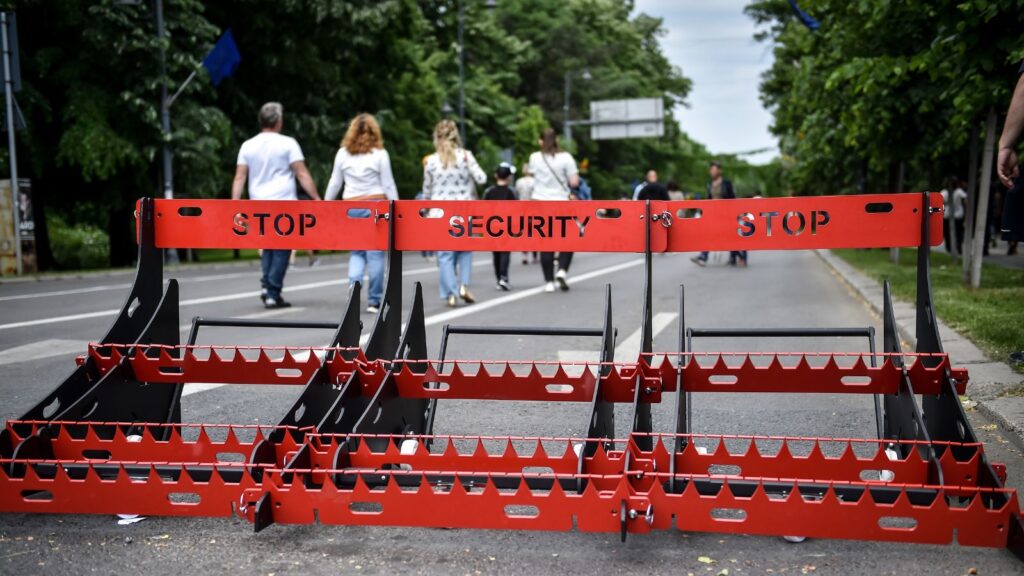
A Canadian perimeter-security company is pushing deeper into the United States at a time when cities, event operators and public-safety agencies are paying closer attention to the risk posed by vehicles entering crowded spaces. Ontario Bollards Inc., based in Georgetown, Ontario, has appointed ZND US as the exclusive American rental-channel distributor for its ättaGard portable anti-ram bollard system.
The agreement gives the Canadian company access to an established U.S. network serving rental companies, construction sites and event operators. More importantly, it reflects a broader change in physical security: protective barriers increasingly need to be crash-tested, quickly deployable and flexible enough to disappear again when an event, road closure or temporary security operation is finished.
A Canadian Security Product Gets a U.S. Rental Channel
Ontario Bollards announced the U.S. distribution agreement on September 15, giving ZND US exclusive rights to sell ättaGard to rental companies and their affiliated distributors across the country. The arrangement is more specific than a conventional dealership agreement. Rather than attempting to build a large direct-sales organization city by city, the Ontario company is placing the product inside a channel already used by organizations that routinely rent temporary fencing, pedestrian barriers and other event or work-site equipment. Ontario Bollards says it has worked in perimeter protection for more than 15 years, supplying fixed, removable, retractable and automatic bollards in addition to portable systems.
That distinction could matter for municipal customers. A city may need substantial vehicle protection for a parade, festival or temporary pedestrian district but have little reason to own enough hardware for every event on its calendar. Rental companies already move equipment between customers and locations as demand changes. Under the agreement, Ontario Bollards provides the security product while ZND handles U.S. sales, channel development and account management. The strategy effectively turns an established equipment-rental network into the Canadian manufacturer’s route to a much larger market.
Why ZND Gives Ontario Bollards a Faster Route to Market
ZND is not entering the American equipment market from scratch. The company traces its history to 1965 and expanded into the United States with a manufacturing operation in Statesville, North Carolina, in 2020. It added a West Coast manufacturing facility in Madera, California, in 2022. The company now supplies temporary fencing and pedestrian-control products from both locations, with rental companies and resellers forming an important part of its customer base. That existing infrastructure is what makes the partnership more significant than simply adding another distributor to a list.
For Ontario Bollards, the appeal is geographic reach without recreating the warehousing, customer relationships and sales infrastructure ZND has already developed. A rental operator supplying fencing for a concert, for example, could potentially source anti-ram protection through the same commercial relationship it uses for other temporary perimeter equipment. ZND President Seth Walters said customers have been asking rental partners more frequently for crash-tested vehicle barriers. That statement comes from the companies involved, but it aligns with a broader shift in U.S. security planning toward stronger physical protection around temporary gatherings and other places where pedestrians and vehicles may otherwise come into close proximity.
The Product Is Designed Around Speed of Deployment
The ättaGard system is built around a simple constraint: many locations needing vehicle protection cannot accommodate a major construction project. Ontario Bollards describes the unit as a heavy-duty steel bollard that sits on the existing surface rather than depending on the deep foundations associated with many permanent security installations. The company’s specifications list a 10-inch nominal pipe and an individual bollard weight of about 234 kilograms. Connector plates allow individual units to be combined into wider configurations, while a purpose-built ättaMover is designed to help crews lift and reposition the substantial bollards.
That approach changes how a barrier can be used operationally. Closing a downtown street for three days is very different from securing the entrance to a power plant for 20 years. Digging foundations, rerouting underground utilities and pouring concrete may make sense for permanent infrastructure but can be unrealistic for temporary events. Ontario Bollards says ättaGard can be placed directly on pavement without excavation or permanent civil work. Once the security need ends, the equipment can be removed and deployed somewhere else. That portability is central to the U.S. rental strategy because the same inventory can serve multiple customers instead of remaining permanently installed at one site.
Crash Ratings Matter More Than the Bollard’s Appearance
A large steel object can look imposing without necessarily stopping a moving vehicle, which is why crash testing is central to the anti-ram market. The ättaGard product brand says an individual unit is engineered to PU30 P2 performance, while three connected units reach the M30 level. Under the ASTM vehicle-barrier rating framework, PU30 represents a roughly 5,000-pound pickup-class vehicle travelling at about 30 mph. M30 testing uses a much heavier medium-duty test vehicle of roughly 15,000 pounds at the same nominal speed. Penetration classifications such as P1 and P2 describe how far the vehicle travels beyond the barrier during the standardized test.
Those designations provide a common engineering language, but they should not be interpreted as a universal guarantee. ASTM International explicitly warns that a penetration rating established under a controlled crash test does not mean a barrier will perform identically under every real-world condition. Vehicle approach angle, terrain, installation configuration and other site characteristics can change the outcome. The standard is therefore most useful as part of a site-specific security assessment. For buyers evaluating portable barriers, the important difference is between a product that merely blocks a lane visually and one whose performance has been assessed against a defined vehicle impact.
Vehicle-Ramming Risk Has Become Harder for Cities to Ignore
Demand for stronger barriers is developing against a measurable security concern rather than aesthetics alone. A September 2025 update from the Mineta Transportation Institute examined a recent increase in vehicle-ramming attacks and recorded 27 incidents worldwide during the seven months from November 1, 2024, through May 31, 2025. Four occurred in the United States. Looking across the longer period since 2012, the researchers found that the U.S. had recorded more vehicle-ramming attacks than any other country in their dataset and identified an upward long-term trend in American incidents.
The researchers also found that public gatherings and pedestrian environments can create particularly serious consequences because a moving vehicle can reach many people very quickly. Not every vehicle intrusion has the same motive, and the study distinguishes between ideological attacks and other violent incidents. From a physical-security perspective, however, the practical challenge is similar: keeping an unauthorized vehicle from reaching people. That helps explain why municipalities and event operators are looking beyond ordinary crowd-control barricades. A temporary metal pedestrian fence can direct foot traffic, but stopping a vehicle moving at road speed demands a fundamentally different level of engineering.
U.S. Security Guidance Is Pushing Toward Layered Protection
Federal guidance has also moved vehicle protection deeper into mainstream event and infrastructure planning. The U.S. Cybersecurity and Infrastructure Security Agency’s Vehicle Incident Prevention and Mitigation Security Guide recommends a “Plan, Prevent, Protect” framework. It calls for risk assessments, emergency planning, traffic and crowd management, staff preparation and properly selected physical barriers rather than relying on any single protective measure. CISA separately advises planners to consider both active and passive vehicle barriers depending on the location and the nature of the threat.
That guidance adds an important caveat to the growing interest in bollards: more hardware is not automatically better security. CISA warns planners to preserve emergency-vehicle access, avoid creating dangerous pedestrian choke points and maintain safe entry and exit routes for people with accessibility needs. A barrier line has to work with the venue rather than simply surround it. In practice, that can mean combining traffic changes, distance from crowds, controlled vehicle access, staff procedures and physical barriers. Portable systems fit that philosophy when they allow security layouts to change as event entrances, emergency routes and crowd patterns change.
Temporary Events Create a Different Security Problem
Permanent sites can be engineered around fixed security infrastructure from the beginning. A festival route, marathon, farmers’ market or temporary pedestrian street rarely has that advantage. The same roadway may carry normal traffic on Friday, become a dense public gathering on Saturday and reopen to vehicles Sunday night. CISA’s security resources specifically address outdoor events such as festivals, parades and marathons because their temporary nature creates unusual perimeter challenges. Organizers have to create meaningful separation between vehicles and pedestrians without permanently altering the street.
That is the environment Ontario Bollards is targeting with ättaGard. The system can be configured in individual or connected arrangements, and the company says it is designed to maintain pedestrian movement while blocking vehicle access. The ability to reposition equipment is particularly relevant where emergency access must remain available. A six-block festival route, for instance, might require protection at several intersections but still need designated openings for ambulances, fire apparatus or authorized deliveries. The value of a portable barrier in that setting is not simply that it can be moved; it is that security planners can redesign the perimeter as operating conditions change.
Rental Fleets Could Change the Economics of Anti-Ram Protection
The commercial argument behind the Ontario Bollards-ZND agreement is that many customers need serious vehicle protection without needing it every day. Purchasing a large inventory of crash-tested barriers can be difficult to justify for an organization that stages only a handful of major events each year. A rental fleet spreads the capital cost across many users and allows equipment to move from one event to another. Ontario Bollards has therefore described rental distribution as a way to make temporary perimeter protection scale more quickly.
ZND is particularly suited to that approach because its American business is already structured around equipment that is repeatedly deployed, collected, stored and redeployed. Temporary fencing is handled in much the same operational cycle. Anti-ram barriers are heavier and technically more demanding, but the underlying logistics are familiar. For a rental company, adding crash-tested vehicle mitigation also creates another category that can be offered alongside fencing and pedestrian-control equipment. For cities and event operators, the model could turn anti-ram protection from a major infrastructure purchase into an operating expense tied to specific events or temporary risk periods.
The Addressable Market Goes Well Beyond Festivals
Festivals and parades are the most visible applications, but the two companies are targeting a much broader group of American customers. Their announced U.S. rollout includes law enforcement, public works departments, stadiums, special events, critical infrastructure, construction work zones, and government and corporate facilities. Many of these sites have different reasons for controlling vehicles. A stadium may be concerned with large pedestrian crowds, while an industrial or government location may need to prevent unauthorized access to a sensitive perimeter.
That breadth is important because it gives the product a potential role outside the seasonal event calendar. CISA’s vehicle-security guidance is directed not only at event organizers but also at critical-infrastructure owners and operators responsible for protecting people and facilities from vehicle threats. Construction and public-works environments can likewise require temporary separation between traffic and protected areas. Ontario Bollards already sells several categories of fixed and removable crash-rated products, so the portable system does not replace permanent security. Instead, it extends the company’s lineup toward locations where conditions change frequently or where excavation, foundations and permanent street alterations are impractical.
The U.S. Rollout Is Already Moving Into Public-Works and Police Circles
Ontario Bollards and ZND have begun placing the product directly in front of the professional groups most likely to specify or deploy it. The companies showcased ättaGard at the American Public Works Association’s 2026 PWX conference in Houston, held from August 30 through September 2. APWA said the Houston gathering brought together more than 6,000 public-works and infrastructure professionals, making it a logical venue for a system aimed partly at municipalities, road operations and temporary street closures. The companies say demonstrations, pilot deployments and rental-channel rollouts are also underway in selected U.S. markets.
Their next major stop is expected to be the International Association of Chiefs of Police annual conference in Orlando from October 24 through October 27. IACP says the gathering attracts more than 16,000 public-safety professionals and features more than 600 vendors. Exposure at both conferences shows how Ontario Bollards is positioning the system at the intersection of public works and law enforcement rather than treating it as a niche architectural product. The larger test will come after the demonstrations: whether American rental operators decide that crash-tested vehicle barriers have become standard inventory rather than specialized equipment ordered only after a major security concern emerges.
