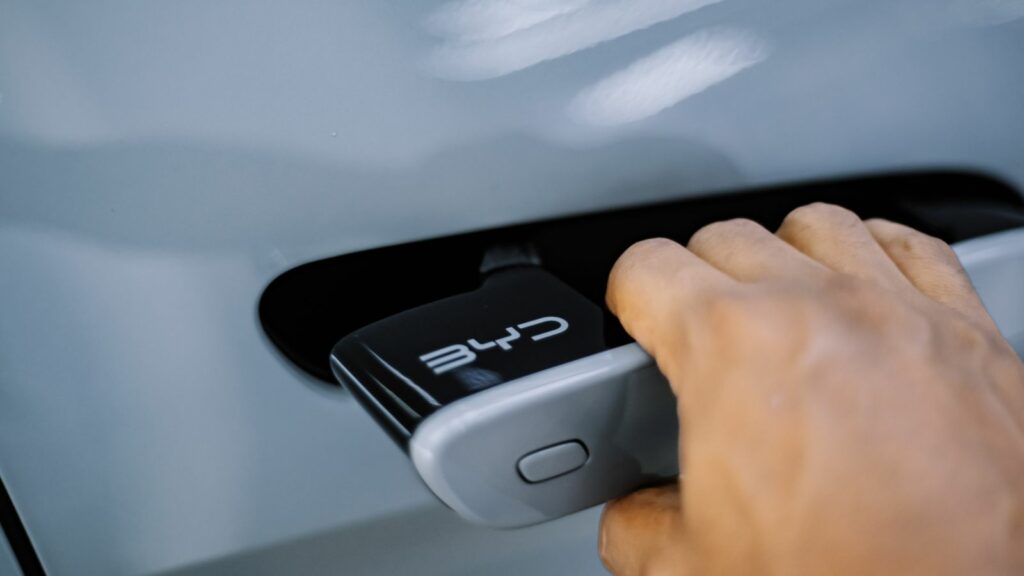
An electric SUV parked in a driveway may soon do far more than wait for the morning commute. BYD and Australian electricity retailer Amber Electric have expanded their vehicle-to-grid partnership to include the Sealion 7, allowing eligible vehicles to supply a home with stored electricity and send power back into the grid.
The September 18 announcement brings BYD’s popular electric SUV into an Australian program already operating at more than 50 sites and now being expanded to 1,000 households with government-backed funding. For households with solar, fluctuating electricity prices and a large EV battery sitting unused for many hours each day, the proposition is compelling: the car becomes both transportation and a substantial energy-storage asset. The larger trial will test whether that idea works reliably and economically at something closer to real-world scale.
Sealion 7 Joins Australia’s Biggest Live Residential V2G Program
The Sealion 7 becomes the second BYD model formally supported in Amber Electric’s vehicle-to-grid program, joining the Atto 3. Amber says more than 50 V2G installations are already operating and that more than 8,000 people have joined its waiting list. The Australian Renewable Energy Agency is providing an additional A$13.6 million to expand the V2G component from 50 households to 1,000. ARENA says the extra commitment brings its total support for Amber’s broader EV-charging project to A$16.8 million. That makes the expansion more than a modest technology demonstration; the goal is to find out how V2G behaves across hundreds of actual homes, cars and daily routines.
The Sealion 7 significantly broadens the potential participant pool. Australian sales data compiled from VFACTS and Electric Vehicle Council figures shows more than 30,000 Sealion 7s have been sold since the model arrived in 2025. In August 2026 alone, 2,213 were delivered, making it Australia’s second-best-selling battery-electric vehicle for the month and sixth among vehicles of all powertrains. Instead of testing bidirectional charging around a rare specialist model, Amber can now work with an EV already appearing regularly in suburban driveways.
An 82.56kWh Car Battery Becomes Household Energy Storage
Both Australian Sealion 7 variants use an 82.56kWh BYD Blade Battery. That capacity is several times greater than many dedicated residential batteries, which helps explain the interest in connecting EVs more deeply to household electricity systems. A car arriving home with substantial charge remaining could theoretically hold enough energy to cover a large amount of normal household consumption, although the actual usable amount depends on driving requirements, minimum battery settings, system losses and the limits imposed by the V2G program.
The process is more sophisticated than the Sealion 7’s existing vehicle-to-load feature. V2L, already standard on the SUV, can run individual appliances through an adapter. V2G requires compatible bidirectional charging equipment that can move electricity in both directions between the vehicle and an approved electrical installation. Amber’s system can charge the car when rooftop solar is abundant or grid electricity is inexpensive, then discharge it to help supply the house or export power when electricity is more valuable. Owners can retain a minimum charge level and set a required departure time, helping ensure tomorrow morning’s drive does not become secondary to tonight’s electricity trading.
The Financial Case Depends on Buying Low and Exporting High
Vehicle-to-grid economics revolve around timing. Solar-heavy electricity systems can experience periods when power is inexpensive during the day, followed by much tighter conditions during the evening as solar generation drops and household demand remains high. A bidirectional EV can absorb electricity during the cheaper period and return some of it later. Amber exposes customers to wholesale electricity prices and uses automation to manage charging and discharging, meaning the financial benefit can become unusually large when wholesale prices spike.
Early results provide striking examples, though they should not be treated as guaranteed savings for every household. Amber says one Victorian participant eliminated the electricity cost associated with charging the EV and recorded an additional A$1,200 in savings over 12 months. A South Australian participant reportedly earned about A$500 during a single afternoon when electricity prices surged during a heatwave. Amber has also modelled optimised V2G at around A$2,500 a year in potential value under New South Wales conditions. Real returns will vary considerably with electricity prices, solar production, driving habits, location and how often the car is available to the system.
BYD Is Addressing Two of V2G’s Biggest Consumer Barriers
Manufacturer support matters because bidirectional charging places the traction battery into a role beyond ordinary driving. BYD says eligible Sealion 7 owners participating in the Amber program retain battery warranty support for V2G operation. That is an important distinction: the arrangement applies to vehicles participating in the approved program and should not be interpreted as blanket BYD approval for every third-party bidirectional charger or independently configured V2G installation.
BYD and Amber are also using vehicle discounts to lower the financial hurdle for new participants. Eligible buyers can receive six per cent off the base recommended retail price, including GST, on the Sealion 7 Premium and Performance as well as qualifying Atto 3 variants. Published program pricing puts the Sealion 7 Premium at A$49,811 after the discount, compared with a base RRP of A$52,990, while the Performance falls from A$63,990 to A$60,151 before on-road costs. Specialist EV publication Zecar reports a standard A$2,990 program cost covering a single-phase StarCharge Halo charger and installation, although site-specific electrical work can alter installation expenses.
One Thousand Cars Could Form a Surprisingly Large Distributed Battery
The scale becomes clearer when the Sealion 7’s battery is multiplied across the trial. If 1,000 participating vehicles each had an 82.56kWh battery, their combined nominal storage would equal roughly 82.6 megawatt-hours. In practice, nowhere near all of that energy would necessarily be available simultaneously because vehicles will have different charge levels, some will be away from home and owners need to retain energy for driving. Still, the calculation illustrates why energy planners increasingly view EVs as potential grid resources rather than simply another source of electricity demand.
CSIRO research has already demonstrated CCS2-based V2G in Australian conditions, showing that compatible EVs can absorb surplus rooftop-solar electricity and return energy during higher-demand periods. The potential value increases as more renewable generation enters the grid. Thousands of individually modest batteries can collectively shift energy from periods of abundance into periods of scarcity. ARENA’s expanded Amber project is designed partly to examine whether this distributed model can operate at scale, coordinating customers, vehicle manufacturers, electricity networks, charging hardware and software rather than relying on ideal laboratory conditions.
Australia Is Still Working Through the Rules and Hardware
The technology may work, but connecting thousands of bidirectional vehicles to an electricity network involves far more than plugging them into ordinary wallboxes. Australian government research published in 2026 identified product availability, technical standards and network connection policies among the barriers to V2G and vehicle-to-home adoption. Building type, strata arrangements, insurance requirements and differences between jurisdictional regulations can complicate installations further. That means a homeowner with a technically compatible EV cannot automatically assume that V2G is available at a particular property.
Regulation is moving, however. Australia’s Energy and Climate Change Ministerial Council endorsed a Consumer Energy National Technical Regulatory Framework on September 11, 2026. It provides for a national technical code covering consumer-energy equipment including inverters and EV supply equipment. Meanwhile, government guidance continues to stress that only some EV-and-charger combinations have manufacturer-confirmed V2X support. Those details make the 1,000-home Amber project particularly useful. Large-scale field experience can expose connection problems, hardware incompatibilities and customer issues that smaller demonstrations cannot easily uncover before V2G becomes a mainstream retail product.
Battery Wear Remains a Real Question, Not a Reason to Ignore V2G
Sending electricity in and out of an EV battery adds cycling, so concerns about long-term degradation are understandable. The effect, however, depends heavily on how the battery is managed. A peer-reviewed 2025 study in Applied Energy modelled EV batteries under different driving and V2G scenarios over a decade. It found that V2G increased degradation compared with driving alone, with the additional cycling changing the degradation profile and requiring sufficient financial compensation to make the service economically worthwhile. The researchers also found calendar ageing remained a major contributor to total battery degradation.
That research was not conducted specifically on the BYD Sealion 7, so its numerical results should not be treated as a prediction for BYD’s Blade Battery. It does demonstrate why manufacturer involvement is important. Software can restrict state-of-charge ranges, manage discharge rates and preserve enough energy for transportation, while warranty arrangements determine who bears the risk if additional cycling affects battery health. For an owner, V2G therefore is not simply a question of how much electricity can be sold. The meaningful calculation weighs revenue and household savings against battery usage, charging equipment, daily mobility and long-term ownership plans.
The Sealion 7 Could Move V2G From Experiment to Everyday Technology
Timing may be one of the most significant parts of BYD’s announcement. Electric vehicles accounted for 25.6 per cent of Australian new-vehicle sales in August 2026 according to Electric Vehicle Council data, putting battery-electric vehicles ahead of petrol and diesel individually for the month. The Sealion 7 itself has become one of the country’s highest-volume EVs. That creates a very different environment from earlier V2G demonstrations involving only small numbers of specialist vehicles and difficult-to-source chargers.
The real test now is whether hundreds of ordinary households can use the technology without reorganising daily life around the electricity grid. Cars still need to be ready for school runs, commutes and weekend trips. Installations must work safely, software needs to make thousands of small decisions automatically, and savings must be meaningful after equipment and electricity costs. If Amber’s 1,000-household rollout delivers those outcomes, the Sealion 7 could illustrate a broader change in what an electric vehicle represents. The expensive battery purchased for transportation could spend its parked hours helping run the house, absorbing excess solar and supporting the wider electricity system.
