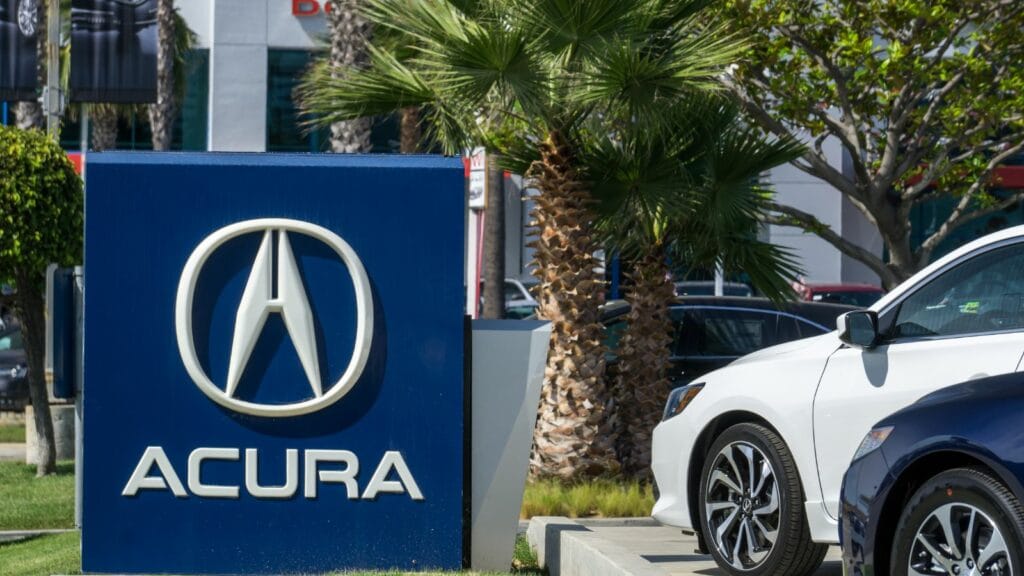
Acura is preparing one of the biggest expansions in its history, confirming plans for three SUVs that could reshape its Canadian lineup. The most ambitious is an eight-passenger flagship that will become the largest SUV the brand has ever developed, offering more seating capacity than the current seven-passenger MDX.
Announced on October 13, 2026, the strategy also includes a rugged adventure-focused SUV arriving in early 2028 and an entirely redesigned RDX featuring Acura’s first two-motor hybrid powertrain.
The announcement signals a shift toward larger family vehicles, outdoor capability, and improved fuel efficiency. With Canadian sales of several existing Acura models already climbing, the company is betting that a broader selection of premium SUVs will help it attract new customers while keeping established owners within the brand.
Acura’s Eight-Passenger Flagship Will Be Its Biggest SUV Ever
The largest vehicle in Acura’s upcoming expansion is an all-new eight-passenger SUV designed to sit above the MDX. Acura confirmed that the model is under development, describing it as an answer to growing demand for spacious premium family vehicles. Unlike the MDX, which accommodates seven occupants, the future flagship will provide room for an additional passenger. That makes it a significant departure for a company whose SUV lineup has traditionally focused on compact and midsize luxury vehicles.
However, Acura has not disclosed the new flagship’s official name, exterior dimensions, engine specifications, or Canadian starting price. It has also avoided committing to a specific launch date. The announcement establishes the vehicle’s place in the lineup rather than unveiling a finished production model. For larger Canadian families, the promise is nevertheless appealing. A premium SUV capable of carrying eight people could accommodate children, relatives, and additional passengers without requiring households to move into a different automotive brand.
The New Flagship Will Give MDX Buyers More Room to Grow
The existing MDX provides a useful starting point for understanding Acura’s ambitions. The 2026 Canadian model offers three rows of seating, a removable second-row middle seat, and a one-touch sliding mechanism to improve access to the back. Standard versions use a 3.5-litre V6 producing 290 horsepower, while the MDX Type S Ultra employs a turbocharged 3.0-litre V6 generating 355 horsepower. Acura also offers premium amenities including available massaging front seats, a 12.3-inch touchscreen, and an advanced Bang & Olufsen sound system.
The eight-passenger SUV will need to justify its position above this already well-equipped vehicle. Additional seating alone may not be enough for families who regularly travel with luggage, sports equipment, or camping supplies. Third-row legroom, cargo capacity with every seat occupied, and easy passenger access could become important selling points. Acura has not yet revealed those measurements, so claims that the newcomer will provide substantially greater usable interior space remain unverified. Its confirmed advantage, for now, is seating capacity.
An Adventure-Ready Acura SUV Is Scheduled for Early 2028
Another important addition will target drivers who want luxury without sacrificing outdoor capability. Acura confirmed that a new adventure-ready SUV is scheduled to arrive during the first half of 2028, marking an expansion into a segment the company does not currently serve with a dedicated model. The automaker promises modern styling, premium comfort, technology, and the capability needed for outdoor activities. It also released a teaser showing a wheel and rugged-looking tire kicking up dirt, offering an early indication of the vehicle’s intended personality.
The announcement has naturally invited comparisons with Honda’s Passport TrailSport. The updated 2027 Passport, already arriving at Canadian dealerships, features specially developed off-road equipment, all-wheel drive, and 245 millimetres of ground clearance. Automotive publications have suggested Acura could use a similar approach, potentially adding more luxurious materials and equipment. However, Acura has not confirmed that its new SUV will share the Passport’s platform, suspension, engine, or off-road specifications. Those possibilities remain informed speculation rather than announced product details.
The Fourth-Generation RDX Will Introduce Two-Motor Hybrid Technology
The third confirmed model is the next-generation Acura RDX, scheduled to reach the market in 2028. It represents a particularly important shift because it will become the first Acura vehicle to use Honda’s new two-motor hybrid-electric system. Acura initially announced the project in January 2026, explaining that the redesigned compact luxury SUV would help establish a broader powertrain strategy. The company also said production of the outgoing third-generation RDX would be suspended during the first half of 2026 to prepare for the transition.
The RDX has been a familiar name among North American luxury SUV buyers since its 2007 model-year introduction. According to Acura, approximately 850,000 units were sold across its first three generations in North America. The upcoming hybrid therefore carries substantial expectations. It will need to deliver the responsiveness associated with Acura while offering improved efficiency for everyday driving. Exact horsepower, battery capacity, fuel consumption, and Canadian pricing have not yet been announced. Importantly, this will be Acura’s first application of the new two-motor system, not its first hybrid vehicle ever: the company previously offered a three-motor MDX Sport Hybrid.
A New V6 Hybrid Could Bring More Power and Towing Capability
Acura is developing another major piece of technology alongside its new SUVs: a V6 hybrid powertrain intended for larger vehicles in the D-segment. According to the company’s October announcement, the system is being engineered to deliver responsive performance, stronger towing capabilities, and improved efficiency. The combination suggests Acura wants to preserve the power and driving character associated with its larger vehicles while reducing the fuel-consumption compromises traditionally associated with powerful gasoline engines.
Honda’s broader development plans provide additional context. In May 2026, the manufacturer confirmed that larger hybrid vehicles using newly developed V6 engines, electric drive units, and battery technology were planned for North America beginning in 2029. However, Acura has not explicitly confirmed which of its three upcoming SUVs will receive the V6 hybrid. It has also withheld horsepower, fuel consumption, towing ratings, and Canadian pricing. Those unanswered questions matter to households planning to tow boats, campers, or recreational equipment, where real-world capability can be as important as luxury appointments.
Honda’s Hybrid Strategy Is Becoming More Important
Acura’s upcoming vehicles are part of a much larger shift within Honda. On October 9, 2026, the parent company announced that its next-generation electrified powertrain would carry the name Honda Hybrid, with the first global applications arriving in 2027. Honda plans to introduce 15 next-generation hybrid models worldwide by the end of its fiscal year in March 2030, concentrating much of that expansion in North America. The technology builds on Honda’s existing two-motor system while introducing improvements to engine efficiency, powertrain packaging, and vehicle control.
Honda has set an objective of improving fuel efficiency by more than 10% in its next-generation hybrids while reducing hybrid-system costs by approximately 30%. Those are development targets rather than confirmed results for the future Acura RDX. The company is also working on an electric all-wheel-drive system and a new vehicle platform intended to balance lighter construction with improved handling. This approach gives Acura a way to offer electrification without requiring every customer to adopt a fully battery-electric vehicle. For Canadian households without convenient home charging, conventional hybrids could remain especially practical.
Canada’s Strong SUV Market Makes the Expansion Timely
Acura’s decision to prioritize SUVs reflects the direction of Canada’s automotive market. Statistics Canada reported that trucks accounted for 88% of new motor vehicle sales in 2025, a category that includes SUVs, minivans, pickups, commercial trucks, and buses. Although that figure should not be interpreted as an SUV-only market share, it illustrates how far buying preferences have shifted away from traditional passenger cars. Canadians increasingly have access to a broad selection of crossovers and larger utility vehicles across mainstream and premium brands.
For many households, practicality is a deciding factor. A family transporting children to hockey practice may prioritize cargo space and easy access to the back seats, while another planning weekend trips to a cottage might value all-wheel drive and towing capability. Acura’s strategy attempts to address both situations without abandoning the premium experience associated with the brand. The eight-passenger SUV targets families needing more seating capacity, while the adventure-focused model is intended for customers seeking greater versatility outdoors. The hybrid RDX, meanwhile, offers a different balance of manageable size, performance, and efficiency.
Acura’s Canadian Sales Are Already Showing Encouraging Signs
Acura is not entering this expansion from a position of complete stagnation. According to the company’s October 13 announcement, Canadian Integra sales increased 81% during the first nine months of 2026 compared with the same period in 2025. Sales of the larger MDX rose 18%, suggesting that interest in Acura’s established three-row SUV remains healthy. The recently introduced ADX premium compact SUV also contributed to the company’s momentum, recording more than 3,000 Canadian sales between January and September.
These figures help explain why Acura is pursuing a broader lineup rather than concentrating on a single flagship. The Integra appeals to customers seeking a smaller, sportier vehicle, while the ADX provides an entry point into luxury SUV ownership. The RDX and MDX serve buyers with different passenger and cargo requirements. Adding rugged and larger family-oriented options could help keep customers within Acura as their transportation needs change. Acura will celebrate its 40th anniversary in Canada in 2027, and its network of more than 50 dealerships provides an established foundation for introducing the vehicles when they become available.
Established Luxury SUVs Will Present Tough Competition
Acura’s largest-ever SUV will enter a market where several manufacturers already offer spacious premium alternatives. The 2026 Infiniti QX80, for example, accommodates eight passengers in its LUXE configuration and provides three rows of seating. The Lexus TX is another established competitor, offering six- and seven-passenger configurations alongside gasoline and hybrid powertrains. These models demonstrate that buyers looking for comfortable transportation for larger families already have options, making Acura’s eventual combination of price, passenger space, and equipment particularly important.
Competition will also be intense for the adventure-ready SUV. The Lexus GX combines a body-on-frame design with available off-road equipment, while Honda’s own Passport TrailSport offers dedicated trail-oriented features. Acura’s challenge will be finding a distinctive position between conventional luxury crossovers and more specialized off-road vehicles. Neither higher ground clearance nor an upscale interior automatically guarantees success. Customers will likely compare ride comfort, traction systems, towing capability, durability, technology, and long-term ownership costs. Until Acura reveals the specifications and pricing of its new vehicles, meaningful value comparisons with these established alternatives will remain preliminary.
Canadian Buyers Will Have to Watch Different Launch Timelines
The three vehicles share a development strategy, but their schedules are not identical. Acura has confirmed that the adventure-ready SUV is expected in the first half of 2028, while the fourth-generation RDX Hybrid is scheduled to reach the market during 2028. The eight-passenger flagship remains under development without an official launch date. Some automotive publications have suggested a possible arrival around 2029 or 2030, but those estimates should not be mistaken for a manufacturer commitment. Canadian specifications, trim levels, pricing, and delivery dates have not been finalized publicly.
There is another distinction worth considering: Acura is not introducing three entirely new nameplates. The RDX Hybrid replaces an existing model, while the adventure-focused SUV and eight-passenger flagship will expand the company’s coverage into additional categories. Together, these projects represent a meaningful change in how Acura intends to serve Canadian buyers. The coming years will determine whether the company can translate its ambitions into competitive products that deliver genuine practicality, dependable performance, and premium features. For now, the strongest confirmed development is that Acura’s future will include more SUVs, greater seating capacity, and a much larger role for hybrid technology.
