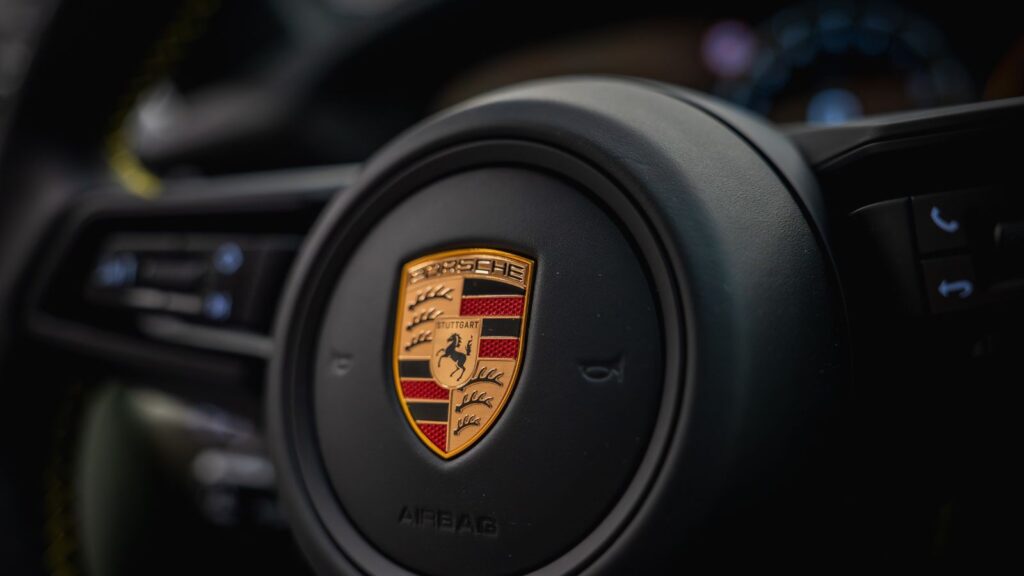
Porsche is preparing to put a new sports car above its most famous model. At a New York unveiling on October 15, 2026, the German automaker introduced the Mission S, a dramatic mid-engine concept previewing a permanent supercar family positioned higher than the 911.
The planned architecture is being designed to accommodate gasoline engines, conventional hybrids and plug-in hybrids, although Porsche has not finalized which powertrains will reach customers. A fully electric version is not currently planned.
The reveal is about more than speed: Porsche is reworking its business around exclusivity and higher-value vehicles during a difficult period for sales and profitability. The Mission S offers a glimpse of how that strategy might look—and how it might feel from behind the wheel.
Porsche Is Planning a Permanent Flagship Above the 911
For decades, the 911 has anchored Porsche’s sports-car identity, even when more exotic machines appeared for limited periods. The Mission S announcement changes that hierarchy. Porsche says it is developing a dedicated mid-engine super-sports-car platform intended to support a model line above the 911, rather than a single collectible hypercar with a predetermined production run. Chief executive Michael Leiters described the planned addition as permanent and versatile. That is a significant commitment of direction, although the company has shown a concept rather than a production-ready car with finalized specifications.
A permanent model line could eventually support different versions, technologies and performance levels instead of asking every buyer to compete for one exceptionally small edition. Porsche has not released a production allocation, a final name or details of how many versions are intended. What it has confirmed is the ambition to make this new class of mid-engine supercar a continuing part of its portfolio.
A New York Pier Connects the Mission S With Porsche’s Past
Porsche chose an unusually meaningful location for the Mission S’s world premiere: a pier in Queens overlooking the Manhattan skyline. In 1953, images of the mid-engine Porsche 550 Spyder were taken at the same site and circulated internationally. The original 550 helped establish the German manufacturer’s reputation for compact, competition-influenced sports cars. By returning to that waterfront more than seven decades later, Porsche framed its newest concept as a continuation of a familiar idea, not simply an expensive experiment detached from the brand’s history.
That setting also provided a fitting stage for the Mission S’s proportions. Its cabin sits forward, with the engine positioned behind the occupants but ahead of the rear axle. The result is a low, wide silhouette that looks different from the rear-engined 911 while remaining recognizable as a Porsche. The historical reference does not mean the new car will reproduce the 550’s dimensions or construction. Instead, it communicates a design ambition: make the driving experience central even as performance technology becomes more complicated.
The Mid-Engine Layout Gives Engineers a Different Starting Point
Since its introduction in 1963, the 911 has kept its engine at the rear, a distinctive arrangement Porsche continues to emphasize. A mid-engine car places the powerplant between the axles, typically behind the occupants, helping keep a substantial share of its mass near the centre of the chassis. That arrangement can support quick changes of direction and balanced handling, although suspension tuning, tyres, weight and aerodynamics ultimately determine what a finished vehicle feels like.
Porsche is hardly new to the idea. The 550 Spyder, 914, Boxster and Cayman all contributed to its mid-engine history, while the company’s 718 models have long promoted their low and central centre of gravity. What makes Mission S different is its intended position above the 911, not merely the location of its engine. The new architecture allows Porsche to develop a flagship without rewriting the 911’s defining rear-engine layout. For drivers, that could mean two distinctly different kinds of high-performance Porsche rather than one replacing the other.
Gasoline and Hybrid Systems Are Possible, but Trims Are Unconfirmed
Porsche executives have told automotive journalists that the planned Mission S architecture can accommodate a gasoline-only engine, a conventional hybrid or a plug-in-hybrid system. That flexibility is central to the announcement, but it should not be mistaken for a confirmed three-model launch range. A conventional hybrid and a plug-in hybrid would also serve different purposes, even if both combine an engine with electric assistance.
A hybrid system can provide extra torque and more immediate acceleration, while a plug-in version may add a battery capable of charging externally and travelling some distance on electricity alone. Either approach adds packaging, cooling and weight considerations to a car designed around precise handling. Porsche has already demonstrated high-performance hybrid engineering in the 918 Spyder and today’s 911 T-Hybrid models. For now, however, the exact hardware planned for its new flagship remains confidential. The confirmed development is an adaptable platform, not a published specification sheet for multiple showroom-ready supercars.
The Engine Rumours Are More Detailed Than Porsche’s Disclosures
An eight-cylinder powerplant is among the possibilities circulating in automotive reporting, with speculation ranging from a flat-eight to a V-8 design. Neither engine configuration has been officially announced for the production supercar. A teaser showing an 8,000-rpm marking on the Mission S’s tachometer has also attracted attention, but a number on a concept instrument does not establish the rev limit of a future production engine.
Other questions remain unanswered: horsepower, torque, vehicle weight, acceleration, maximum speed and even the final transmission choices. MotorTrend reports that Porsche is engineering the platform to support two- or three-pedal configurations, leaving manual and automatic possibilities open. That is intriguing for drivers who value involvement, but it is not a promise that a manual gearbox will be sold. The most useful way to read the early disclosures is as a statement about engineering freedom. Until Porsche announces tested specifications, any claimed performance advantage over a particular rival would be speculation.
The Exterior Draws From the GT1, 959, 917 and 928
The Mission S’s styling combines several recognizable Porsche references instead of copying one historic model. Its round headlights and muscular front fenders recall the 911, while its low nose draws inspiration from the 911 GT1. The roofline flows toward an integrated active rear wing with echoes of the 959, and the rear’s layered treatment also references the GT1. Over the engine compartment, a prominent cooling feature recalls the horizontal fan associated with Porsche’s 917 racing car. Even the unusual, almost disc-like wheels borrow ideas from the 928.
Porsche’s design team, led by Tobias Sühlmann, describes the concept as a preview of a broader design identity that will influence future cars. A continuous line links the lighting elements around the body, while wide surfaces and visible technical details give the vehicle a distinctive stance. The concept’s active wing and cooling features signal performance priorities, but Porsche has not confirmed their precise production forms. What can already be judged is the effort to make a radical flagship recognizably Porsche.
A Screen-Light Cabin Brings the Driver Back to the Centre
Inside the Mission S, Porsche has resisted the trend toward enormous dashboard displays. There is no permanently integrated centre infotainment screen or fixed passenger display. Instead, the concept uses a retractable smartphone holder compatible with MagSafe technology, supported by the My Porsche app when navigation or information is needed. Five rounded instruments sit behind the steering wheel, with an analogue needle on the central rev counter. Porsche says the central gauge can move closer to the driver depending on the chosen driving mode, while surrounding displays change their arrangement.
There are physical controls, a dedicated place for a traditional key to the left of the wheel and seats arranged to create a deep, enclosed driving position. For Porsche, that mix of tactile switches and adaptable digital displays is intended to make the driving experience more intuitive. The final production cabin could change, particularly where safety systems and regional regulations require different equipment, but the underlying design direction is clear: technology should support the drive rather than dominate the dashboard.
It Would Follow Famous Supercars Without Repeating Their Limited Runs
Porsche has launched extraordinary flagships before, but generally as special chapters rather than permanent model families. The Carrera GT entered production in 2003 with a naturally aspirated V-10 and was built in just 1,270 examples before manufacturing ended in 2006. The 918 Spyder followed with plug-in-hybrid technology, combining a V-8 with electric motors for 887 PS. Porsche completed its planned production run of 918 cars in 2015.
The Mission S platform is being presented differently. Porsche says the aim is a continuing supercar offering that can evolve rather than disappear after a single numbered run. That does not settle how exclusive the vehicles will be or how many will be produced annually. Even a permanent line could be made in small volumes at very high prices. For collectors, the distinction between a finite numbered edition and a continuing flagship may influence expectations. For Porsche, it offers a way to spread development work across future versions while giving its top performance category a lasting identity.
The Earlier Mission X Shows How Porsche’s Priorities Have Shifted
In June 2023, Porsche unveiled the Mission X, an all-electric hypercar concept with dramatic upward-opening doors and a battery placed behind the seats. The manufacturer described ambitious targets that would apply if it reached production, including a 900-volt electrical system and an exceptionally strong power-to-weight ratio. Mission X was a design and technology study, not a car Porsche committed to sell. Three years later, the Mission S points in a different direction: a mid-engine flagship designed around combustion and potentially hybrid powertrains rather than a battery-electric-only future.
Porsche executives now say there is insufficient demand for a fully electric offering in this particular ultra-high-performance segment, according to interviews with Car and Driver and MotorTrend. That is a statement about the intended new flagship, not a withdrawal from electric vehicles generally. Porsche’s October strategy still includes electric replacements for the 718 Boxster and Cayman, alongside continued battery investment. The contrast between the two concepts illustrates how quickly market expectations can reshape even an expensive, highly specialized vehicle program.
Slower Sales Have Made High-Margin Models More Important
Porsche’s new supercar is emerging during a difficult commercial period. The manufacturer delivered 178,532 vehicles worldwide during the first nine months of 2026, down 16% from 212,509 in the comparable 2025 period. Deliveries in China fell 33%, while North America declined 13%. At the same time, the company reported stronger demand for its 911 and higher-end variants.
Its strategy, called Sportwagenschmiede ’35, sets out a plan to improve margins by simplifying the model range and expanding higher-value offerings. Porsche wants roughly 20% fewer variants and aims to increase the average selling price of top-end models by about 20% over the medium term. It has also set a target for group operating return on sales of 10% to 15% in that period. These are corporate ambitions, not proven results from Mission S. Nevertheless, a new flagship can fit this strategy by commanding higher prices and supporting profitable customization if it attracts enough buyers.
The 911 Remains Central Even With a New Car Above It
A supercar positioned above the 911 does not make the familiar model obsolete. Porsche reported 42,217 worldwide 911 deliveries in the first nine months of 2026, an increase of 12% despite the company’s overall sales decline. Porsche’s strategic presentation specifically promised additional 911 versions even as it announced development of the new mid-engine platform. The message is expansion at the top of the range, not a plan to retire the model that has defined the brand for more than six decades.
Technology is advancing within the 911 lineup too. The latest Turbo S uses Porsche’s T-Hybrid system, combining a 3.6-litre boxer engine with electrically assisted turbochargers and an integrated electric motor to produce 711 PS. The Mission S may offer a different chassis balance and a more exclusive ownership experience, but Porsche has provided no final acceleration or lap-time figures to establish a performance ranking against its future 911 derivatives. The two lines are intended to serve different roles.
Price, Launch Timing and Canadian Availability Are Still Unknown
Porsche has not announced a retail price, production date, order-opening schedule or final name for the Mission S-derived supercar. Automotive journalists have offered projections, including a possible starting price around US$500,000 and a debut no earlier than 2029, but those are estimates rather than factory commitments. The company has also not given a Canadian price, allocation or confirmed availability. Prospective buyers should be cautious about interpreting the October concept reveal as evidence that a finished vehicle can already be reserved through a local dealer.
Porsche must finalize its powertrains, validate the bespoke architecture, confirm the cabin and exterior for production, and determine where and how the vehicle will be manufactured. The most significant news is already clear: Porsche wants a permanent flagship above the 911, engineered around the driver rather than an all-electric mandate. What remains unknown is exactly how that ambition will translate into the first cars customers can actually own.
