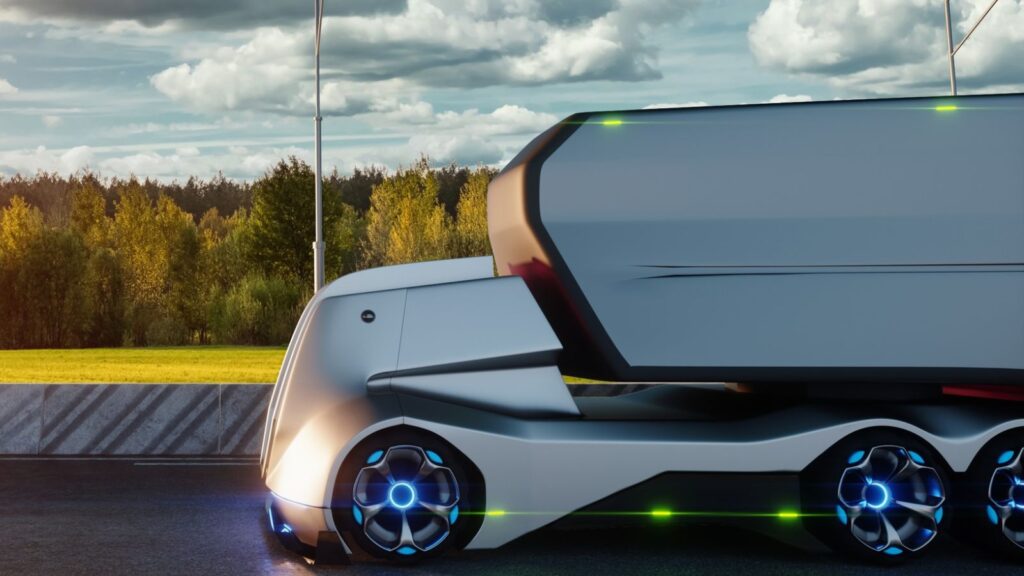
A driverless freight truck may soon have an artificial-intelligence system capable not only of suggesting what to do next, but explaining why it reached that decision. Swedish autonomous-trucking company Einride is expanding its partnership with Nvidia to evaluate the chipmaker’s Alpamayo reasoning technology inside its autonomous driving system.
The companies plan to work toward a live-road evaluation during the second half of 2027. Before that happens, Nvidia’s AI will be tested in a deliberately cautious way: it will observe real driving situations and generate decisions without controlling the vehicle.
The agreement builds on an Nvidia partnership announced only a month earlier and comes as Einride puts cab-less electric trucks into real freight operations in Europe and the United States. The goal is ultimately bigger than one test vehicle—Einride wants reasoning-based AI to help it introduce autonomous freight onto more routes and more types of trucks without rebuilding its driving technology from scratch each time.
Nvidia’s Alpamayo Is Joining the Einride Driver
Einride announced on October 21 that it will evaluate Nvidia Alpamayo as part of the Einride Driver, the autonomous-driving system at the centre of its driverless-truck operations. The Swedish company says it intends to become the first trucking company to deploy Alpamayo on Nvidia’s Hyperion autonomous-vehicle platform. A live-road evaluation is targeted for the second half of 2027, although neither company has announced a location, exact route or commercial launch date for the new technology.
The latest agreement expands a broader partnership unveiled on September 21. Under that earlier arrangement, Einride committed to developing the next generation of its driving system using Nvidia Hyperion and associated AI and safety technology. The new step adds a reasoning model that Einride hopes will make its system easier and less expensive to adapt to different vehicles and operating environments. Importantly, the announcement does not mean Nvidia is replacing Einride’s autonomous-driving software. Einride will continue designing, validating and operating its own system while using Nvidia technology underneath and alongside it.
Alpamayo Is Designed to Explain Why a Vehicle Makes a Decision
Most people experience driving as a constant chain of judgments: a pedestrian approaches a crossing, traffic slows ahead, a vehicle begins drifting toward another lane. Alpamayo is Nvidia’s attempt to give autonomous-driving developers an AI model that can process those situations while producing both a proposed trajectory and an explanation of the reasoning behind it. Nvidia describes Alpamayo as a family of vision-language-action models built specifically for advanced autonomous-vehicle development.
That ability to explain decisions is particularly interesting for safety testing. Instead of seeing only that an AI system chose to brake or change direction, engineers can examine the causal reasoning it generated alongside the proposed movement. Nvidia calls this approach “Chain of Causation.” Its Alpamayo family includes models, simulation technology, development tools and driving datasets intended for Level 4 autonomous systems. The most advanced publicly released version, Alpamayo 2 Super, is a 34-billion-parameter model. Einride has not said that a particular Alpamayo version will independently drive its trucks, and its own safety architecture will remain responsible for vehicle control.
The AI Will Start in Shadow Mode Rather Than Taking the Wheel
One of the most important details in the agreement is what Alpamayo will not initially do. Einride plans to operate the technology in “shadow mode,” meaning the model will run during real operations but will not control steering, acceleration or braking. It can examine what is happening, produce its own proposed response and explain that response, while Einride’s existing autonomous system—or a human driver during applicable testing—continues to operate the vehicle.
Engineers can then compare the model’s output with what actually happened. If the Einride Driver slows for merging traffic while Alpamayo proposes maintaining speed, developers can investigate why the systems disagreed without placing Alpamayo’s decision directly into control of a moving truck. Einride says it will post-train and distill the Nvidia technology using proprietary information collected from its freight operations. Shadow testing therefore becomes both an evaluation tool and a way to adapt a general autonomous-driving model to the specialized circumstances of trucking before considering a deeper role in the production driving system.
The 2027 Road Test Is an Evaluation, Not an Immediate Driverless Rollout
The phrase “driverless-truck trial” can suggest a completely experimental vehicle heading onto public roads for the first time. Einride is considerably further along than that. The specific 2027 milestone concerns the live-road evaluation of Alpamayo within Einride’s broader system. The company already operates Level 4 autonomous trucks in commercial and contracted freight environments. What remains unproven is how Nvidia’s reasoning technology will perform when adapted to Einride’s trucks, freight routes and safety architecture.
That distinction also means there is no announced date when Alpamayo will begin independently controlling customer freight operations. Einride says the project is building toward a live-road evaluation in the second half of 2027, but regulators, routes, operating conditions and validation requirements could all influence what happens afterward. The company believes the technology could shorten development cycles and lower the cost of adapting autonomy to additional vehicle platforms. Whether it achieves those goals will depend on measurable performance—not simply the model’s ability to produce convincing explanations. For autonomous trucking, a decision must ultimately be safe, repeatable and suitable for the conditions in which the truck is authorized to operate.
Hyperion Gives Einride the Computing Backbone Behind the AI
Alpamayo is only one part of Einride’s Nvidia strategy. The company’s next-generation autonomous-driving system is being developed on Nvidia Hyperion, a compute-and-sensor reference architecture intended to support Level 4 autonomous vehicles. Einride plans to modify that architecture for heavy-duty trucking, including the computing, sensor, software and safety requirements associated with freight vehicles. Nvidia supplies the underlying technology, while Einride remains responsible for its autonomous truck system and commercial deployments.
The partnership also reaches into the enormous computing workload required before an autonomous vehicle ever encounters a situation on the road. Einride plans to use Nvidia Blackwell infrastructure to train, test and refine autonomous-driving models. Nvidia Cosmos can be used to search camera data for difficult situations and generate additional synthetic scenarios for training and validation. Nvidia’s Halos technology provides another safety layer spanning hardware, software, AI development and validation. In practical terms, the partnership gives Einride access to a connected development ecosystem rather than simply installing an Nvidia processor in a truck.
Level 4 Does Not Mean a Truck Can Drive Anywhere
Einride describes its autonomous trucks as SAE Level 4 vehicles, but that designation has a more specific meaning than “fully self-driving everywhere.” SAE International’s current automation standard defines Level 4 as automated driving under defined conditions in which a human driver is not required to take over to mitigate risk. The operating system can therefore perform the driving task itself—but only inside the circumstances and operating domain for which it was designed and approved.
That limitation helps explain why freight operations are an attractive early application. A logistics company can repeatedly move goods between known warehouses, distribution centres or stores using controlled routes rather than attempting to handle every road in a country from the first day. Weather, road type, speed, intersections and other conditions can be incorporated into an operational design. Level 5, by contrast, refers to automation capable of driving under essentially all conditions in which a person could drive. Einride is pursuing scalable Level 4 freight, not claiming that its trucks can be dispatched without restrictions to any address on a map.
Einride Already Has a Cab-Less Truck Working for Lidl in Germany
Germany provides one of the clearest examples of what Einride’s driverless strategy looks like outside a test facility. In September 2026, Einride and Lidl put a cab-less Level 4 electric truck into daily logistics operations on a German public road. The vehicle moves goods between a Lidl logistics facility and a store without a driver or safety operator sitting inside it. Germany’s Federal Motor Transport Authority granted a permit for the operation after a safety-validation process.
The companies described it as Germany’s first authorization of its kind for a cab-less Level 4 truck operating in daily public-road logistics. Lidl and Einride plan to expand the initial operation toward a multi-stop delivery arrangement and have discussed further deployments within the wider Schwarz Group. That experience is important for the Nvidia project because Einride can bring real freight data into the development process rather than relying entirely on simulations and demonstration routes. Everyday logistics produces mundane but valuable information—repeated junctions, loading schedules, traffic interactions and operational disruptions—that can expose whether an autonomous system behaves consistently over time.
Two More Driverless Trucks Are Moving Freight Daily in Ohio
Einride is also running autonomous trucks in the United States. On October 6, the company and EASE Logistics announced that two cab-less electric trucks had entered daily freight operations between EASE facilities in Marysville, Ohio. Their routes include company property and local public roads. Nobody rides in the cab, but each truck is monitored by a remote operator who can intervene when necessary.
The operation is part of the Ohio-Indiana Truck Automation Corridor Project, a multi-year initiative involving the Ohio Department of Transportation, DriveOhio and the Indiana Department of Transportation. The project carries a reported value of $8.8 million and is studying automated freight on important transport corridors. Einride and EASE are collecting information including mileage, loads and vehicle uptime to evaluate safety, reliability and operational performance. Remote oversight is a major part of Einride’s model: removing the driver from the truck does not necessarily mean removing people from the operation. Instead, human involvement can move to a remote control environment where operators supervise autonomous vehicles and respond when the system requires assistance.
DAF Is Separately Preparing an Einride-Equipped Truck for 2027 Testing
The Nvidia work coincides with another important 2027 project. Einride has partnered with Dutch truck manufacturer DAF to integrate the Einride Driver into a DAF electric-truck platform. DAF, Einride and Dutch research organization TNO began work on interfaces and validation during 2026. Their published schedule calls for integration and commissioning of Einride’s autonomous software in 2027, followed by interface validation and functional testing using a DAF truck.
That project is separate from the Alpamayo evaluation, but the two efforts illustrate the same strategy. Einride does not want its autonomous technology confined permanently to one purpose-built cab-less vehicle. It is working toward an autonomous system that can be adapted to vehicles from established truck manufacturers and deployed across different freight applications. Nvidia says Hyperion can provide a common technology foundation for that expansion. If Einride can combine a reusable driving system with multiple truck platforms, it could reduce the amount of engineering required for every new deployment. The challenge will be proving that common technology remains dependable when the vehicle, sensors, load characteristics and route conditions change.
Einride Wants to Grow Far Beyond a Handful of Autonomous Trucks
Einride’s autonomous program is part of a much larger freight business. Company filings showed 246 commercial electric trucks and six autonomous trucks deployed under its Freight-Capacity-as-a-Service model as of June 30, 2026. Einride said its contracted autonomous operations had accumulated more than 5,400 driverless hours by the end of the first half, an increase of 64% from the comparable measure it previously reported. Its customers and commercial relationships span North America, Europe and the Middle East.
Management expects its overall operating fleet—not solely autonomous vehicles—to grow to roughly 1,500 to 2,000 trucks by 2028 as existing customer programs expand. Einride estimates that around 80% of the demand captured on its platform could ultimately be suitable for automation in the medium term, although that is a company forecast rather than a guaranteed deployment figure. Its broader fleet expansion also includes hundreds of conventional electric trucks that still require drivers. The importance of Nvidia’s technology is therefore less about one futuristic truck and more about whether autonomy can eventually be applied economically across a meaningful portion of that growing freight network.
Safety Validation Will Matter More Than How Human the AI Sounds
Reasoning models create an intriguing possibility for autonomous driving because their decisions can be examined in language rather than existing only as numbers inside a neural network. That does not automatically make a vehicle safe. An AI system can provide a plausible explanation and still reach an incorrect conclusion. Nvidia’s own autonomous-vehicle platform therefore combines reasoning models with simulation, safety systems, sensor architecture and validation tools rather than treating Alpamayo as a standalone replacement for those layers.
Einride is taking a similar approach. The company says Alpamayo will operate within its own safety architecture, which retains authority over the truck. Its shadow-mode phase is designed to generate comparisons before control responsibility changes. That structure is particularly important in heavy freight, where software must function predictably across repeated commercial operations rather than succeed in a single demonstration. The 2027 road evaluation will therefore be less about whether an AI can describe what it sees and more about whether its proposed decisions consistently meet the safety and performance standards necessary for real logistics.
The Bigger Prize Is Making New Autonomous Routes Cheaper to Launch
The business argument behind the partnership is scalability. Every new autonomous freight route brings different intersections, traffic patterns, road geometry and operating requirements. Every new truck platform introduces another set of sensors, vehicle controls and physical characteristics. If adapting an autonomous-driving system to each combination requires years of bespoke engineering, expanding a driverless freight network becomes slow and expensive. Einride says reasoning-based AI could help shorten those development cycles.
Its proprietary operational data will be used to adapt Alpamayo specifically to freight, while Hyperion provides a more standardized hardware-and-computing foundation. Nvidia’s simulation and training infrastructure can expose models to difficult situations without waiting for all of them to occur during physical road testing. None of that guarantees that regulators or customers will approve deployments more quickly, and the companies have not quantified how much money the Alpamayo project will save. But the goal is clear. The 2027 evaluation is not simply a test of whether an Nvidia AI can ride inside a driverless truck. It is a test of whether smarter, reusable software can help turn autonomous trucking from a collection of tightly controlled routes into a much larger commercial freight network.
