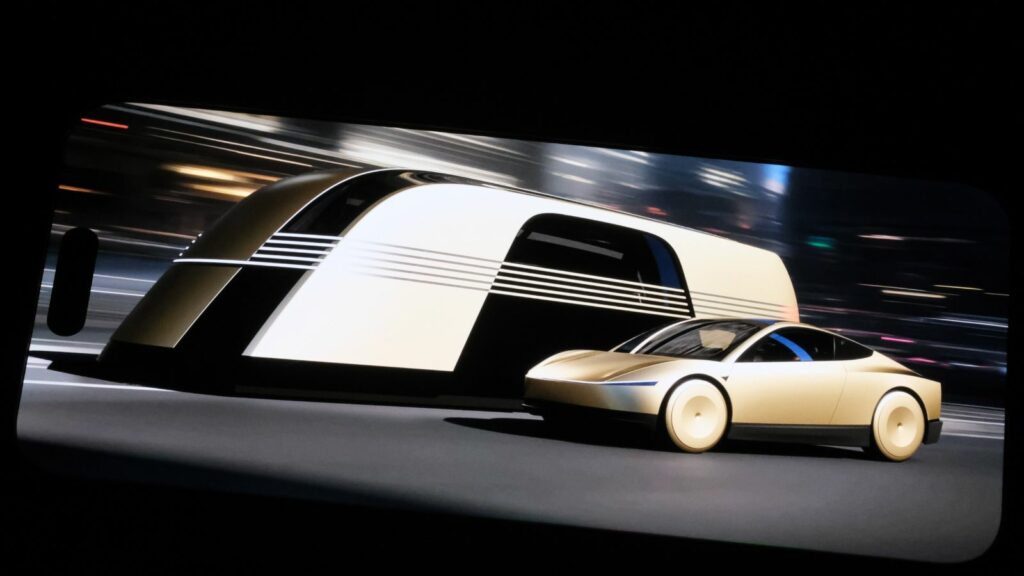
Tesla has put a striking number behind its push into driverless transportation: roughly 3.1 million Robotaxi miles with no reported injuries under the company’s newly published safety metric. The figure covers autonomous operation without an in-vehicle safety monitor from January 22 through October 18, 2026, across six U.S. cities.
The milestone is significant, but the details matter. Tesla is not claiming its Robotaxis have never crashed. It is reporting zero people injured in collisions where its vehicle made first contact, along with zero deployments of a Robotaxi’s own airbags and zero pedestrians or cyclists struck under the same definition. Those distinctions are important as Tesla attempts to prove its driverless technology can move from limited urban deployments to a much larger transportation network.
The 3.1-Million-Mile Claim Is Bigger Than the Headline
Tesla’s newly released Robotaxi Vehicle Safety Report provides its clearest public accounting yet of how its fully driverless fleet is performing. Between January 22 and October 18, the company says its vehicles accumulated approximately 3.11 million miles without an in-car safety monitor. The report covers autonomous operations in Austin, Dallas and Houston in Texas, along with Miami, Orlando and Tampa in Florida.
Tesla reports three particularly notable outcomes over those miles: zero people injured under its defined safety metric, zero deployments of the Robotaxi vehicle’s own airbags and zero pedestrians or cyclists struck where the Robotaxi made first contact. That represents considerably more information than Tesla had previously disclosed about its driverless program. The company also maintains a live mileage estimate, meaning the total displayed on its website can exceed the fixed 3.1-million-mile figure associated with the October 18 reporting cutoff. The safety statistics themselves, however, are tied to the completed reporting period rather than that continuously increasing counter.
What Tesla Actually Means by “Zero Injuries”
The wording behind Tesla’s headline number deserves attention. Its “People Injured” measure counts injuries to anyone inside or outside a vehicle when the Robotaxi made first contact in the collision. That is narrower than simply saying there has never been an injury anywhere in a crash involving a Tesla Robotaxi. Tesla openly explains the distinction in its methodology rather than leaving the definition buried in an unexplained statistic.
One reported multi-vehicle incident illustrates the difference. Tesla says another vehicle struck an SUV, which was then pushed into a Robotaxi waiting at a stop sign. Nobody in the Robotaxi or SUV was injured, although an occupant of the vehicle involved in the original collision was taken to hospital. Tesla does not count that hospitalization in its zero-injury figure because the Robotaxi did not make first contact. In another case, a passenger claimed an injury after a Robotaxi drove over a pothole, but Tesla says its investigation found no associated injury. That incident was also excluded from the injury total.
There Were Collisions — Mostly Low-Speed Ones
Zero injuries should not be confused with zero crashes. Tesla’s downloadable safety data contains dozens of collisions that were reportable under federal automated-driving rules. A review of the file covering no-safety-monitor operation from May 23 through October 18 identified 32 collisions. All but two were classified as property-damage-only events, offering useful context for what happened during the company’s first several million miles of substantially scaled driverless operation.
The circumstances are notable as well. In all but one of those 32 events, the Robotaxi was reportedly travelling at 6 mph or less or was stationary. Sixteen involved another vehicle striking the Tesla, frequently while the Robotaxi was stopped in traffic or at a signal. Other incidents involved low-speed contacts with objects in parking lots or alleys, including chains suspended across entrances. Tesla’s methodology also includes reportable collisions where remote support was assisting or had taken control. The resulting record is therefore more complicated than either “no crashes” or “unsafe robotaxis”: collisions are happening, but the available data indicates that most have so far been low-severity events.
Austin Still Carries Most of the Mileage
Tesla’s 3.1 million miles are not evenly distributed across the country. Austin alone accounts for 2,118,015 miles, or roughly 68% of the total. Dallas ranks second with 608,130 miles, followed by Houston at 225,964. Tesla’s three Florida markets remain much smaller: Orlando has 61,053 miles, Tampa 53,117 and Miami 46,262. Together, the three Texas cities account for about 2.95 million miles.
Tesla has also begun providing information about the conditions in which those vehicles operate. The company reports approximately 862,000 miles after dark and 575,000 miles during weekday rush-hour periods. Another 113,000 miles were classified as driving in rain. Tesla calls the rain total a minimum because it only counts hours in which the relevant city airport weather station recorded rainfall. These figures add useful texture to the mileage total. Millions of miles in warm-weather, geofenced cities are not equivalent to nationwide driving, but the fleet is increasingly encountering darkness, congestion, rain and other everyday conditions rather than accumulating mileage exclusively under ideal circumstances.
Tesla’s Human-Driver Comparison Is Encouraging, but Not Perfect
Tesla estimates that human drivers covering the same 2.95 million miles its Robotaxis travelled in Austin, Dallas and Houston would have been involved in approximately 9.1 collisions with injuries. The company also calculates roughly 4.1 comparable collisions involving deployment of the driver’s vehicle airbag and about 0.52 involving pedestrians or cyclists. Its benchmark draws on Texas crash records and federal vehicle-mile data.
There are legitimate reasons to treat the comparison carefully. Tesla adjusts the human injury benchmark to account for research estimating that about 32% of nonfatal injury crashes are never reported to police. That correction is supported by a National Highway Traffic Safety Administration study, but comparisons between automated and human driving remain challenging because reporting systems are different. There is another methodological mismatch: Tesla’s injury metric requires the Robotaxi to make first contact, while police records generally do not identify vehicles that way, so the human benchmark includes crashes regardless of which vehicle struck first. Tesla itself acknowledges that limitation. The figures are promising, but they are not a controlled experiment proving a definitive safety advantage.
The Fleet Is Scaling Much Faster Than It Was This Summer
The pace at which Tesla is accumulating driverless miles may be as important as the headline total. In its third-quarter update, Tesla said Robotaxi had reached nearly two million cumulative unsupervised miles by September 30. By October 18, the safety report’s city totals had risen to approximately 3.11 million. In other words, more than one million additional miles were added in less than three weeks.
The acceleration becomes even clearer when looking further back. Weekly data associated with Tesla’s safety report indicate that roughly 70% of the 3.1 million miles were accumulated during just seven weeks beginning in late August. Tesla has simultaneously started deploying the purpose-built Cybercab into its Austin fleet rather than relying entirely on Model Ys. The company’s Q3 update says Austin service now operates from 6 a.m. until midnight, with Tesla working to increase fleet supply and improve the software that dispatches vehicles. A strong safety record at a small scale is useful; maintaining it while the number of vehicles, rides and unusual road situations rises rapidly will be the substantially harder test.
Waymo Shows Why More Miles Matter
Tesla’s results become easier to evaluate when placed beside a more mature autonomous fleet. Waymo reported 271.3 million rider-only miles through June 2026 across Phoenix, San Francisco, Los Angeles, Austin and Atlanta. That is close to 90 times the mileage represented in Tesla’s 3.1-million-mile report. Waymo says its vehicles experienced 82% fewer injury-causing crashes and 95% fewer serious-injury-or-worse crashes than its corresponding human-driving benchmarks.
There is also peer-reviewed research behind some of Waymo’s earlier results. A study examining 7.14 million rider-only miles found an injury-reported crash rate of approximately 0.6 incidents per million miles for Waymo compared with 2.8 for its human benchmark. Importantly, Waymo’s current safety analysis counts qualifying collisions regardless of fault rather than limiting injury comparisons to cases where its vehicle made first contact. None of this invalidates Tesla’s early record. It instead illustrates why exposure matters so much in autonomous-vehicle safety. Rare events become easier to measure as hundreds of millions of miles accumulate, while a few million miles can still produce wide statistical uncertainty around exceptionally uncommon serious crashes.
Federal Regulators Are Still Watching Closely
Tesla’s injury statistics arrive while its autonomous program faces significant federal scrutiny. In September, NHTSA opened an Audit Query examining how Tesla determined that its Cybercab complies with applicable Federal Motor Vehicle Safety Standards. The purpose-built vehicle does not have conventional permanently installed controls such as a steering wheel, accelerator or brake pedal, placing it directly in the middle of an evolving regulatory debate over standards originally written around human drivers.
A separate matter opened on October 9 after NHTSA received a defect petition alleging that 2026 Model Y and Cybercab Robotaxis exceeded posted speed limits in active school zones while their automated driving systems were engaged. The agency’s initial document lists four alleged incidents but zero crashes, injuries or fatalities associated with them. Crucially, opening a defect petition does not mean NHTSA has concluded that a defect exists; the agency is evaluating whether a formal investigation is justified. The distinction matters. Tesla’s current collision record can be encouraging while regulators simultaneously examine whether the system consistently obeys traffic laws and whether the Cybercab itself satisfies federal vehicle requirements.
The Next Test Is Expansion, Not Another Headline Number
Tesla’s next challenge is to make the existing safety record survive a far broader deployment. Its Robotaxi service already operates in limited areas of Austin, Dallas, Houston, Miami, Orlando and Tampa, while the new safety page identifies Las Vegas, Phoenix, Jacksonville and San Antonio as markets coming next. Cybercab rides remain considerably more limited, with Austin serving as the initial commercial deployment.
Tesla executives are pushing beyond fleet expansion as well. Following the company’s third-quarter results, engineering chief Lars Moravy said Tesla is aiming to begin getting Cybercabs into customer hands on a limited basis by the end of 2026. Tesla also says Cybercab service is expected to expand to Dallas. Those ambitions make the safety report more than a public-relations statistic. Every new city adds different roads, drivers, weather, construction patterns, emergency vehicles and edge cases. Three million autonomous miles without an injury under Tesla’s stated definition is an encouraging opening record. The stronger evidence will come from whether those zeroes remain intact after tens of millions — and eventually hundreds of millions — more miles.
