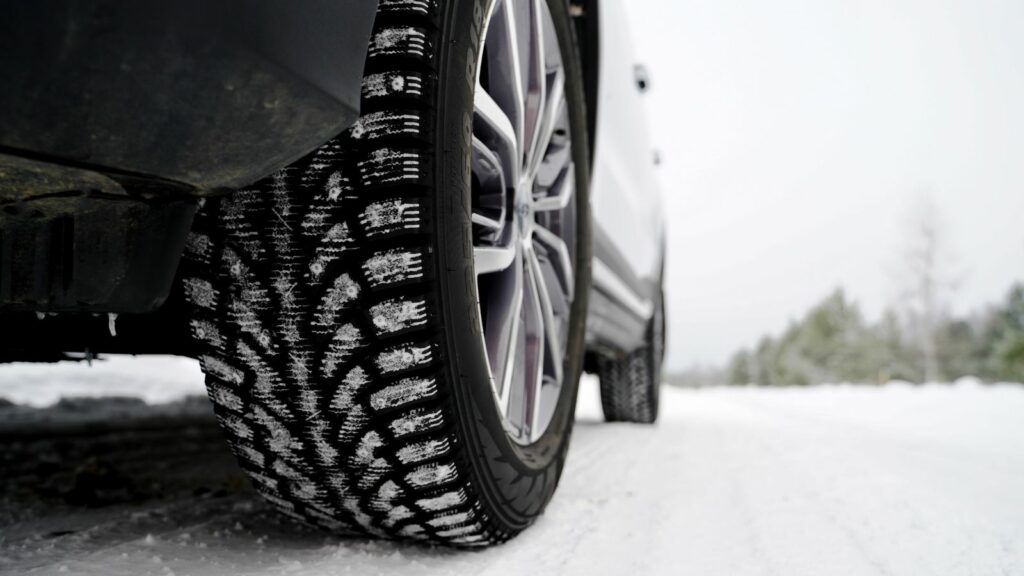
A sheet of polished ice can turn an ordinary winter commute into a careful exercise in braking, steering and patience. Yet one of the oldest tools for improving grip on ice remains surprisingly uncommon in Canada. New national figures show that 84% of Canadian drivers believe studded tires provide extra confidence on icy roads, while only 3% say they use them every winter.
That divide is not simply a case of drivers ignoring better traction. Studded tires occupy an unusual place in Canadian motoring: their advantage can be significant on certain icy surfaces, but provincial restrictions, noise, pavement wear and increasingly capable studless winter tires make the choice far more complicated. New adaptive-stud technology is now attempting to change that calculation.
The Confidence Gap Is Much Bigger Than It Looks
The contrast between confidence and actual use is striking. Research commissioned by Kal Tire and conducted by Sentis among 2,231 Canadian vehicle owners and lessees found that 84% associated studded tires with greater confidence on ice. At the same time, only 22% considered themselves very familiar with the tires, and just 3% said they use them every winter. The polling was conducted from August 27 to September 3, 2026, with a stated margin of error of plus or minus 2.2 percentage points, 19 times out of 20.
The reluctance becomes easier to understand when drivers explain what they associate with studs. Seventy-two per cent viewed them mainly as equipment for motorists who routinely experience severe winter conditions, 63% believed they could damage bare roads and surfaces, and 53% considered them too noisy for everyday driving. Meanwhile, 74% said they encounter conditions that make them worry about traction. Canadians clearly recognize the problem studs are designed to solve; many simply do not think the traditional solution fits their normal commute.
Studs Have a Real Advantage on Ice — But Not Everywhere
A studded tire adds small hard-metal pins to a winter tread, giving the tire another mechanism for generating friction when rubber alone struggles to grip a very slick surface. Controlled research from the Swedish National Road and Transport Research Institute has found studded tires to be superior as a group to non-studded winter tires on wet, smooth ice, although the size of the advantage changes substantially with the condition and roughness of the ice. Research has also shown that studded traffic can roughen polished ice, affecting the grip available to other vehicles using the same road.
That does not mean studs dominate every winter surface. Ontario’s winter-driving guidance notes that studded tires offer stopping distances similar to regular winter tires in many conditions and can be less effective on bare pavement. Snow, packed snow, wet asphalt and smooth ice each present different traction problems. A driver repeatedly crossing glare ice on a rural road therefore has a different tire requirement from a commuter whose route is usually plowed, salted and bare within hours of a snowfall. The strongest argument for studs remains highly specific: persistent, genuinely icy driving.
Canadians Already Embrace Winter Tires — Mostly Without Studs
The 3% figure should not be mistaken for widespread resistance to winter tires. The Tire and Rubber Association of Canada’s 2025 consumer research found that 80% of Canadian drivers were using winter tires, up two percentage points from 2024 and 12 points from 2016. Even after Quebec, where winter tires are legally required for most registered passenger vehicles during the prescribed winter period, was excluded, national usage remained 76%.
Regional adoption was also substantial. TRAC reported winter-tire use of 95% among Atlantic respondents, 77% in Ontario, 70% in Alberta, 70% in Manitoba and Saskatchewan, and 64% in British Columbia. Quebec respondents reported 100% usage. Among winter-tire users nationally, 84% said they believed those tires had helped them avoid a dangerous situation such as losing control or having a collision. Those numbers make the studded-tire gap more revealing: Canadians have largely accepted the value of specialized winter rubber. What they have not accepted nearly as broadly is the need to add metal studs to it.
Provincial Rules Can Eliminate the Choice Before Drivers Reach the Tire Shop
Where a Canadian lives can determine whether studded tires are convenient, restricted or effectively unavailable. Ontario has one of the country’s clearest divides. Provincial regulations permit studded tires for eligible Northern Ontario vehicle owners and certain other specified users during the permitted season, while Southern Ontario residents generally cannot equip their vehicles with studs. Ontario’s current regulation sets the seasonal window from September 1 through May 31 for qualifying vehicles.
Other provinces take different approaches. Quebec requires qualifying registered vehicles to use winter tires from December 1 through March 15, while allowing studded tires on eligible passenger vehicles from October 15 through May 1. British Columbia permits studs on highways from October 1 through April 30 and limits stud protrusion to 2 millimetres; the province recommends studs on all four wheels for balanced traction. Manitoba permits safety studs from October 1 through April 30. With rules changing at provincial borders, a product that appears perfectly logical to a rural northern driver may make little legal or practical sense to someone hundreds of kilometres away in a large southern Ontario city.
Road Wear and Noise Are More Than Old Stereotypes
Drivers’ concerns about damaged pavement are grounded in a genuine engineering trade-off. Studs gain grip partly through mechanical interaction with the road or ice surface, and when those same hard components repeatedly strike bare pavement, abrasion occurs. The OECD’s examination of non-exhaust vehicle emissions notes that research has linked studded tires with substantially greater tire-road and pavement-wear particle emissions. Laboratory research using road simulators has likewise found much higher concentrations of wear particles from studded tires than from friction-style winter tires under comparable test conditions.
The effect is not identical for every stud or road. Research has found that stud weight, number, contact force, vehicle speed and pavement composition can all influence wear and airborne particle production. One experimental study found that reducing stud weight or the number of studs could substantially reduce measured emissions. That is important because it means the environmental trade-off is not frozen in 1970s technology. Still, the concern helps explain both regulations and consumer hesitation. The familiar clicking sound of studs crossing dry asphalt also serves as a constant reminder that a device optimized for ice is still contacting the road when the ice has disappeared.
Adaptive Studs Are Trying to Remove the Biggest Compromise
The newest approach is designed around a simple idea: the stud should become less aggressive when maximum ice grip is not required. Kal Tire’s 2026 research described technology in which an adaptive compound beneath the stud changes its behaviour as conditions change, allowing the stud to sit more firmly for winter grip while reducing its interaction with the road in milder or bare-pavement conditions. Once that concept was explained, 76% of respondents said studs would be a stronger option if they could respond better to conditions, while 33% said they would consider an adaptable studded tire.
A commercial example arrived this year in the Nokian Hakkapeliitta 01, which uses what the manufacturer calls Double Action Stud Technology and is being introduced in Nordic and North American markets for autumn 2026. Nokian says the tire can reduce road wear by up to 30% compared with its predecessor while improving ice grip by as much as 10%, wet grip by up to 5% and cabin noise by as much as one decibel. Those performance figures are manufacturer claims rather than a guarantee of identical results on Canadian roads. Nokian also updated its product language in August 2026 to describe the system as responding to driving conditions, underscoring that the mechanism should not be reduced to a single temperature threshold.
Interest Varies Sharply Across Canada
The national average hides meaningful regional differences. When drivers were asked whether they would consider the newer adaptable-stud concept, interest was highest in Atlantic Canada at 41%. Alberta and the Prairies followed at 38%, Quebec at 34%, British Columbia at 31% and Ontario at 29%. Ontario respondents also supported changing Southern Ontario rules to accommodate adaptable stud technology by roughly a two-to-one margin, according to the commissioned research.
Those differences make sense when viewed through the roads Canadians actually use. British Columbia warns that many of its highways include high mountain passes where snow and ice may appear early in the season, and the province imposes winter-tire requirements on designated routes. Atlantic motorists frequently deal with winter weather that can move between frozen and thawed conditions, while Prairie journeys can cover long distances exposed to rapidly changing weather. Yet regional interest should not be confused with future adoption. Price, local regulations, independent performance evidence and the frequency with which an individual driver actually encounters ice will determine whether curiosity turns into another set of tires in the garage.
The Right Tire Still Depends on the Road Outside the Driveway
For most drivers, the starting point is not whether a tire contains studs but whether it is genuinely designed for winter. Transport Canada recommends looking for the three-peak mountain snowflake symbol and notes that summer and all-season tires begin losing elasticity and traction as temperatures drop below roughly 7°C. The agency also recommends fitting winter tires as a set of four and warns that winter traction declines as tread wears, advising against tires approaching 4 millimetres of tread depth for snow-covered roads.
Maintenance matters as well. Transport Canada says tire pressure can fall by roughly 1 psi for every 5°C drop in temperature, making cold-weather pressure checks particularly important. Studded tires cannot overcome worn tread, incorrect inflation, excessive speed or insufficient following distance. Their strongest case is for motorists who repeatedly encounter hard-packed snow, freezing rain or smooth ice and who are legally permitted to use them. For everyone else, Canada’s numbers suggest the prevailing choice will remain a high-quality studless winter tire. The remarkable part is not that only 3% use studs; it is that so many Canadians believe in their icy-road advantage while deciding that, for the roads they actually drive, the trade-offs still outweigh it.
