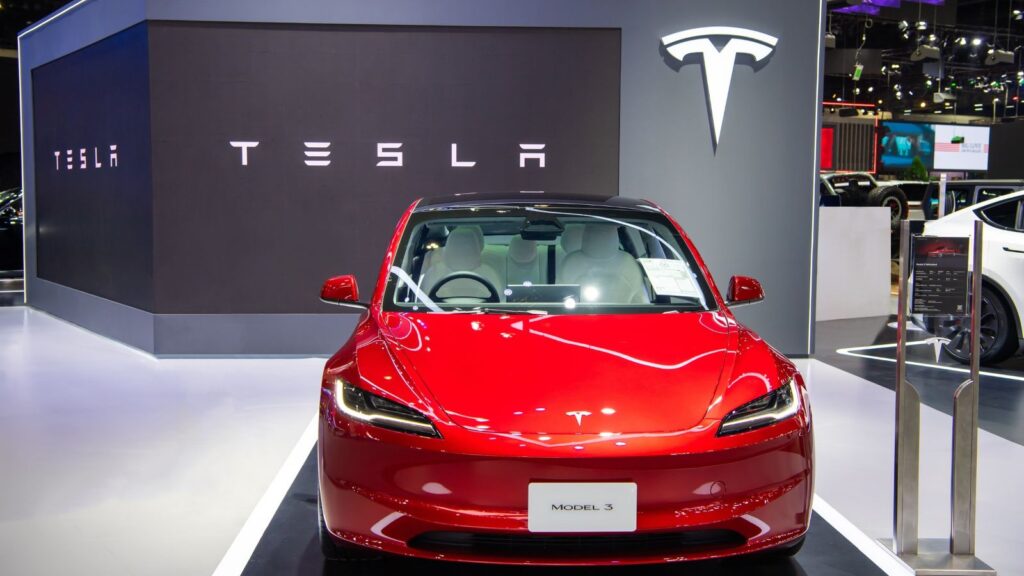
Tesla has quietly changed one of the most important numbers attached to the Model 3 in Canada. The company’s Canadian Model 3 materials now show the Premium Rear-Wheel Drive with up to 584 kilometres of EPA-estimated range and a 5.2-second 0–100 km/h time, replacing the 463-kilometre and 6.2-second figures associated with the Shanghai-built car sold earlier this year. Yet the version that made the biggest splash — the $39,490 Model 3 Premium RWD — is still unavailable to order.
That combination makes the update more than a routine website edit. The new specifications closely resemble a U.S.-built rear-drive Model 3 previously sold in Canada, raising the possibility that Tesla is preparing another sourcing change. For now, however, Tesla has not announced a Canadian relaunch, a new price or a confirmed factory of origin.
A Quiet Website Change Rewrites the Entry Model
The biggest change is the range figure. Tesla’s Canadian Model 3 materials now show the Premium Rear-Wheel Drive at 584 kilometres of EPA-estimated range, up from the 463-kilometre figure attached to the lower-priced Shanghai-built version. The listed 0–100 km/h time has also moved from 6.2 seconds to 5.2 seconds. No Canadian pricing announcement accompanied the specification change, and the Premium RWD remains unavailable for a fresh factory order.
Tesla’s Canadian web pages have not always updated in perfect lockstep. Recent snapshots of the company’s configurator, support pages and comparison materials have shown older prices or specifications even as other parts of the site changed. That distinction matters because a displayed specification does not automatically mean a vehicle is orderable. For Canadian shoppers, the meaningful signal is not simply that “584 km” has appeared, but that Tesla has changed the technical identity of a trim that remains behind an order pause.
The $39,490 Model 3 Is Still Unavailable
Tesla paused new Canadian orders for both Model 3 Premium variants in mid-October. The company said high demand had exhausted its import quota and indicated ordering could resume if the federal government issued more quota, with March 2027 cited as the expected timing. The affected lineup included the Premium Rear-Wheel Drive at $39,490 and the Premium All-Wheel Drive at $49,990, both tied to Tesla’s Shanghai supply strategy.
That left the Model 3 Performance, priced at $74,990, as the version Canadian customers could still configure and order. The gap is striking: a shopper considering the $39,490 rear-drive car suddenly faced a jump of more than $35,000 to reach the remaining factory-order option. Tesla’s Canadian support pages have continued to display the lower Premium MSRPs, illustrating the difference between a trim remaining in the company’s published price structure and that trim actually being available for a new order at a given moment.
The 584-KM Figure Points Toward a U.S.-Built Configuration
The new 584-kilometre figure is notable because it closely matches Tesla’s current U.S. rear-wheel-drive Model 3 specification of 363 miles of EPA-estimated range. It also echoes the long-range rear-drive Model 3 Tesla sold in Canada in 2024, when the company sourced Canadian cars from the United States rather than Shanghai. That earlier Canadian configuration was also advertised with 584 kilometres of range and a 5.2-second 0–100 km/h time.
Those parallels are strong evidence of a possible sourcing change, but they are not confirmation. Tesla has not publicly said the Canadian Premium RWD will come from Fremont, California, nor has it announced a restart date under a U.S.-supply plan. The safer conclusion is that the website now describes a vehicle whose range and acceleration numbers line up unusually well with a U.S.-built long-range rear-drive Model 3. Until Tesla changes the configurator or issues a formal statement, factory origin remains an informed inference rather than a confirmed production decision.
The Import-Quota Story Is More Complicated Than “Sold Out”
Tesla’s explanation for the order pause centres on Canada’s quota for electric vehicles originating in China. The federal program allows 49,000 Chinese-origin EVs into Canada during the first quota year, from March 1, 2026, through February 28, 2027, at a 6.1% most-favoured-nation tariff rate. As of October 23, federal utilization data showed 15,931 vehicles counted against that annual limit, leaving 33,069 available.
That does not mean Tesla can claim all of the remaining volume. Global Affairs Canada says permits are administered on a first-come, first-served basis, but the rules also allow the department to set aside quota to provide equitable access to automakers, including new entrants. The government does not publish company-by-company allocations or shipment details. The national quota can therefore have tens of thousands of spaces left while Tesla still says its own access has been exhausted. Public data confirms available national capacity; it does not reveal the specific import volume Tesla has been permitted to use.
Tariffs Could Make a U.S. Return Much More Expensive
The $39,490 price became possible after Tesla returned to Shanghai-built Model 3s for Canada under the new China EV quota. Vehicles entering within that quota face Canada’s 6.1% most-favoured-nation tariff rather than the 100% surtax that previously applied to Chinese EVs. That trade-policy change gave Tesla room to offer the Model 3 Premium RWD at a price far below the tariff-inflated U.S.-sourced lineup that preceded it.
A Fremont-built replacement would face a different trade environment. Canada continues to impose a 25% counter-tariff on non-CUSMA-compliant vehicles imported from the United States and on the non-Canadian and non-Mexican content of CUSMA-compliant U.S.-made vehicles. The exact duty on a Tesla depends on qualifying content and import treatment, so simply adding 25% to the sticker price would be misleading. Still, the policy creates a significant cost obstacle. A 584-kilometre U.S.-built car could solve Tesla’s near-term supply problem while making it considerably harder to preserve the headline $39,490 Canadian price.
The Federal EV Rebate Adds Another Constraint
Canada’s Electric Vehicle Affordability Program can provide up to $5,000 for an eligible battery-electric vehicle in 2026. To qualify, a vehicle generally needs a final transaction value of $50,000 or less unless made in Canada, and it must be manufactured in Canada or a country with a free-trade agreement. That origin rule is why a Shanghai-built Model 3 does not qualify, even though its $39,490 MSRP sits comfortably below the program’s transaction-value ceiling.
Tesla’s Canadian incentives page states that Model 3 vehicles are not currently eligible for the federal program. A future U.S.-built Model 3 could satisfy the free-trade-country requirement, but that alone would not guarantee an incentive: transaction value, program administration and vehicle eligibility would still matter. Timing matters as well. Transport Canada’s schedule reduces the maximum battery-electric incentive from $5,000 in 2026 to $4,000 in 2027. For buyers waiting until the expected March quota reset, available federal support could therefore be smaller.
584 KM Is a Big Paper Gain, Not a Guaranteed Road Result
Moving from 463 kilometres to 584 kilometres represents 121 kilometres of additional rated range, or roughly a 26% increase on paper. That is large enough to change how a buyer thinks about long-distance travel. A driver planning a 400- to 450-kilometre intercity trip, for example, would see substantially more theoretical buffer in the 584-kilometre car than in the version sold earlier this year, particularly when deciding where a charging stop might be necessary.
EPA-rated range is still a standardized estimate, not a promise of what every Canadian driver will see. Tesla notes that actual driving range varies with speed, weather, elevation, vehicle configuration, battery temperature and other conditions. Its range guidance also points to tire choice, hard acceleration, climate use, cargo and cold temperatures as factors that can increase energy consumption. Those variables matter in Canada, where winter conditions can materially affect EV efficiency. The 584-kilometre number is valuable for comparing configurations, but practical trip planning still requires a reasonable margin.
What Canadian Buyers Should Watch Next
Canada’s electric-vehicle market has also been strengthening again. Statistics Canada reported 22,716 zero-emission vehicles sold in August 2026, up 55.1% from a year earlier and equal to 13.0% of all new-vehicle sales that month. In the second quarter, 58,811 new ZEVs were registered, representing 10.7% of registrations. More than half were assembled in Asia, showing how international production remains central to Canada’s EV supply.
For Tesla, the immediate question is whether the 584-kilometre listing becomes a Canadian product buyers can actually purchase before the Chinese quota year resets. The clearest signs will be the Premium RWD becoming selectable again, a Canadian cash price, confirmed factory origin, updated federal-incentive status and any new quota announcement from Ottawa. Until those pieces appear, the website change is best viewed as a strong clue rather than a completed relaunch. The $39,490 Model 3 remains the price Canadians remember, but it is not currently the car they can simply order.
