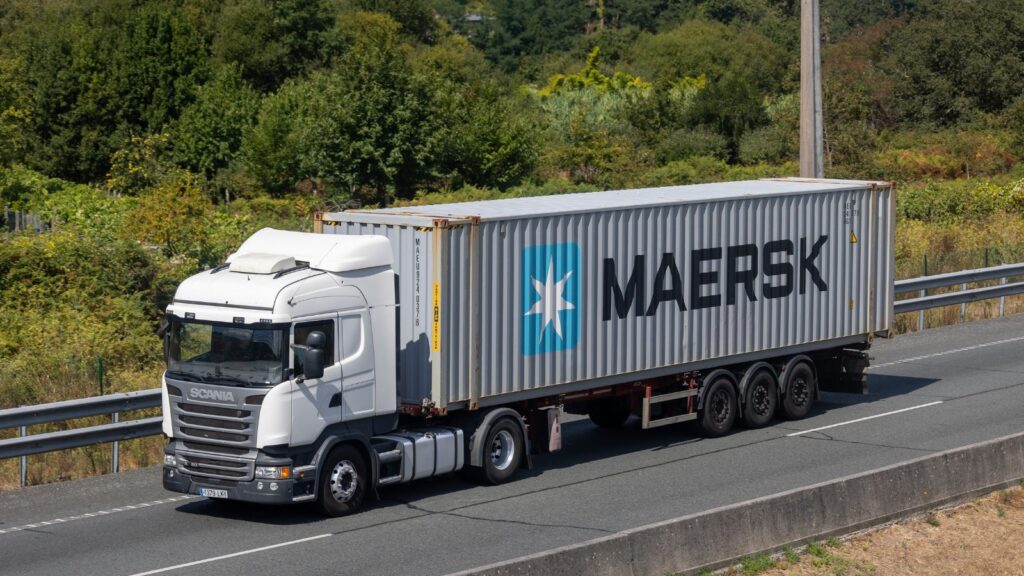
A shipping container can travel thousands of kilometres across the ocean, only for a new transportation expense to emerge during the final stretch of its journey. Canadian importers and exporters now face that challenge as global shipping giant Maersk introduces a 24% fuel surcharge on eligible container trucking services, effective November 1, 2026.
The temporary adjustment affects certain inland transportation movements connected to Canadian ports, adding another cost consideration for businesses that depend on international trade. Maersk attributes the decision to rising global energy prices and disruptions affecting fuel availability.
While the surcharge applies specifically to inland haulage rather than an entire shipment’s cost, its financial impact could become significant for companies moving large volumes of containers. The change also raises questions about shipping budgets, consumer prices and how Canadian businesses can manage increasingly unpredictable transportation expenses.
The 24% Surcharge Is Now in Effect
Maersk’s revised Canadian fuel surcharge officially took effect on November 1, 2026, following an announcement issued on October 7. The company established the charge at 24% of eligible inland haulage costs, specifically targeting container drayage. Drayage connects shipping terminals with warehouses, rail facilities and other transportation points. Maersk’s announcement identifies movements between ocean terminals and the first inland node, covering the Canadian portion of eligible import and export transportation.
An important distinction is that the 24% surcharge does not represent a government tax or a blanket increase in ocean freight rates. It applies to a defined portion of the transportation service. Maersk describes the adjustment as temporary and says it will reassess the percentage monthly. For businesses already managing transportation budgets, that creates an immediate expense alongside uncertainty about future charges. The November rate is established, but subsequent adjustments will depend on changing market conditions.
What the 24% Charge Means for Shipping Bills
The financial impact becomes clearer when the surcharge is translated into actual dollars. Consider a hypothetical container movement with a base inland trucking cost of C$1,000. Applying Maersk’s 24% surcharge produces an additional C$240, bringing that transportation component to C$1,240 before other applicable fees or taxes. If the base haulage rate were C$1,500, the surcharge would amount to C$360. These examples illustrate the calculation rather than Maersk’s actual rates on particular routes.
For businesses transporting large quantities of imported merchandise, those charges can accumulate quickly. A company moving 50 containers with a hypothetical base trucking rate of C$1,000 each would incur C$12,000 in fuel surcharges at the announced percentage. However, that would not necessarily represent C$12,000 in entirely new costs because previous fuel adjustments may already have applied. The meaningful comparison is between the old and new total transportation bills, including every applicable charge.
Both Importers and Exporters Are Affected
Although rising import costs are a major concern, Maersk’s announcement covers exports as well. The adjustment applies to qualifying Canadian container movements under two service arrangements: Carrier Haulage and Multi-Carrier bookings. Carrier Haulage generally involves Maersk coordinating inland transportation associated with a container shipped through its ocean network. The Multi-Carrier service allows Maersk to manage inland transportation even when another shipping company handles the ocean voyage.
That distinction broadens the group of potentially affected customers beyond those booking ocean freight directly with Maersk. Consider a Canadian manufacturer exporting machinery overseas while relying on Maersk for the trucking connection to a port. Its inland transportation costs may be affected even though the surcharge is not imposed on the machinery itself. Companies arranging trucking independently should not assume this particular Maersk charge applies to their separate transportation contracts. However, independent trucking companies may use their own fuel adjustment formulas, making comparisons between providers increasingly important.
Shipment Dates Could Determine Which Charges Apply
One detail that deserves attention is Maersk’s Price Calculation Date, commonly known as the PCD. The company uses this date to establish applicable shipment pricing, but the calculation differs according to the regulatory circumstances. For non-Federal Maritime Commission shipments, Maersk’s Canadian notice generally references the estimated departure date of the first vessel in the latest applicable booking confirmation. For FMC-regulated shipments, it uses the date when Maersk or an authorized representative takes possession of the final container listed on the transport document.
There is another consideration when importers arrange inland transportation after their cargo has already departed its country of origin. Maersk specifies that the import shipment creation date determines the relevant surcharge calculation in that situation. Consequently, companies cannot rely solely on the date their containers arrive at a Canadian port. Booking confirmations, contract conditions and the timing of additional services can influence how the applicable charge is established.
Rising Diesel Prices Help Explain Maersk’s Decision
Maersk attributes its surcharge adjustment to rising global energy prices and the evolving security situation in the Middle East, which it says has affected international fuel availability. Canadian diesel prices provide important context. Fuel-pricing company Kalibrate reported that retail diesel ended September 2026 at 260.7 cents per litre, an increase of 23.9 cents from the previous month. Its analysis identified expensive crude oil, unusually high refining margins and tight diesel inventories as major contributors to the increase.
The Bank of Canada’s October 28 economic assessment also identified higher crude prices and refinery margins as significant sources of pressure on Canadian businesses. Expensive diesel increases the cost of operating trucks, distributing merchandise and transporting goods between facilities. Maersk says its surcharge is intended to maintain service continuity, protect cargo and secure sufficient trucking capacity. However, the company has not publicly demonstrated that every affected Canadian route experienced a fuel-cost increase of exactly 24%. The surcharge is a commercial pricing adjustment rather than a direct measurement of national diesel inflation.
Canadian Shipping Costs Were Already Facing Fuel Adjustments
The November surcharge is part of a longer sequence of fuel-related changes announced by Maersk during 2026. In April, the company issued a Canadian inland fuel advisory addressing rising energy costs and fluctuations in diesel prices. Another announcement in May introduced a further temporary adjustment affecting Carrier Haulage and Multi-Carrier bookings. That notice described a 16% adjustment for truck movements and established a monthly review schedule for eligible shipments.
Those earlier announcements matter because the November surcharge should not automatically be interpreted as an entirely new expense added on top of every previous adjustment. Maersk’s latest Canadian notice establishes a 24% surcharge under its revised framework. It does not instruct customers to add that percentage to all the percentages mentioned in earlier notices. Businesses seeking to calculate their actual cost increase must compare current quotations with previous invoices and contractual terms. The broader pattern nevertheless demonstrates how frequently fuel volatility has forced shipping companies to reconsider inland transportation pricing throughout the year.
Another Maersk Fuel Increase Is Scheduled for November 16
The 24% Canadian trucking surcharge is not the only fuel-related development affecting Maersk customers this month. In a separate October 16 announcement, the shipping company outlined increases to its Emergency Intermodal Fuel Surcharge for eligible container movements involving inland rail ramps and container yards in Canada and the United States. Beginning November 16, the charge is scheduled to reach US$350 per inbound dry container and US$400 per inbound refrigerated container. Outbound shipments will face corresponding charges of US$125 and US$175.
For perspective, Maersk’s June announcement listed inbound charges of US$200 for dry containers and US$250 for refrigerated units. The November increases therefore add another financial consideration for qualifying shipments. Importantly, these fixed per-container emergency charges are separate from the percentage-based Canadian trucking surcharge. Maersk specifically states that certain store-door movements can face the emergency intermodal fee separately from fuel charges associated with inland pickup or delivery. Customers need to examine their actual routes and service arrangements to determine whether multiple charges apply.
Canada’s Major Ports Highlight the Scale of the Issue
The importance of inland container transportation becomes apparent when examining Canada’s largest shipping gateways. The Port of Vancouver handled approximately 3.8 million twenty-foot equivalent units (TEUs) in 2025, representing a 9% increase from the previous year. Meanwhile, the Port of Montreal reported approximately 1.52 million TEUs during the same period, an increase of 3.6%. A TEU measures standardized container capacity rather than the number of individual truck journeys, but these figures demonstrate the enormous scale of Canada’s containerized trade.
Not every container passing through these ports is subject to Maersk’s surcharge, and port-wide statistics cannot establish the carrier’s potential surcharge revenue. Nevertheless, they highlight the importance of efficient connections between ships, trucking companies and inland transportation networks. An importer receiving goods near a coastal terminal faces different logistical requirements from one transporting merchandise to a distant distribution centre. Route selection, terminal access, container availability and the transportation provider all influence the final cost. Even a surcharge limited to qualifying movements can become an important consideration in those calculations.
Higher Shipping Costs Could Eventually Reach Canadian Consumers
One of the biggest questions is whether the additional trucking expense will eventually appear in retail prices. Consider a hypothetical importer bringing 1,000 small kitchen appliances into Canada. If the shipment incurs C$240 in fuel surcharges, that translates into 24 cents per appliance before accounting for any previous fuel adjustments. If the container holds only 100 higher-value products, the same charge represents C$2.40 per item. The financial effect depends on shipment contents, overall transportation costs and the company’s pricing strategy.
The Bank of Canada’s October economic assessment warned that elevated transportation and import costs were increasing pressure on businesses. Its third-quarter Business Outlook Survey also found that roughly half of firms planned to pass on some or all of their cost increases related to the Middle East conflict and tariffs. International Monetary Fund research has similarly documented how shipping-cost increases can gradually affect consumer inflation. However, none of this establishes that Maersk’s particular surcharge will produce a measurable increase in Canadian retail prices. Some businesses may absorb the expense, while others may incorporate it into future price adjustments.
Businesses Face Tougher Decisions About Transportation Planning
For Canadian importers and exporters, managing the surcharge begins with understanding which shipments qualify. Logistics teams should review inland transportation contracts, compare current rates with previous invoices and confirm whether Maersk is responsible for the relevant trucking movement. The company identifies its Canadian fuel adjustments using the billing codes IFS for imports and EFS for exports. Where shipments involve inland rail ramps or container yards, businesses should also determine whether a separate emergency intermodal charge applies.
Planning may become more complicated because Maersk intends to review the Canadian surcharge monthly, leaving open the possibility of future adjustments. Businesses can evaluate competing trucking arrangements, improve shipment scheduling and build greater flexibility into transportation budgets. However, an alternative provider offering a lower base rate may not necessarily deliver a lower overall cost once other fees and operational risks are considered. Maersk also provides an invoice-dispute process through its MyFinance platform for customers who believe charges are incorrect. Ultimately, the surcharge reinforces an important reality for Canadian trade: controlling costs increasingly requires looking beyond ocean freight prices and understanding every expense between the port and the final destination.
