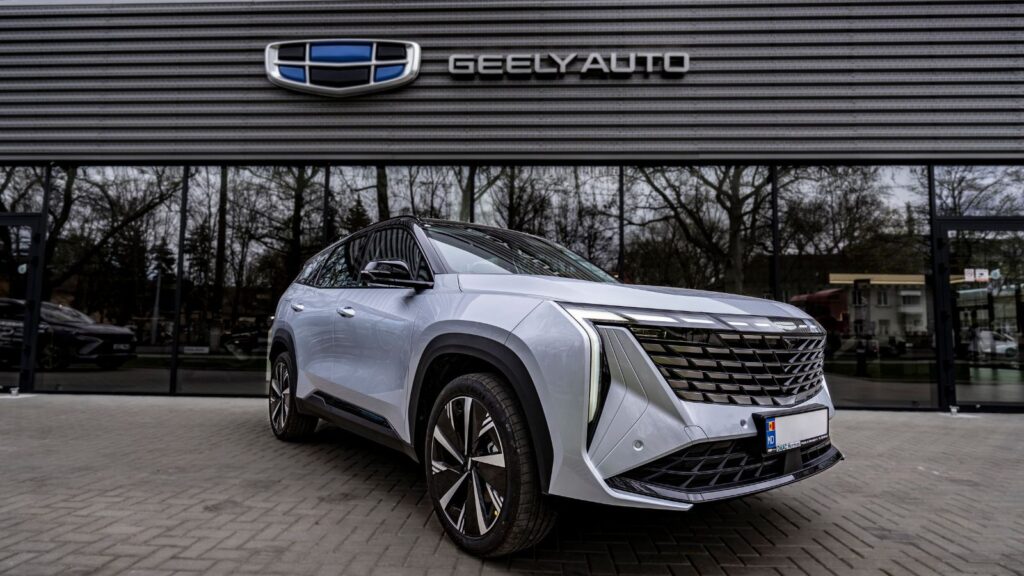
Geely is preparing to put its own name on Canadian showroom floors, and its latest sales report shows the scale of the company behind that move. Geely Automobile Holdings reported 310,183 vehicle sales in October 2026, its strongest month of the year and a modest increase from October 2025. The headline figure hides a more complicated story: electric vehicle sales and exports climbed sharply while demand within China weakened. With a Canadian launch planned for 2027 but no confirmed models or prices, those contrasting trends offer an early look at the opportunities and challenges facing the newcomer.
October Sales Come Remarkably Close to a Record
Geely Automobile Holdings sold 310,183 vehicles in October 2026, compared with 307,133 in October 2025. The year-over-year increase was just under 1%, but the monthly trend was stronger: sales rose about 6.2% from September’s 292,168 vehicles. October was Geely’s highest-volume month of 2026 and came within only 245 units of the record 310,428 vehicles reported in November 2025. Averaged across October’s 31 calendar days, the latest total represents more than 10,000 vehicles a day. That is a substantial manufacturing and distribution operation, even if its growth rate looks restrained.
There is an important distinction behind the impressive number. It covers the listed Geely Automobile group’s reported vehicle sales across multiple brands and markets, not just cars wearing the Geely badge. The company also describes these October results as unaudited, meaning they remain subject to final confirmation. For Canadian drivers, the figure demonstrates the scale of the prospective entrant, not demand that has already materialized here. Geely’s Canadian vehicles are still expected in 2027. Understanding what powered October’s results is more useful than treating the headline as an automatic prediction of Canadian success.
Electric Cars Provide Much of the Momentum
Geely’s clearest October growth came from vehicles that can be plugged in. The company reported 214,996 new-energy vehicle sales, combining battery-electric vehicles and plug-in hybrids. That represented roughly 69% of its overall total and an increase of nearly 21% from a year earlier. Fully electric vehicles accounted for 140,758 sales, up 43% from the 98,348 recorded in October 2025. In other words, about 45 out of every 100 vehicles in the company’s reported October total were battery-electric. That is a significant shift for a manufacturer that also produces gasoline-powered cars.
Plug-in hybrids moved in the opposite direction for the month. Geely sold 74,238 of them, down from 79,534 a year earlier, a decline of about 7%. These vehicles can handle some journeys using electricity while retaining a gasoline engine for longer trips. The contrast matters because a strong electric portfolio does not mean every powertrain is growing at the same pace. It also does not tell Canadians which technology Geely will introduce first. A family considering an affordable electric crossover and a driver wanting a plug-in hybrid may eventually have very different reasons to visit a Geely retailer, depending on the lineup that is actually announced.
Exports Are Becoming a Major Growth Engine
International business supplied one of October’s biggest surprises. Geely reported 107,153 exported vehicles, compared with 41,568 in October 2025, an increase of roughly 158%. Exports represented about 35% of total sales, making overseas markets far more important to the monthly result than they were a year earlier. The company had already surpassed 100,000 exports in June, and October continued that unusually strong run. In the company’s reporting, exports cover markets outside mainland China, including Hong Kong, Macao and Taiwan. They should not be mistaken for sales exclusively in Europe or North America.
For Geely, expansion abroad is not simply about placing a few unfamiliar cars in new showrooms. Vehicles need local approvals, trained technicians, replacement parts, suitable charging equipment where applicable and customer support that remains available years after the sale. Moving more than 100,000 vehicles into export markets in a single month suggests its international operations are already operating at meaningful scale. Still, that total says nothing about how many vehicles will eventually be allocated to Canada. The 2027 entry will require its own market strategy rather than relying on momentum generated elsewhere.
China’s Weaker Sales Reveal a Different Story
The export surge looks even more important when compared with performance at home. Subtracting October exports from the companywide total leaves 203,030 vehicles sold within mainland China, down from 265,565 in the same month of 2025. That represents a year-over-year decline of about 23.6%. Domestic sales did improve by roughly 9.5% from September, so October was not uniformly negative. Nevertheless, the difference between rising international volumes and falling domestic volumes is difficult to ignore. The company is increasingly relying on buyers outside its home market to support its overall sales.
That imbalance helps explain why a new destination such as Canada is strategically interesting, even though Geely has not announced Canadian sales forecasts. Overseas expansion can broaden a manufacturer’s customer base and reduce its dependence on any single country, but it adds complexity. Vehicles that appeal in one region may need changes to equipment, pricing, software and marketing elsewhere. A Canadian commute involving freezing mornings, highway driving and long distances between service locations creates a different ownership test from a short urban journey in China. Geely’s challenge is to translate international volume into products and support that fit local conditions.
The Brands Behind the Total Are Moving at Different Speeds
The 310,183 figure brings together three distinct businesses within the listed auto group. Its core Geely brand sold 255,742 vehicles in October, about 4% more than a year earlier. That total includes 153,385 vehicles from the Geely Galaxy range, which grew approximately 20%. Galaxy is part of the core figure, not an additional number to be added on top. The premium Zeekr brand sold 32,483 vehicles, up around 52%, while Lynk & Co reported 21,958, down roughly 45%. Those contrasting outcomes show why a single groupwide growth percentage can obscure substantial shifts beneath it.
The corporate family is broader still. The parent, Zhejiang Geely Holding Group, has interests in Volvo Cars, Polestar and Lotus, but their sales are not part of this particular 310,183-unit tally. Geely’s November filing also separately reported 22,495 October sales for Malaysian automaker Proton, another figure outside the published group total. Such distinctions matter as the company prepares its Canadian debut. Its announced 2027 launch concerns the mainstream Geely Auto nameplate; it does not automatically establish Canadian launches for Zeekr, Lynk & Co or every other company associated with the wider holding group.
The Ten-Month Results Show Both Progress and Pressure
From January through October, Geely Automobile reported 2,545,664 vehicle sales, about 3% higher than the comparable period of 2025. That amounts to roughly 74% of the company’s 2026 target of 3.45 million vehicles. Reaching the full-year goal would require approximately 904,000 additional sales during November and December, or around 452,000 per month. That is considerably higher than Geely’s reported monthly record. The calculation does not mean the target has been abandoned; it illustrates how demanding the remaining stretch has become despite October’s comparatively strong result.
The export target tells a very different story. Through October, Geely had exported 904,823 vehicles, almost 98% of its revised annual target of 920,000. The company raised that export goal from 640,000 in August after its international business expanded far faster than expected. Together, the two targets reveal a company whose global push is outpacing its overall volume growth. For Canada, that is useful context: Geely’s arrival forms part of a much larger international expansion, but an ambitious sales strategy abroad is not the same as a confirmed local delivery schedule.
Canada Is Confirmed for 2027, but the Lineup Is Not
Geely Auto formally announced its Canadian market entry on October 9, 2026. The company said a Canadian team was already in place and that it was establishing local operations ahead of introducing its first vehicles to consumers in 2027. Bryan Wu, managing director of Geely Auto Canada, described the country as an important step in the brand’s international expansion and emphasized building long-term customer trust. This is a concrete commercial plan rather than an unconfirmed industry rumour, supported by a newly launched Canadian website and an effort to recruit retail and service partners.
What remains unknown is just as important as what has been announced. Geely has not formally named its first Canadian models, published Canadian prices or identified opening dealership locations. It has not provided a specific first-delivery date, either. The broader Geely Auto Group sold more than 3.02 million vehicles globally in 2025, including nearly 1.69 million new-energy vehicles, so it is entering this process with considerable experience. But Canadians cannot yet compare a confirmed Geely model against a Toyota, Hyundai or Chevrolet on a local dealer’s lot. That stage of the launch is still ahead.
Dealerships and Service Could Matter as Much as the Cars
Geely’s Canadian announcement places unusual emphasis on local partnerships. Rather than simply announcing a shipment of vehicles, the company says it is developing a retail and service network intended to support customers throughout ownership. That distinction matters for a brand unfamiliar to many Canadian shoppers. Buying a car is one decision; trusting the company to supply a replacement windshield, diagnose a warning light or address a warranty claim several winters later is another. A dealer network can help build confidence, but its practical value depends on locations, technician training and parts availability.
The company has said its vehicles are present in more than 100 countries and regions, yet that broad footprint cannot substitute for a functioning Canadian service operation. A buyer in a major city may have different expectations from someone who regularly drives between smaller communities. As the launch approaches, shoppers will need details about warranty coverage, roadside assistance, collision-repair access and whether nearby service points can work on the model they choose. None of those Canadian-specific arrangements should be assumed from Geely’s overseas warranties or from the presence of other brands connected to its parent company.
Canada’s Chinese EV Import Rules Create an Opening
Geely’s plans arrive amid a significant change in Canadian trade policy. On March 1, 2026, Canada implemented an initial annual quota of 49,000 electric vehicles originating in China that can enter at a 6.1% most-favoured-nation tariff rate. The arrangement replaced the previous 100% surtax on Chinese EVs and is administered through import permits. The quota is not a sales commitment to any one manufacturer: eligible companies must secure access, and a vehicle must still satisfy applicable Canadian requirements. Geely’s Canadian launch is therefore linked to an opening in the market, not to an automatic allocation of imports.
Affordability is part of the policy’s stated purpose, but the details require care. Canada’s framework calls for half the quota to be reserved by 2030 for vehicles with a qualifying import value of C$35,000 or less. That is an import-price threshold, not a promise that a vehicle will carry a C$35,000 showroom sticker. Shipping, retail margins, taxes and other costs can affect what a Canadian customer ultimately pays. Just as importantly, a lower tariff does not determine which Geely vehicles will be available in 2027. The company still needs to explain its product choices and actual Canadian pricing.
The Next Test Is Turning Global Experience Into Canadian Value
Geely already has models that give Canadians a sense of its global product direction. The EX5 is a fully electric SUV sold in export markets, while the Starray EM-i is a plug-in hybrid SUV introduced in markets including the United Kingdom. Either type could appeal to shoppers comparing everyday running costs with the convenience of longer trips. But neither has been officially confirmed for Canada, and specifications or prices from overseas should not be treated as Canadian offers. Transport Canada also requires imported new vehicles to meet applicable Canadian motor vehicle safety standards, so bringing a model here involves more than changing its badge.
There is a genuine market to compete for. Statistics Canada reported 174,611 new vehicles sold nationally in August 2026, including 22,716 zero-emission vehicles, a 13% share. Its definition includes both battery-electric and plug-in hybrid vehicles. Geely’s opportunity will depend on whether its eventual Canadian products offer compelling prices, credible driving range, practical charging or fuel options and reliable after-sales support. October’s 310,183 sales show an automaker capable of moving vehicles on a global scale. The more meaningful Canadian milestone will come when buyers can inspect a confirmed model, see a real price and know who will service it.
