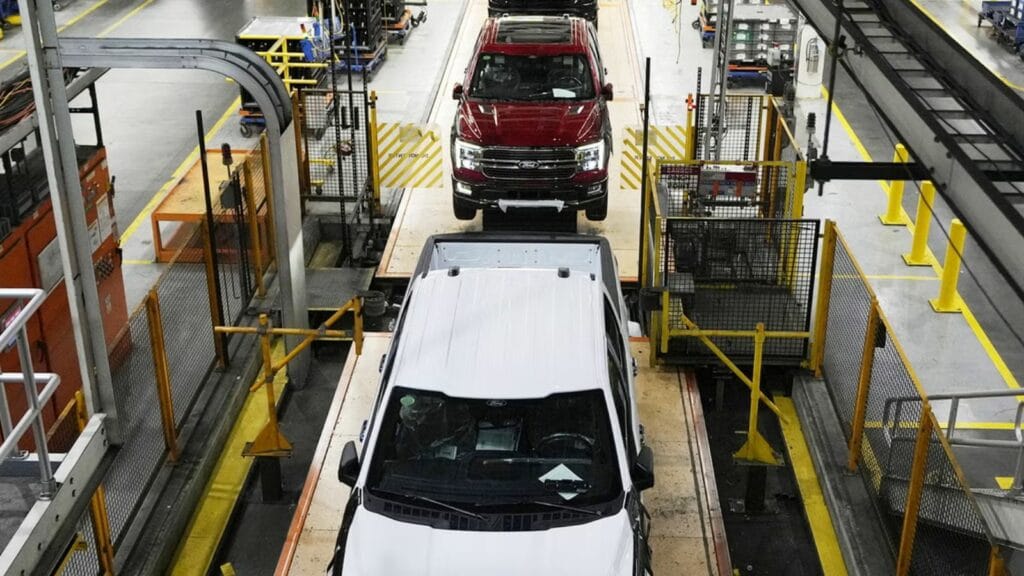
The battle over Chinese automobiles is creating a growing divide between the United States and Canada. American automakers are demanding a permanent ban on Chinese vehicles, warning that inexpensive imports and connected-car technology threaten domestic manufacturing and national security. Meanwhile, Canada has taken a different approach, reopening its market to a limited number of Chinese-made electric vehicles and creating opportunities for manufacturers such as BYD and its competitors.
The disagreement comes at a particularly sensitive moment for North America’s automotive industry. With trade tensions rising, manufacturers investing billions in new technologies, and consumers struggling with vehicle affordability, the decisions made in Washington and Ottawa could reshape competition across the continent. The central question is whether protecting established manufacturers outweighs the potential benefits of giving consumers more affordable choices.
U.S. Automakers Want Congress to Make the Restrictions Permanent
On November 2, 2026, the Alliance for Automotive Innovation renewed its demand for Congress to permanently prohibit Chinese connected vehicles from entering the American market. The organization represents major manufacturers, including General Motors, Ford, Toyota, Volkswagen, Hyundai, Honda and Stellantis. Its president and CEO, John Bozzella, argues that Chinese manufacturers could undermine companies that have invested heavily in American factories, technology and employment. The alliance also maintains that vehicles containing Chinese-connected hardware and software present national security concerns that cannot be addressed through tariffs alone.
The timing is significant. Lawmakers are preparing to return to Washington after the November 3 midterm elections, with only a limited period remaining before the current congressional session ends in December. A bipartisan proposal advanced through a Senate committee in July, while the corresponding House legislation has attracted more than 100 co-sponsors. However, neither chamber has completed the legislative process. Automakers want Congress to act before the political calendar creates further uncertainty, arguing that permanent legislation would give manufacturers a clearer foundation for long-term investment decisions.
Existing American Restrictions Already Make Chinese Vehicle Sales Difficult
The proposed legislation would strengthen a regulatory framework that already presents major obstacles for Chinese automakers. In January 2025, the U.S. Department of Commerce finalized rules targeting connected vehicles and components associated with China and Russia. The restrictions address technology capable of communicating with external systems, including certain vehicle connectivity hardware and software. They also cover automated-driving software, reflecting concerns about the growing amount of information modern automobiles collect and process during everyday use.
Under these regulations, restrictions involving covered software and sales by manufacturers linked to China or Russia apply beginning with the 2027 model year. Additional hardware restrictions take effect for the 2030 model year, with an earlier January 2029 deadline for components without a designated model year. Importantly, manufacturing a vehicle inside the United States does not automatically exempt a Chinese-controlled company from the rules. The government also provides limited authorization mechanisms for qualifying transactions. The legislation automakers are supporting would go further by establishing restrictions in federal law, making the broader policy more difficult for a future administration to reverse.
Canada Reverses Its Earlier Tariff Policy and Opens a Limited Door
Canada’s decision represents a significant change from its approach in October 2024, when Ottawa imposed a 100% surtax on Chinese-made electric vehicles. That measure was designed to protect Canadian manufacturers from what the government viewed as unfair international competition. However, during Prime Minister Mark Carney’s visit to Beijing in January 2026, Canada and China reached a preliminary arrangement addressing several longstanding trade disputes. Ottawa agreed to permit an initial 49,000 Chinese-made electric vehicles annually at the standard most-favoured-nation tariff of 6.1%, with the new quota system taking effect on March 1.
The arrangement was also designed to improve conditions for Canadian exporters. China reduced its combined tariffs on Canadian canola seed to approximately 15%, down from roughly 85%, while suspending certain additional duties on agricultural and seafood products. This gave the agreement significance beyond the automotive industry, particularly for Prairie farmers and seafood producers dependent on international markets. Ottawa maintains that the vehicle quota represents less than 3% of annual Canadian new-vehicle sales, limiting the immediate disruption to domestic manufacturers. Nevertheless, the policy establishes a path for Chinese vehicles that Washington is increasingly determined to close.
BYD, Geely and Chery Are Preparing for Canadian Expansion
Chinese automakers have begun responding to Canada’s revised import policy, although their progress varies considerably. BYD, one of the world’s largest electric-vehicle manufacturers, has established a Canadian corporate presence and launched a dedicated website. Its published terms describe plans to sell vehicles through approved dealerships, while regulatory records reviewed by Reuters indicate that the manufacturer has begun compliance procedures involving two passenger cars. An automotive retail consultant working on potential BYD locations previously discussed plans for approximately 20 dealerships, but that figure should not be confused with an officially confirmed nationwide opening schedule.
Other Chinese manufacturers have made more specific announcements. Geely confirmed on October 9 that it had established Canadian operations and was developing a retail and service network ahead of its first consumer vehicle launches in 2027. Chery is also preparing to enter Canada, with its Omoda and Jaecoo brands targeting an early 2027 introduction. BYD executive vice-president Stella Li previously indicated that Canadian passenger-vehicle sales would likely begin in 2027. As of early November 2026, BYD has not publicly finalized its Canadian model lineup, prices or dealership opening dates, demonstrating the difference between gaining market access and actually delivering vehicles to customers.
Official Import Numbers Show Canada’s Market Is Opening Slowly
Despite the attention surrounding Chinese automakers, Canada’s import figures show that the market is not being flooded with newly arriving vehicles. According to Global Affairs Canada’s quota report updated October 30, 2026, only 16,206 vehicles had been recorded under the program since March. That left 32,794 available spaces out of the annual allocation of 49,000. The report recorded 5,982 vehicles in July and 5,490 in August, but only 603 in September. No additional imports were recorded for October in the latest published figures.
The numbers also reveal an unexpected complication involving Tesla. The American company began importing lower-priced, Shanghai-built Model 3 sedans into Canada earlier in 2026. However, in October, Tesla suspended orders for certain Model 3 versions, stating that it had exhausted its import allocation. That announcement appeared inconsistent with the substantial number of unused spaces in the national quota. Global Affairs Canada subsequently confirmed that it was consulting automakers about distributing the remaining allocation but declined to disclose company-specific information. The situation demonstrates that Canada’s import system affects established global manufacturers, not simply Chinese-owned brands seeking their first Canadian customers.
Affordable Chinese EVs Could Challenge Canada’s Existing Pricing Structure
One of Ottawa’s main arguments for opening the market is that greater competition could improve electric-vehicle affordability. Canada’s agreement with China includes a provision to reserve an increasing share of import capacity for less expensive vehicles. Beginning in the second quota year, 10% of the allocation is intended for vehicles with an import value of C$35,000 or less. That proportion is scheduled to rise to 50% in the fifth year, beginning in March 2030. The overall annual quota is also scheduled to increase by 6.5% each year, gradually expanding the number of eligible imports.
There is an important distinction between the government’s affordability target and what consumers will actually pay. The C$35,000 threshold refers to the vehicle’s free-on-board import value, not its final dealership price. Transportation, tariffs, distribution expenses and dealer margins can increase the cost significantly. Chinese-built EVs also face a disadvantage under Canada’s federal Electric Vehicle Affordability Program, which provides incentives of up to C$5,000 for qualifying battery-electric vehicles in 2026. Eligibility requires vehicles to be manufactured in Canada or a country with which Canada has a free-trade agreement. China does not qualify under that rule, meaning imported Chinese-made models would have to compete without that federal purchase incentive.
Connected-Car Technology Creates a Major National Security Debate
The controversy surrounding Chinese automobiles extends far beyond vehicle prices and factory competition. Modern connected vehicles contain cameras, location services, wireless communication systems and software capable of transmitting information to external networks. American officials argue that certain technologies controlled by companies subject to Chinese jurisdiction could create opportunities for unauthorized data access or remote interference. These concerns helped shape the U.S. Commerce Department’s restrictions, which specifically target sensitive vehicle connectivity and automated-driving systems rather than electric motors or batteries alone.
Canadian privacy officials have also acknowledged the risks, although they emphasize that data-security concerns are not exclusive to Chinese-made vehicles. In April 2026, the Office of the Privacy Commissioner told a parliamentary committee that connected vehicles can expose drivers to privacy risks involving cloud storage, overseas data transfers and access by foreign authorities. The office also made clear that evaluating individual manufacturers requires examining their vehicles, contracts and legal obligations. This distinction matters because a potential vulnerability is not proof that a particular model is conducting surveillance. For Canadian regulators, the challenge is balancing technological innovation and consumer access with credible safeguards for personal information.
Canadian Autoworkers Fear Another Threat to Domestic Manufacturing
Canada’s decision has generated opposition within its own automotive industry, particularly among labour organizations concerned about employment and future investment. Unifor, one of the country’s largest private-sector unions, criticized the January agreement and warned that heavily subsidized Chinese vehicles could displace domestically manufactured products. National president Lana Payne argued that expanding imports from China could weaken Canadian assembly operations and automotive parts suppliers at a time when the industry is already dealing with American tariffs, production uncertainty and changing electric-vehicle demand.
Those concerns carry considerable economic weight. According to the federal government’s 2026 automotive strategy, Canada’s auto sector supports more than 500,000 jobs directly and indirectly, including approximately 125,000 direct manufacturing positions. Statistics Canada has also estimated that U.S. demand supported roughly 76% of Canadian automobile and light-duty vehicle manufacturing jobs in 2024. For workers in communities such as Windsor, Oshawa and Oakville, decisions affecting North American vehicle production have consequences extending beyond assembly lines. Suppliers, transport companies and local businesses depend on sustained manufacturing activity. Ottawa argues that cooperation with Chinese manufacturers could eventually attract new joint ventures and investment, but those potential benefits have not yet eliminated concerns about competition with existing Canadian factories.
Canada Is Not an Automatic Back Door Into the American Market
One of the strongest objections raised by U.S. automakers is that Chinese manufacturers could use Canada to establish a North American presence before attempting expansion into the United States. Reuters reported in June that several Chinese manufacturers viewed Canada as an attractive market because Canadian and American consumers have similar vehicle preferences and the countries share closely related automotive standards. Building Canadian dealerships, service operations and customer relationships could give those manufacturers experience operating in North America, even if American sales remain unavailable.
However, selling a Chinese vehicle in Canada does not automatically make it eligible for sale in the United States. The Canada–United States–Mexico Agreement has strict automotive rules of origin, including a requirement that qualifying passenger vehicles generally contain at least 75% North American regional value to receive preferential tariff treatment. A vehicle manufactured in China cannot acquire Canadian origin simply by passing through a Canadian dealership. American connected-vehicle restrictions and other import requirements create additional barriers. The concern, therefore, is less about a simple loophole at the border and more about Chinese manufacturers establishing commercial relationships that could support future American expansion if U.S. policy changes.
Trump’s Position Adds Uncertainty to the Next Stage of the Dispute
President Donald Trump’s position has complicated the American industry’s campaign for permanent restrictions. In September 2026, Trump indicated that he would be open to Chinese automakers establishing factories in the United States, provided they employed American workers. He drew comparisons with foreign manufacturers that already operate American assembly plants, while opposing Chinese companies using factories in Mexico to export vehicles into the United States. His remarks created tension with domestic automakers, which argue that allowing Chinese-controlled manufacturers to produce vehicles on American soil would not necessarily eliminate national security or competitive concerns.
The debate also reflects China’s growing influence in international automotive markets. Figures drawn from Eurostat show that European Union imports of passenger vehicles manufactured in China exceeded 1.1 million units during the first eight months of 2026, surpassing the total recorded throughout 2025. Those figures include vehicles produced in China by both Chinese and foreign-owned manufacturers, but they illustrate the country’s expanding role in global production. For Washington, the immediate question is whether Congress will turn existing restrictions into permanent legislation before the session ends. For Ottawa, the challenge is proving that carefully managed competition can improve affordability and attract investment without undermining Canadian workers. Both countries are making decisions with consequences that could extend well beyond the current trade dispute.
