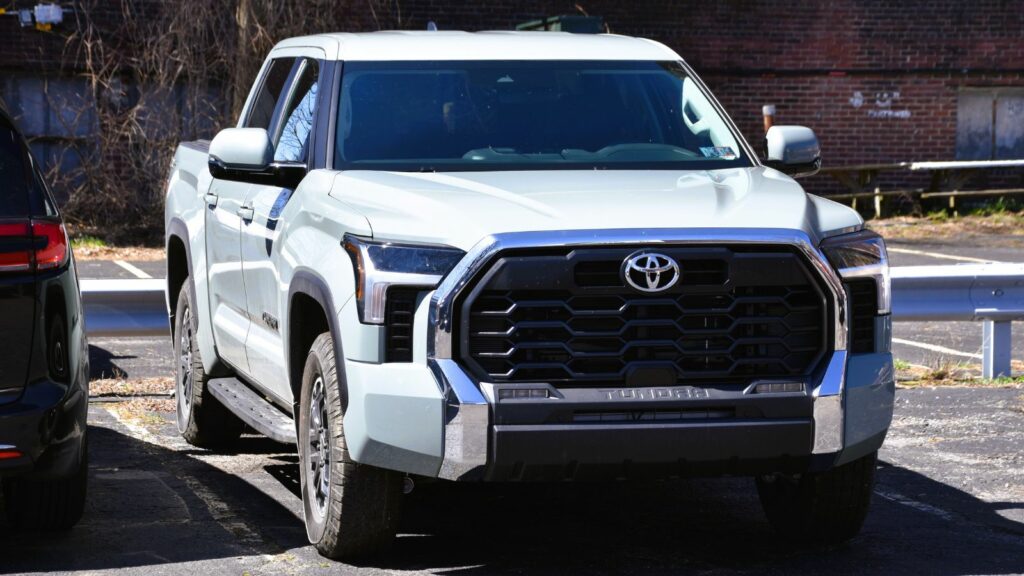
The price of a full-size pickup truck is becoming just as important as its towing capacity. Toyota’s newly updated 2027 Tundra is arriving in Canada with a starting manufacturer’s suggested retail price of $61,340, but premium configurations now exceed $100,000 before taxes.
Announced on November 5, 2026, the updated Tundra brings fresh styling, improved towing technology, a new Trailhunter off-road package, and more standard digital features. Toyota is also expanding the performance capabilities of its hybrid-powered TRD Pro.
For Canadian drivers, the latest pricing highlights an increasingly important distinction between a practical working pickup and a luxury vehicle with serious hauling capabilities. The Tundra continues to offer both, but the financial gap between them is substantial.
A $61,340 Starting Price Comes With Important Details
Toyota has set the starting MSRP of the 2027 Tundra CrewMax SR 4×4 with a 5.5-foot bed at $61,340. This entry-level configuration provides four-wheel drive, a spacious passenger cabin, and the essential capabilities expected from a full-size pickup. However, the advertised amount does not represent the complete purchase price. Toyota lists an estimated vehicle price of $64,998 once applicable freight, pre-delivery inspection, air-conditioning charges, and specified dealer fees are included.
That distinction matters for Canadian buyers comparing vehicles or calculating financing requirements. Toyota’s estimated vehicle price still excludes sales taxes, licensing, registration, and insurance. A contractor purchasing a replacement work truck or a family upgrading to a larger vehicle could therefore face a noticeably higher final bill. The important takeaway is that the $61,340 headline establishes the entry point, not the full cost of ownership. Buyers comparing dealerships should examine complete written quotes rather than focusing exclusively on advertised MSRPs.
The Price Increase Is Smaller Than It First Appears
Comparing the new Tundra with its predecessor requires a closer look at the equipment and configurations involved. Toyota advertised the 2026 Tundra from $54,340, making the new $61,340 starting price appear $7,000 higher. However, the older figure applied to a rear-wheel-drive Double Cab, while the 2027 entry model is a four-wheel-drive CrewMax. A more appropriate comparison is the 2026 CrewMax SR 4×4 with a 5.5-foot bed, which started at $59,585. Against that model, the 2027 MSRP is $1,755 higher.
The comparison also reveals improvements in standard equipment. The previous SR featured an eight-inch touchscreen, while the updated model receives a 14-inch display, a larger digital instrument cluster, and additional driver-assistance technologies. Toyota has also removed two-wheel-drive configurations from its Canadian lineup for 2027. Consequently, the higher advertised entry price reflects both a change in the available model mix and an increase in the price of a comparable four-wheel-drive truck. For budget-conscious buyers, those differences are important when evaluating value.
Toyota Offers 31 Different Tundra Configurations
Despite changes to the lineup, Toyota continues to offer substantial variety in the Canadian full-size pickup market. The 2027 Tundra is available in 31 configurations, covering two powertrains, two cab designs, and three bed lengths. The range includes 16 gasoline-powered CrewMax configurations, three gasoline Double Cab models, and 12 hybrid versions. Every Canadian model comes with four-wheel drive as standard, giving buyers consistent traction capabilities regardless of whether they choose a work-oriented SR or a premium hybrid.
The different configurations serve considerably different purposes. CrewMax models emphasize passenger accommodation, making them attractive to families and drivers who regularly travel with colleagues. Double Cab variants offer an alternative for buyers who prioritize cargo-bed length. Toyota provides beds measuring 5.5, 6.5, and 8.1 feet, depending on the configuration. The Double Cab SR5 with an 8.1-foot bed starts at $65,790, offering a practical option for carrying longer materials. For Canadian businesses, choosing the right cab and bed combination may be more important than selecting additional luxury equipment.
The Gasoline V6 Still Delivers Serious Towing Capability
Toyota continues to offer its twin-turbocharged i-FORCE V6 gasoline powertrain for customers who prefer a conventional pickup configuration. In the entry-level CrewMax SR, the engine produces 358 horsepower, with Toyota listing a towing capacity of 8,289 pounds. Moving to the CrewMax SR5 increases output to 389 horsepower and raises the published towing rating to 11,155 pounds. The SR5 starts at $67,850, making it an important step up for drivers who regularly transport equipment, boats, or recreational trailers.
Those figures demonstrate why the gasoline-powered Tundra remains relevant even as Toyota expands its hybrid offerings. For a landscaping contractor carrying equipment between properties or a family towing a camper on summer trips, engine output is only part of the equation. The correct towing configuration, trailer brakes, payload, and loaded trailer weight also matter. Toyota provides a standard towing hitch and trailer electrical connectors across the lineup, but the maximum permitted trailer weight depends on the vehicle’s exact specifications and loading conditions. Buyers should confirm those ratings before selecting a model.
The Hybrid Tundra Brings 437 Horsepower and 583 LB-FT of Torque
Toyota’s i-FORCE MAX hybrid powertrain offers another approach to full-size pickup performance. Combining a twin-turbocharged V6 with hybrid-electric assistance, the system produces 437 combined horsepower and 583 lb-ft of torque. Toyota lists a maximum Canadian towing capacity of 5,080 kilograms, equivalent to approximately 11,200 pounds, for the 2027 Tundra lineup. These figures place the hybrid models among the strongest configurations in the range, especially for drivers who value torque when accelerating with a heavy load.
The hybrid lineup begins with the CrewMax Limited at $80,000 MSRP, or $83,658 using Toyota’s estimated vehicle-price calculation. This is considerably more expensive than the entry-level gasoline model, although it includes substantial comfort and technology equipment. The hybrid Limited features heated and ventilated front seats, premium JBL audio, a panoramic moonroof, and a 2.4-kilowatt onboard power supply. For some owners, these additions could justify the higher purchase price. Others may prefer the lower initial cost of a gasoline Tundra, particularly when their towing requirements fall comfortably within its capabilities.
The New Trailhunter Brings Factory-Ready Off-Road Capability
One of the most significant additions for 2027 is the Tundra Trailhunter, a factory-equipped package designed for drivers interested in overlanding and remote exploration. Based on the gasoline-powered SR5 TRD Off-Road, the Trailhunter starts at $72,675 MSRP, with an estimated vehicle price of $76,333. Its specialized equipment includes Old Man Emu suspension components, 33-inch all-terrain tires, bronze-finished 18-inch wheels, aluminum skid plates, and front recovery hooks. The package also incorporates an electronically locking rear differential, Crawl Control, and Multi-Terrain Select.
These improvements target buyers who want more than an appearance package but may not need the extreme performance focus of the TRD Pro. For example, a driver planning extended camping trips through British Columbia or exploring gravel roads in Northern Ontario could benefit from the additional underbody protection and off-road technology. Toyota’s approach also gives customers a factory-equipped foundation for further modifications. Importantly, the Trailhunter remains substantially less expensive than the hybrid TRD Pro, making specialized off-road equipment accessible without requiring a near-six-figure investment.
TRD Pro Performance Package Pushes Pricing Above $103,000
Toyota’s performance-focused Tundra TRD Pro receives notable changes for 2027, including newly tuned FOX QS3 adjustable shock absorbers, distinctive exterior styling, upgraded lighting, and red front recovery hooks. The standard hybrid TRD Pro carries an MSRP of $94,553, rising to an estimated vehicle price of $98,211. Buyers seeking additional performance can choose the new TRD Pro Performance Package, which increases combined powertrain output from 437 to 469 horsepower. The package also adds specialized front seats, a performance exhaust, and a cold-air intake.
The financial implications are substantial. Toyota lists the TRD Pro Performance Package at $99,446 MSRP, but its estimated vehicle price reaches $103,104 before taxes. That places the truck firmly in six-figure territory, even without additional provincial sales taxes or registration costs. For enthusiasts, the increased output and specialized suspension may offer a compelling combination of power and off-road capability. However, the premium also illustrates how far modern pickups have moved beyond basic transportation. The TRD Pro is designed for buyers who place a high value on specialized performance, not simply those who need a vehicle capable of towing a trailer.
The Capstone Shows How Luxury Has Changed Pickup Pricing
The Tundra Capstone represents Toyota’s most luxurious interpretation of its full-size pickup. For 2027, the hybrid-powered Capstone starts at $97,730 MSRP, with Toyota calculating an estimated vehicle price of $101,388. Adding towing mirrors increases that figure to $101,708. The equipment list includes 22-inch alloy wheels, semi-aniline leather upholstery, walnut wood trim, acoustic front side glass, and distinctive illuminated interior badging. Toyota has also made its upgraded Adaptive Variable Suspension standard on the Capstone, emphasizing improved ride comfort and control.
These features create a different ownership proposition from the entry-level SR. A Capstone buyer may use the truck for towing a recreational trailer on weekends while expecting the comfort and refinement of a luxury vehicle during daily commuting. The suspension system, premium interior materials, and additional sound insulation all support that positioning. Nevertheless, the price raises legitimate questions about how much comfort is necessary in a working pickup. The Capstone’s MSRP remains below $100,000, but Toyota’s estimated vehicle price crosses that threshold before sales taxes, making it an unmistakably premium purchase.
A 14-Inch Touchscreen Is Now Standard Across the Lineup
Technology is becoming a more important part of the Tundra’s appeal, and Toyota has made several significant improvements for 2027. Every model now receives a 14-inch touchscreen multimedia system and a 12.3-inch digital instrument cluster. The updated infotainment platform features a configurable home screen and easier access to frequently used functions. Toyota has also introduced a standard integrated Drive Recorder, which uses the vehicle’s external cameras to capture 20-second video clips. These features bring equipment previously associated with more expensive configurations into the entry-level truck.
The updated Tundra also introduces Toyota Safety Sense 4.0, which includes enhanced pre-collision technology, pedestrian detection, radar cruise control, lane-assistance functions, and other driver-support systems. Connected features receive attention as well, including a 10-year trial for Remote Connect, Safety Connect, and Service Connect, alongside a three-month Drive Connect trial. Toyota notes that these services require compatible 5G connectivity and account registration. For drivers spending long hours on highways or travelling with family, the additional technology may contribute to convenience and confidence, although electronic assistance remains a supplement to attentive driving.
New Towing Technology Could Make Difficult Manoeuvres Easier
Toyota is also introducing advanced towing assistance designed to address some of the challenges associated with large trailers. The 2027 Tundra’s new trailer-assistance technology includes Automated Trailer Detection, which uses cameras and radar sensors to recognize a connected trailer and identify its physical characteristics. Additional systems include Trailer Blind Spot Monitor, which adjusts the monitored area to account for trailer length, and Trailer Lane Trace Assist, which provides steering support under certain conditions. An enhanced Trailer Backup Guide offers dynamic guidelines and semi-automated steering assistance when reversing.
These technologies could prove particularly useful in situations where a trailer’s size makes ordinary driving more complicated. Reversing a camper into a narrow campsite, navigating a busy boat launch, or changing lanes while towing all require extra attention. Toyota’s systems are intended to reduce some of that workload, although drivers remain responsible for controlling their vehicles. The manufacturer is also offering an upgraded combination of Adaptive Variable Suspension and rear air suspension on selected hybrid Platinum and 1794 configurations. That equipment is designed to help maintain vehicle composure and manage changing loads.
Canada’s Expensive Truck Market Puts Toyota’s Pricing Into Perspective
The Tundra’s pricing reflects a broader trend affecting Canadian pickup buyers. According to AutoTrader’s first-quarter 2026 Price Index, the average price of a new truck in Canada reached $81,831, an increase of 3.8% compared with the same period in 2025. That contrasted with the overall new-vehicle market, where the average price declined 2.7% year over year to $62,830. Although those figures represent an earlier period rather than November 2026 pricing, they illustrate how trucks have faced different price pressures from the wider automotive market.
Against that backdrop, the 2027 Tundra offers considerably different financial propositions within a single model family. The entry-level SR remains a relatively accessible option in the full-size segment, while the Capstone and TRD Pro Performance Package reach price levels associated with premium vehicles. Toyota’s expanded technology, specialized suspension systems, and luxury equipment provide reasons for those differences, but they do not eliminate the importance of affordability. For Canadian consumers, the central decision is whether the additional capability and comfort justify the higher purchase cost. As pickups become increasingly sophisticated, choosing equipment that meets actual needs may be the most effective way to avoid spending thousands on features that will rarely be used.
