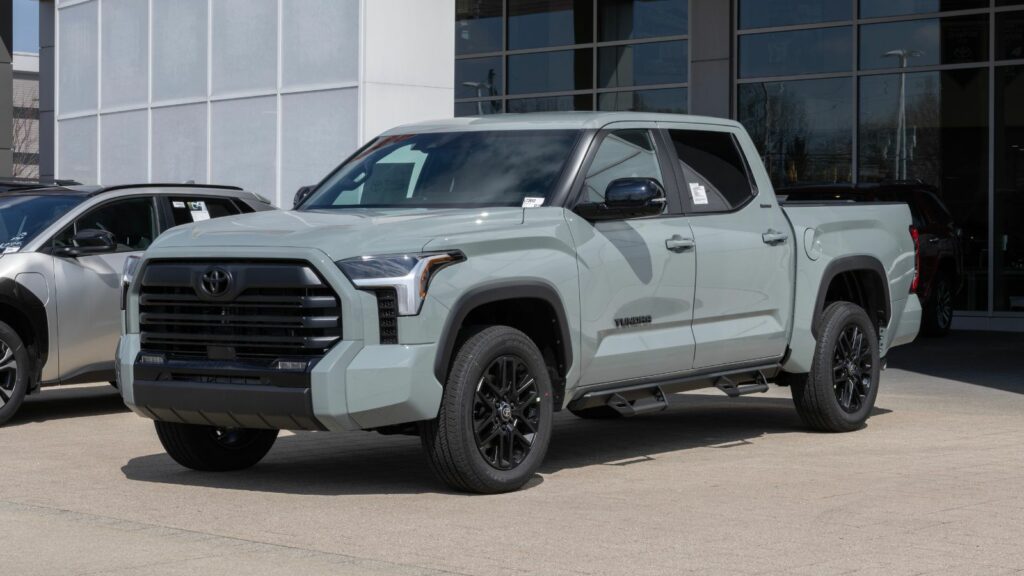
The days when a full-size pickup was simply an affordable work vehicle seem increasingly distant. Toyota’s latest Tundra pricing illustrates how far the market has moved, with the updated 2027 model reaching $103,104 before sales tax in Canada.
That figure belongs to the new Tundra TRD Pro with the Performance Package, a powerful hybrid pickup combining specialized off-road equipment with premium technology. Toyota’s November 5, 2026 announcement also reveals higher prices for several familiar configurations, while introducing new features across the lineup.
For Canadians already dealing with expensive vehicles, financing costs, and household expenses, the six-figure Tundra raises a familiar question: how much truck is worth the money?
The Most Expensive Tundra Now Costs More Than $103,000
Toyota Canada’s newly announced pricing puts the 2027 Tundra i-FORCE MAX TRD Pro with the Performance Package at a starting manufacturer’s suggested retail price of $99,446. However, the company’s estimated vehicle price reaches $103,104 once freight, pre-delivery inspection, air-conditioning charges, maximum dealer fees, and other specified charges are included. That amount excludes sales taxes, licensing, insurance, and registration. The distinction matters because the advertised base MSRP is technically below $100,000, even though Toyota’s estimated pre-tax vehicle price has crossed that threshold. For Canadians comparing trucks online, the difference between the two figures can make a substantial difference when calculating the amount required to complete a purchase.
The six-figure price also highlights how dramatically pickup trucks have evolved from their traditional roles. Modern full-size models increasingly combine serious hauling ability with the technology, comfort, and specialized equipment once associated with expensive luxury SUVs. Toyota’s most expensive Tundra is not simply a basic truck with leather seats. It includes performance upgrades, sophisticated suspension components, and advanced electronic systems intended for demanding driving conditions. Still, the pricing raises questions about practical value. A contractor who needs dependable transportation for equipment may have little use for the highest-performance model, while an off-road enthusiast may see the additional hardware as a worthwhile investment. The $103,104 figure represents the upper end of Toyota’s newly announced Canadian Tundra lineup rather than the cost of every Tundra.
Toyota’s New Performance Package Adds Power and Nearly $5,000
The new Performance Package is the major reason Toyota’s most expensive Tundra carries such an impressive price. The 2027 TRD Pro normally produces 437 combined horsepower through its i-FORCE MAX hybrid powertrain. With the Performance Package, output increases to 469 horsepower, a gain of 32 horsepower. Toyota also includes a TRD performance exhaust, TRD cold-air intake, specialized ISO-Dynamic front seats, and distinctive performance badging. The standard TRD Pro starts at $94,553, while the upgraded version begins at $99,446. That represents an additional $4,893 in MSRP before the other charges included in Toyota’s estimated vehicle prices.
The performance upgrades arrive alongside other significant improvements to the TRD Pro. Toyota has introduced revised FOX QS3 adjustable shock absorbers intended to improve stability and control over uneven ground. Red recovery hooks, enhanced lighting, and a distinctive Honeycomb exterior colour help separate the truck visually from less expensive models. For someone regularly travelling along rocky trails or remote access roads, properly designed suspension components can be more meaningful than decorative accessories. However, the extra horsepower and specialized equipment will not necessarily benefit every owner. The package makes the Tundra more powerful and distinctive, but buyers still need to decide whether those advantages justify paying nearly $5,000 more than the already expensive TRD Pro.
The Luxury-Focused Capstone Is Also Crossing $100,000
The TRD Pro is not the only Tundra approaching or exceeding six figures. Toyota has priced the 2027 Tundra Capstone hybrid at $97,730 in base MSRP, with an estimated vehicle price of $101,388 before taxes. Choosing the Capstone with towing mirrors brings the respective figures to $98,050 and $101,708. Unlike the performance-focused TRD Pro, the Capstone is designed primarily around luxury and refinement. It features 22-inch dark-chrome alloy wheels, premium semi-aniline leather upholstery, walnut wood trim, acoustic side glass, and distinctive interior detailing. Toyota has also made its Adaptive Variable Suspension system standard on this grade for 2027.
Those features reflect how automakers increasingly position expensive pickups as alternatives to premium family vehicles. A Capstone owner might use the truck for highway commuting, weekend travel, towing a recreational trailer, and transporting family members rather than working exclusively at construction sites. Its cabin is intended to provide a more comfortable experience during long journeys, while retaining the usefulness of a truck bed. The challenge is that luxury equipment significantly increases the purchase price without necessarily improving the basic transportation needs of every household. Heated and ventilated seating, premium materials, and sophisticated suspension technology certainly add convenience, but the decision becomes more complicated when those comforts push the vehicle’s estimated price beyond $100,000 before tax.
Toyota’s Year-Over-Year Price Increases Are Difficult to Ignore
Comparing Toyota’s official pricing for the 2026 and 2027 model years reveals increases across several comparable Tundra configurations. The standard hybrid TRD Pro carried a starting MSRP of $89,326 for 2026, compared with $94,553 for 2027, an increase of $5,227. The hybrid Capstone rises from $94,280 to $97,730, adding $3,450. Even the gasoline-powered CrewMax SR 4×4 moves upward, from $59,585 to $61,340, a difference of $1,755. These comparisons are based on published starting prices before additional charges, rather than individual dealer transaction prices. They also involve vehicles whose standard equipment has changed between model years.
That last point is important when interpreting the increases. The refreshed Tundra adds technology, safety systems, revised design elements, and other improvements that were not necessarily included with previous versions. Consequently, the higher prices cannot automatically be treated as pure inflation or evidence that any particular tariff caused the change. Nevertheless, the financial effect is straightforward for shoppers considering a similar new truck. A returning Tundra customer comparing the latest TRD Pro with the previous model year’s version faces a higher starting price before considering financing or tax. For households planning to replace an aging pickup, those additional thousands of dollars can influence whether they purchase immediately, choose a lower grade, or continue driving their existing vehicle.
Even the Cheapest New Tundra Has Become More Expensive
The affordability challenge extends beyond Toyota’s most luxurious models. For 2026, the manufacturer’s Canadian Tundra lineup started at $54,340 for a rear-wheel-drive Double Cab SR. The least expensive 2027 model is now the four-wheel-drive CrewMax SR, with an MSRP of $61,340 and an estimated vehicle price of $64,998 before taxes. The difference between the two starting MSRPs is $7,000, although they are not identical configurations. Toyota has eliminated rear-wheel-drive models from its newly announced Canadian range, making 4×4 standard across every Tundra. The revised entry point therefore reflects both pricing changes and the disappearance of the previous cheaper configuration.
For Canadian buyers, standard four-wheel drive offers practical advantages, especially in regions where snow-covered roads, rural properties, and difficult driving conditions are common. However, it also removes a lower-priced option for customers who do not require that capability. Toyota says the 2027 lineup includes 31 distinct models, covering two powertrains, two cabin configurations, and three bed sizes. A contractor needing a longer cargo bed can still choose a Double Cab SR5 with an 8.1-foot bed, starting at $65,790. That versatility is useful, but it demonstrates how quickly prices increase once buyers begin comparing the available body styles and equipment packages. Entry-level full-size truck ownership now requires a substantial financial commitment.
The New Trailhunter Offers a Different Kind of Off-Road Value
Toyota is also expanding the Tundra lineup with a new Trailhunter configuration aimed at buyers interested in overlanding and recreational off-road driving. The 2027 Tundra SR5 Trailhunter starts at $72,675, with an estimated vehicle price of $76,333 before taxes. It builds on the SR5 TRD Off-Road configuration, incorporating specialized equipment intended to make the truck better prepared for challenging terrain. Toyota lists upgraded Old Man Emu suspension components, 33-inch all-terrain tires, bronze-coloured wheels, front recovery hooks, additional underbody protection, and distinctive exterior details. The model also includes a locking rear differential, Crawl Control, and Multi-Terrain Select.
The Trailhunter represents a different approach from the much more expensive TRD Pro with its Performance Package. Rather than emphasizing maximum horsepower, it concentrates on equipment that can be useful for travelling away from paved roads. A Canadian family planning camping trips along remote forestry roads, for example, might appreciate the protective hardware and specialized tires more than an additional 32 horsepower. The Trailhunter costs $4,180 more in starting MSRP than the regular SR5 TRD Off-Road, making it a meaningful but smaller step upward than the jump to the highest-priced performance truck. Whether it represents better value depends heavily on how frequently those capabilities are used. For ordinary commuting, much of the specialized equipment may provide limited everyday benefit.
Towing Technology Remains One of the Tundra’s Biggest Selling Points
Despite the emphasis on expensive luxury and performance packages, Toyota continues to focus heavily on traditional pickup capabilities. The available i-FORCE MAX hybrid combines a twin-turbocharged V6 with an electric motor to produce 437 combined horsepower and 583 lb-ft of torque in its standard configuration. Toyota quotes a maximum towing capacity of up to 5,080 kilograms, or approximately 11,200 pounds, depending on the vehicle configuration. Every 2027 Tundra also receives a 122-litre fuel tank, a standard towing hitch, and trailer electrical connections. An available 2.4-kilowatt inverter provides electricity for compatible equipment, offering additional convenience at worksites or outdoor destinations.
Toyota is introducing a series of advanced towing assistance technologies intended to simplify difficult manoeuvres. Automated Trailer Detection can identify a connected trailer and measure relevant characteristics, while Trailer Blind Spot Monitor extends the monitored area beyond the truck itself. The updated Trailer Backup Guide also provides enhanced visual guidance and steering assistance. These features can be particularly valuable for drivers reversing a large travel trailer into a campsite or navigating a crowded boat launch. However, buyers should remember that maximum towing ratings depend on the specific truck and its equipment. The manufacturer’s highest published rating does not apply automatically to every Tundra. Proper loading, trailer weights, and driver attention remain essential regardless of how sophisticated the electronic assistance becomes.
Toyota Is Making Expensive Technology Standard Across the Lineup
One of the most significant updates for 2027 involves technology that is no longer restricted to the most expensive Tundra grades. Toyota has made a 14-inch multimedia touchscreen standard across the Canadian lineup, alongside a 12.3-inch digital instrument display. The updated multimedia platform includes customizable screen layouts, quick-access controls, and enhanced connectivity. A built-in Drive Recorder can capture 20-second video clips using the vehicle’s external cameras, providing a potentially useful record of certain driving events. These additions help explain why even the entry-level Tundra offers more electronic equipment than earlier generations of basic pickups. The benefits extend beyond luxury, particularly for owners who frequently navigate unfamiliar roads.
Safety technology is also receiving a major update. The 2027 Tundra includes Toyota Safety Sense 4.0, featuring systems such as pre-collision assistance with pedestrian detection, adaptive cruise control, lane departure alerts, lane tracing assistance, and proactive driving assistance. Toyota also offers a 10-year trial of certain connected services, including Remote Connect, Safety Connect, and Service Connect, together with a three-month Drive Connect trial. The connected features depend on compatible technology, registration, and network availability, meaning their long-term value should be assessed carefully. Buyers increasingly receive sophisticated equipment as part of the purchase price, but some digital conveniences may involve subscriptions after introductory periods. This makes the ownership experience more connected while also introducing another potential expense beyond the original vehicle purchase.
Canada’s Pickup Price Problem Goes Beyond Toyota
The Tundra’s pricing changes arrive against a complicated backdrop for Canada’s automotive market. AutoTrader’s first-quarter 2026 price data showed that new trucks averaged $81,831, an increase of 3.8 per cent from the same period a year earlier. Used trucks also became more expensive during that period, with average prices rising 4.4 per cent to $51,719. Those figures help explain why a six-figure pickup is no longer an isolated example of premium vehicle pricing. However, the overall market has not moved uniformly upward. AutoTrader subsequently reported that average new-vehicle prices across the broader industry declined 2.2 per cent year over year in the second quarter.
This distinction matters because expensive trucks can become more costly even while average prices elsewhere in the automotive market moderate. Household affordability remains another important consideration. Statistics Canada reported that consumer prices increased 3.1 per cent year over year in September 2026, while gasoline prices rose 27.8 per cent. That combination places additional pressure on families already managing transportation, housing, and other living expenses. A truck purchase involves more than comparing dealership prices; it also requires assessing fuel consumption, insurance premiums, maintenance, and available household income. Toyota’s highest-priced Tundra may appeal to a relatively specialized group of customers, but the broader concern about vehicle affordability affects Canadians shopping across almost every price category.
Taxes and Financing Could Make the Real Purchase Price Much Higher
The most important number for Canadian shoppers is not necessarily the one displayed beside a vehicle’s specifications. Toyota’s $103,104 estimated price excludes sales taxes, and provincial tax rules can make a substantial difference. In Ontario, where the harmonized sales tax is 13 per cent, applying that rate alone would push a $103,104 purchase above $116,500. The final amount could be higher if other charges apply. Canada’s federal luxury tax can also affect qualifying light-duty pickups whose taxable selling value exceeds $100,000. Its applicability depends on the specific vehicle and transaction, including relevant fees and exemptions, so the Tundra’s published MSRP alone does not establish whether the tax will be payable.
Financing can add another layer of expense. The Financial Consumer Agency of Canada warns that longer vehicle loans generally reduce regular payments but increase the total interest paid. They can also increase the risk of negative equity, where the outstanding loan exceeds the vehicle’s resale value. This makes it especially important for buyers of expensive pickups to compare the full cost of financing rather than concentrating entirely on monthly affordability. Toyota’s 2027 Tundra delivers substantial upgrades in technology, towing assistance, comfort, and performance, but its pricing illustrates an increasingly important reality in the Canadian vehicle market. A truck can offer more capability than ever before while also requiring buyers to make far more demanding financial decisions.
