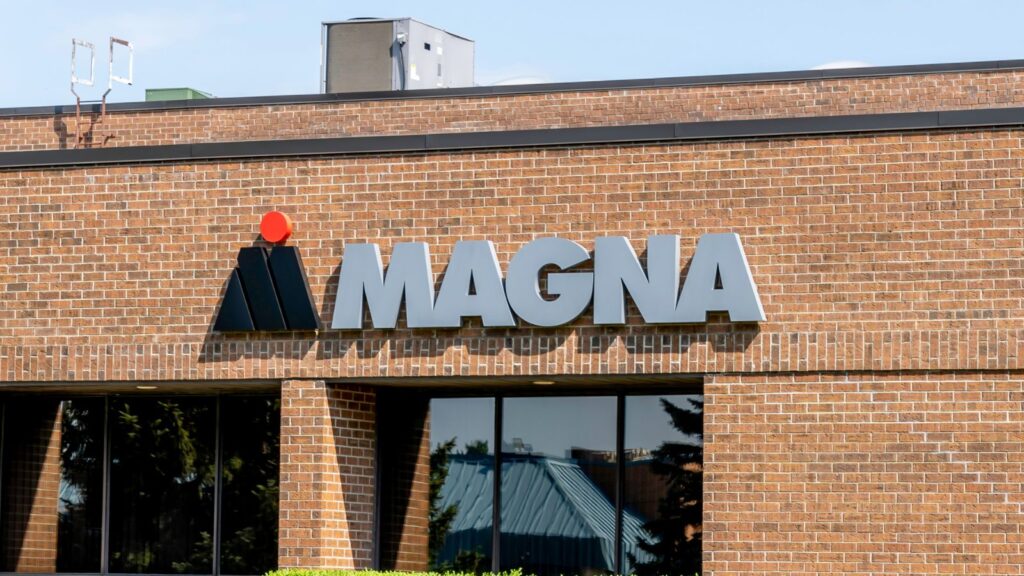
Canada’s automotive industry is facing another period of uncertainty, but one of its largest companies is moving ahead with a substantial financial commitment to shareholders. Magna International, the Aurora, Ontario-based automotive parts giant, has received approval from the Toronto Stock Exchange to repurchase up to 25.8 million common shares, representing approximately 10% of its public float.
Announced on November 5, 2026, the renewed share buyback program comes as Canadian automotive manufacturers navigate U.S. tariffs, fluctuating vehicle production and rising manufacturing costs. Magna’s decision also follows stronger third-quarter earnings, suggesting that the company is balancing financial discipline with the need to remain competitive in a changing North American automotive market.
A Buyback Covering Nearly 10% of Magna’s Public Float
Magna’s newly approved normal course issuer bid allows the company to purchase up to 25,778,000 common shares over approximately 12 months. The authorization represents nearly one-tenth of its public float, meaning the portion of its shares available to public investors. As of October 31, 2026, Magna reported 258,383,499 issued and outstanding common shares, including a public float of 257,862,127 shares. The size of the authorization makes it a significant financial decision for one of Canada’s most internationally connected automotive manufacturers. If a substantial number of shares are ultimately purchased and cancelled, the company could reduce its outstanding share count and potentially improve future earnings per share.
The program is scheduled to begin November 9, 2026, and expire no later than November 8, 2027. However, receiving approval does not mean Magna is required to purchase the entire amount. Management retains considerable flexibility over the timing and volume of repurchases, depending on market conditions and the company’s financial priorities. That distinction matters because the authorization establishes a maximum number of shares, not a guaranteed spending commitment. The actual financial impact will depend on how aggressively Magna uses the program.
Magna Has Already Completed Its Previous 25.3-Million-Share Program
The newly approved repurchase plan follows the completion of another substantial buyback. Magna’s previous authorization, announced in November 2025, permitted the purchase of up to 25.3 million common shares. By October 30, 2026, the company had repurchased the entire authorized amount, even though the existing program was not scheduled to expire until November 6. Of those purchases, 25,044,933 shares were cancelled, while the remaining shares were used to support stock-based compensation programs. That history demonstrates that Magna has been willing to follow through on substantial repurchase authorizations rather than simply leaving them available as an option.
The previous purchases were completed through Canadian and American trading venues at reported weighted-average prices of C$86.13 and US$62.10, respectively. Those figures reflect trading in different currencies and markets, rather than a single uniform purchase price. The completion of the previous authorization provides investors with useful evidence of Magna’s capital allocation priorities. Nevertheless, it does not guarantee that the company will exhaust its newest authorization. Management must still consider future vehicle production, operating expenses, market valuations and the need to preserve financial flexibility.
How the Repurchase Program Will Work
Under the renewed arrangement, Magna can acquire shares through the Toronto Stock Exchange, the New York Stock Exchange and permitted alternative trading systems. Depending on applicable regulations, purchases may also be completed through private agreements or specific repurchase arrangements. The company has indicated that shares may be purchased for cancellation or used to support employee stock-based compensation awards. Cancelled shares reduce the number of outstanding shares, while shares acquired for compensation programs serve a different purpose. That distinction is important when evaluating how much the buyback could ultimately benefit existing shareholders through a smaller share count.
The program also operates under trading restrictions designed to regulate repurchase activity. On the Toronto Stock Exchange, Magna generally faces a daily purchase limit of 279,091 shares, subject to exceptions for block purchases. The company has also established an automatic purchase plan with a designated broker. This arrangement can facilitate transactions under predetermined instructions during certain periods when Magna would otherwise face trading restrictions or internal blackout periods. These mechanisms provide continuity while maintaining regulatory safeguards. Ultimately, Magna can modify, suspend or discontinue its repurchase activity, giving management room to respond if financial conditions change.
Stronger Third-Quarter Earnings Support the Decision
Magna’s latest financial results help explain why management is comfortable pursuing another large buyback. For the third quarter ended September 30, 2026, the company reported US$10.1 billion in sales, approximately 4% below the same period in 2025. Lower vehicle production in several important markets contributed to that decline, with North American light-vehicle production falling 5% and Chinese production declining 7%. European production increased 3%, providing some relief. Magna’s revenue also reflected the completion of certain manufacturing programs and the sale of its Lighting and Rooftop Systems businesses. Despite these pressures, the company’s profitability improved significantly.
Net income attributable to Magna reached US$383 million, compared with US$305 million a year earlier. Adjusted earnings before interest and taxes increased 11% to US$683 million, while the adjusted operating margin climbed to 6.8%. Adjusted earnings per share rose 38% to US$1.83. Management attributed the stronger performance to operational improvements, favourable commercial developments and reduced net tariff costs. Previous share repurchases also contributed to per-share earnings growth by reducing the average number of diluted shares outstanding. The results demonstrate that Magna has been able to improve profitability even when vehicle production and overall revenue face pressure.
Magna Is Generating Significant Cash Despite Industry Uncertainty
A major factor supporting the new authorization is Magna’s cash generation. During the third quarter of 2026, the company generated US$950 million from operating activities and reported US$584 million in free cash flow. For the first nine months of the year, free cash flow reached approximately US$1.57 billion, compared with US$560 million during the equivalent period in 2025. Those figures help explain why Magna believes it can continue rewarding shareholders while investing in manufacturing operations. However, part of the nine-month cash performance reflected customer recoveries associated with adjustments to certain North American electric vehicle contracts, making it important to distinguish recurring cash generation from specific recoveries.
Magna returned US$658 million to shareholders during the third quarter through US$529 million in share repurchases and US$129 million in dividends. Across the first nine months, the company repurchased approximately 22.9 million shares for US$1.43 billion. It also raised its full-year free cash flow outlook to between US$1.85 billion and US$1.90 billion. Strong cash flow provides greater flexibility, but the company must still balance shareholder distributions against planned capital spending of approximately US$1.5 billion in 2026. Maintaining that balance will become especially important if tariffs, production disruptions or higher operating costs intensify.
U.S. Tariffs Continue to Complicate Magna’s Financial Planning
Trade tensions remain a central concern for automotive suppliers operating across Canada and the United States. Although Magna reported stronger third-quarter earnings, its financial statements made clear that tariffs continue to affect profitability. The company benefited from recovering more tariff-related costs and experiencing a lower net tariff burden during the quarter. Chief financial officer Philip Fracassa indicated that reduced net tariff costs contributed approximately 30 basis points to adjusted operating margins. However, he also cautioned that the full-year net tariff headwind was expected to remain comparable to the previous year’s impact. The improvement in one quarter therefore should not be mistaken for a permanent resolution of trade-related expenses.
The challenge extends beyond tariffs themselves. Magna reported that higher commodity costs reduced third-quarter adjusted margins by approximately 50 basis points, offsetting some of the improvement from lower tariff expenses. Materials such as aluminum, resins and electronic components can become more expensive before manufacturers successfully negotiate recoveries with their customers. For automotive suppliers working under complex production contracts, a relatively modest change in component costs can affect profitability across large manufacturing programs. Magna expects to mitigate or recover substantial portions of these increases over time, but the timing remains important. Preserving financial flexibility alongside share repurchases gives the company additional room to absorb unexpected costs.
Canada’s Dependence on the U.S. Makes the Trade Dispute Particularly Serious
Magna’s financial decisions are unfolding within an automotive industry heavily dependent on American customers. According to Canada’s federal government, more than 90% of Canadian-made vehicles and approximately 60% of Canadian-made automotive parts are exported to the United States. Statistics Canada has also estimated that U.S. demand supported 76.4% of Canadian automobile and light-duty vehicle manufacturing jobs in 2024. These figures demonstrate why changes in American trade policy can have consequences far beyond the companies directly importing finished vehicles. Canadian parts producers, logistics businesses and manufacturing communities all depend on the continued movement of products across the border.
The current tariff framework adds complexity to those relationships. The United States maintains 25% sectoral tariffs on automobiles and certain automotive parts, although CUSMA-compliant parts currently qualify for an exemption. For qualifying vehicles, the value of American content is also exempt from the 25% automotive tariff. Canada has imposed its own automotive countermeasures in response. These distinctions make compliance, sourcing decisions and supply-chain documentation especially important for manufacturers. For Magna, which supplies numerous automakers through operations in 27 countries, maintaining efficient cross-border production remains essential. A strong balance sheet may provide financial protection, but it cannot eliminate the broader uncertainty created by changing trade rules.
Recent Canadian Trade Figures Highlight the Industry’s Challenges
New Canadian trade statistics reinforce concerns about automotive production. Data released by Statistics Canada on November 4, 2026, showed that exports of motor vehicles and parts declined 4.9% in September compared with August. Imports of motor vehicles and parts fell 9.1%, following a 9.3% decline the previous month. Statistics Canada attributed part of the weakness to supply disruptions that caused unexpected production stoppages in the United States. Imports of motor vehicle engines and parts also declined 5.6%, coinciding with reduced light-truck production in Canada. The figures illustrate how interconnected production schedules can quickly affect trade flows on both sides of the border.
Employment figures provide another indication of the industry’s vulnerability. Statistics Canada reported that employment in motor vehicle parts manufacturing declined 9.3% between December 2024 and December 2025. Separately, its first-quarter 2026 business conditions research found that 50.6% of Canadian manufacturing businesses reported negative effects from U.S. tariffs over the preceding year. Although these figures do not establish that Magna itself has reduced employment because of tariffs, they demonstrate the broader pressures confronting manufacturers. For communities built around automotive production, the stakes extend beyond quarterly profits to stable employment, investment decisions and the ability to attract future vehicle programs.
Magna’s Different Manufacturing Divisions Face Uneven Pressures
Magna’s operations extend well beyond conventional automotive parts, covering vehicle structures, electronics, seating systems and complete-vehicle manufacturing. That diversification can provide important opportunities, but its latest financial results show that performance varies considerably between divisions. In the third quarter, the company’s Body Exteriors & Structures business generated approximately US$4.16 billion in revenue, while adjusted operating earnings increased to US$387 million from US$305 million a year earlier. Power & Vision also improved its adjusted earnings despite lower reported sales. These divisions demonstrate that profitability can improve even when overall vehicle demand is not particularly strong.
Other areas experienced greater difficulties. Magna’s Seating Systems revenue fell from US$1.52 billion to approximately US$1.25 billion, with adjusted operating earnings declining from US$62 million to US$28 million. Management identified production changeovers at Ford’s Louisville plant and retooling at BMW’s Spartanburg facility as important contributors. Such disruptions reveal how changes at individual automakers can ripple through a supplier’s financial performance. When a customer temporarily adjusts production to prepare for a new vehicle program, suppliers may experience lower orders before normal manufacturing volumes resume. Maintaining sufficient capital to manage these transitions is essential, particularly when new technologies and shifting consumer demand are changing the types of vehicles being produced.
Magna’s Next Challenge Is Balancing Shareholder Returns With Future Growth
Magna’s updated financial outlook provides a useful starting point for evaluating whether its latest buyback authorization is sustainable. The company expects full-year 2026 sales of between US$41.2 billion and US$42 billion, with adjusted earnings per share ranging from US$6.85 to US$7.15. Its adjusted operating margin is projected at 6.3% to 6.5%. These targets reflect management’s expectations rather than guaranteed results, and future performance remains vulnerable to production changes, material costs and trade disruptions. The company’s November 11 Investor Day in New York City will provide another opportunity for management to explain its longer-term strategy and financial priorities.
For shareholders, the renewed repurchase authorization signals that Magna sees value in maintaining a substantial capital-return program. For workers, suppliers and communities connected to automotive manufacturing, however, the larger question is whether the company can continue investing in production capacity, technology and new vehicle programs while navigating uncertain trade conditions. Those priorities are not necessarily incompatible, but they compete for financial resources. Magna has demonstrated stronger profitability and cash generation despite declining quarterly sales. Its next challenge is proving that those improvements can continue. The significance of the 25.8-million-share authorization will ultimately depend not only on how many shares are purchased, but also on whether Magna maintains the competitiveness of the manufacturing operations supporting its business.
