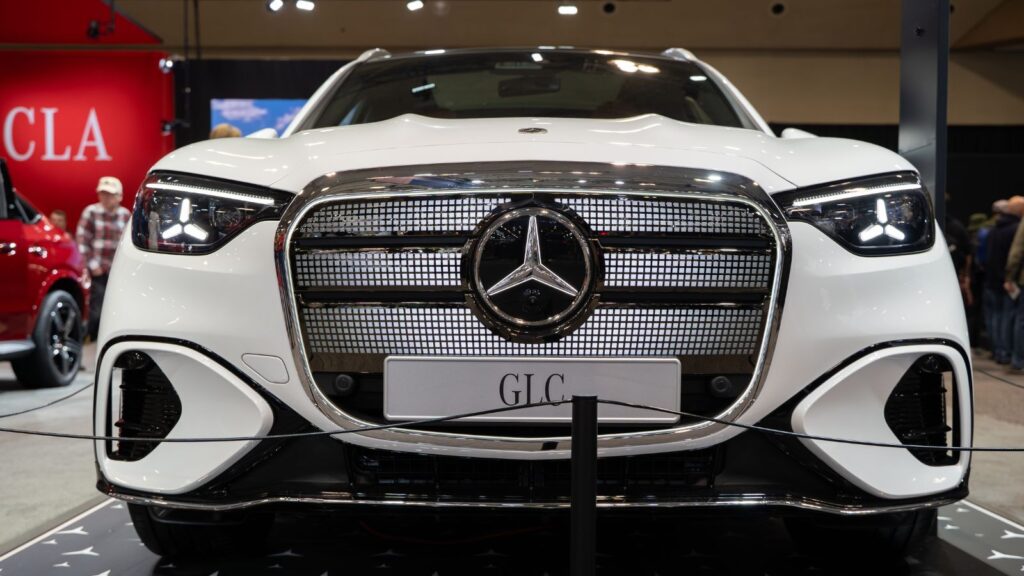
Mercedes-Benz is bringing its electric future into the heart of Toronto’s luxury shopping district, placing the new 2027 electric GLC at the centre of an immersive experience designed to showcase the next generation of premium vehicles.
The all-electric SUV is being featured at Mercedes-Benz Studio Toronto inside Holt Renfrew’s Bloor Street flagship, giving Canadians another opportunity to explore its technology, design, and luxury features. Although the GLC previously appeared at Toronto’s Canadian International AutoShow in February, the November presentation marks a new stage in its Canadian introduction.
With 483 horsepower, an estimated driving range of up to 563 kilometres, and a starting MSRP of $78,400, the electric GLC arrives as established luxury automakers compete to make electric vehicles more appealing to Canadian drivers.
Mercedes-Benz Turns Toronto’s Luxury Shopping District Into an Electric Showcase
Rather than relying exclusively on a conventional dealership unveiling, Mercedes-Benz has chosen an unusual setting to showcase its newest electric SUV. The vehicle is being featured at Mercedes-Benz Studio Toronto, located inside Holt Renfrew at 50 Bloor Street West. The space originally opened in June 2026 and combines automotive displays with luxury retail, hospitality, and personalized experiences. Its latest transformation, announced November 5, introduces a holiday-inspired presentation that runs through December 31. Visitors can explore the electric GLC while discovering special collections and other displays designed around the comforts of upscale travel.
The approach reflects a broader effort to make electric vehicles feel like a natural extension of luxury ownership rather than an unfamiliar technological experiment. Instead of focusing entirely on batteries and specifications, Mercedes-Benz is emphasizing comfort, personal attention, and craftsmanship. Visitors can examine interior materials, paint finishes, and customization options in an environment resembling a premium retail experience. For customers who may be curious about electric vehicles but hesitant to make the transition, the setting offers a relatively informal opportunity to become familiar with the technology.
The Electric GLC Brings a Familiar Mercedes Name Into a New Era
The electric GLC is not simply a conventional GLC with its engine removed. Mercedes-Benz developed it around an electric-first vehicle architecture, giving designers different opportunities to arrange the battery, cabin, and drivetrain. The name, however, is deliberately familiar. The GLC has long been one of the company’s most important models worldwide, so applying it to a new battery-powered SUV makes the transition easier to understand. Its global unveiling took place in September 2025, and production began ramping up at the company’s Bremen plant in Germany during 2026.
That connection between familiar styling and new engineering may matter more than an unconventional badge would. A family comparing electric and gasoline SUVs still needs the same fundamentals: passenger room, useful storage, confidence in bad weather, and a vehicle that feels comfortable on a long drive. Mercedes-Benz is keeping the GLC’s recognizable identity while building in newer software, an electric drivetrain, and packaging designed for battery power. The result is intended to expand the GLC family, rather than make the gasoline model disappear overnight.
Canadian Pricing Starts at $78,400, but Premium Features Raise the Cost
Mercedes-Benz Canada’s October 20 pricing announcement gives buyers a clearer starting point than many early electric-vehicle reveals. The 2027 GLC 400 4MATIC Electric has a manufacturer’s suggested retail price of $78,400, while the company lists an all-inclusive selling price of $84,491 before applicable sales taxes. That higher figure includes specified delivery and dealer-related charges. It is a meaningful distinction for anyone who has seen a headline price rise sharply after fees appear on a purchase worksheet.
The standard equipment list is substantial, but the available packages can raise the bill further. Mercedes-Benz lists an Exclusive package at $2,500, Pinnacle at $5,800, and Pinnacle Plus at $8,500, each before tax. Upper-level features include the large Hyperscreen display, upgraded audio, and front-seat massage. For a household trading in a premium gasoline SUV, the comparison will involve more than the sticker: financing terms, insurance, charging costs, and the value placed on optional comfort features all influence the decision. Mercedes-Benz says Canadians can configure and order the vehicle through authorized dealers.
Standard All-Wheel Drive Delivers 483 Horsepower
The launch version of the electric GLC is not designed to feel like a compromise on performance. Its two electric motors produce a combined 483 horsepower and 590 pound-feet of torque, with 4MATIC all-wheel drive fitted as standard. Mercedes-Benz quotes a 0-to-100-km/h time of 4.3 seconds, acceleration that would be exceptionally quick for a vehicle carrying children, luggage, and groceries. Electric motors provide immediate response, which can make merging onto a highway or pulling away from a traffic light feel effortless.
Still, the more relevant question for many Canadian drivers is how that performance translates into daily control. A wet commute through Toronto, a snowy residential street in Ottawa, or a steep driveway in Quebec places a different demand on a vehicle than a straight-line acceleration test. All-wheel drive helps distribute power, but proper winter tires and careful driving remain essential when traction is limited. Available rear-axle steering and AIRMATIC air suspension add another layer of sophistication, although buyers should confirm whether those features are included in their chosen configuration.
A 563-Kilometre Range Targets Everyday Driving and Longer Trips
The GLC’s battery specifications suggest Mercedes-Benz understands that charging convenience now matters as much as acceleration. Its 94-kWh battery supports an estimated Canadian driving range of up to 563 kilometres. That is enough for many commuters to drive several days between charges and gives longer-distance travellers more flexibility when deciding where to stop. It is also worth separating that Canadian figure from the higher provisional range Mercedes-Benz publicized around the SUV’s earlier European debut, which was based on different testing assumptions.
The vehicle uses an 800-volt electrical architecture and supports DC fast charging at up to 330 kW. Under optimal conditions, Mercedes-Benz says it can add roughly 260 to 303 kilometres of range in 15 to 20 minutes. Those numbers are promising, but they are not a guarantee at every roadside station. Battery temperature, charge level, weather, and the actual power available from the charger can change the result substantially. For Canadian owners, dependable charging stops will matter more than achieving the maximum advertised speed once.
Mercedes-Benz Introduces a More Intelligent Digital Interior
Inside, Mercedes-Benz is asking buyers to think of the electric GLC as a technology product as well as a vehicle. Standard equipment includes a 10.3-inch digital instrument cluster and a 14-inch central display, together with navigation incorporating Google’s mapping technology and electric-route intelligence. The fourth-generation MBUX system runs on the company’s MB.OS operating platform, which also supports an AI-powered voice assistant. Rather than navigating multiple menus while driving, occupants are meant to be able to request information or adjust certain functions through conversation.
The biggest visual statement is optional: a 39.1-inch MBUX Hyperscreen spanning much of the dashboard. It gives the cabin a futuristic appearance, but Mercedes-Benz reserves it for higher equipment packages, so buyers should not assume every GLC on a showroom floor has it. Technology also extends beyond entertainment. Available driver-assistance features and standard parking assistance are meant to reduce everyday friction, particularly in crowded urban spaces. None of that eliminates the driver’s responsibility, and the long-term test will be whether the controls remain intuitive after the novelty of a giant screen fades.
Luxury Comfort Meets Practical Family Space
The luxury story is not limited to horsepower and screens. Mercedes-Benz equips the electric GLC with heated front seats, a heated steering wheel, and a fixed panoramic glass roof as standard, all features that can make a difference during a Canadian winter. Higher packages add amenities such as ventilated front seats, massage functions, and the SKY CONTROL panoramic roof, which can display 162 illuminated stars. The effect is theatrical, but it also shows how far premium manufacturers are willing to go to make an electric cabin feel distinctive.
Useful space may be a stronger selling point after the showroom visit. Mercedes-Benz lists a 4.5-cubic-foot front trunk for smaller bags or charging accessories and as much as 61.4 cubic feet of rear cargo room with the back seats folded. That leaves possibilities for a weekend trip, children’s sports equipment, or a bulky purchase without treating the SUV like a special-occasion vehicle. Optional AIRMATIC suspension also targets ride comfort. The important distinction is between the comfort buyers receive as standard and the expensive extras on a display vehicle.
BMW, Audi, and Other Luxury Brands Intensify the Electric SUV Competition
Mercedes-Benz is entering a category in which the familiar German luxury brands are no longer competing only against one another’s gasoline SUVs. BMW has announced a Canadian starting MSRP of $75,900 for the 2027 iX3 50 xDrive, with a certified range of up to 698 kilometres and DC charging capability of up to 400 kW. Audi’s Q6 e-tron also offers fast charging and an advertised range exceeding 523 kilometres in its Canadian materials. Those figures give prospective GLC buyers credible alternatives to compare without leaving the premium segment.
The comparison is not as simple as selecting the longest range or the lowest starting price. Each manufacturer uses different suspension tuning, interior layouts, driver-assistance packages, and service experiences to make its case. The Mercedes counters with 483 horsepower, a long list of standard comfort features, and a cabin built around its newest digital platform. Meanwhile, electric SUVs from Genesis and Porsche broaden the choice even further. A Canadian buyer shopping in this price bracket can now weigh several distinct interpretations of what an electric luxury vehicle should be.
Canada’s Growing EV Market Creates an Opportunity for Mercedes-Benz
The timing of the electric GLC’s arrival comes amid renewed growth in Canada’s zero-emission vehicle market, although adoption remains far from universal. Statistics Canada recorded 58,811 new zero-emission vehicle registrations in the second quarter of 2026, accounting for 10.7 per cent of all new motor vehicle registrations. That was up from 8.6 per cent a year earlier. Registrations of battery-electric vehicles alone rose 37.4 per cent year over year, indicating that demand has continued even as affordability and charging concerns remain part of the discussion.
Ontario offers Mercedes-Benz a particularly relevant audience. Statistics Canada reported a 46.6 per cent year-over-year increase in new zero-emission vehicle registrations in the province during that same quarter. Those figures do not establish how many customers will spend more than $80,000 on a premium SUV, but they do show why automakers want their newest electric models in front of Canadian shoppers. The challenge is converting curiosity into ownership among households that can afford a luxury vehicle yet still want practical reassurance about winter driving, charging access, and resale value.
Charging Infrastructure and Ownership Costs Will Determine Its Success
Fast-charging promises are only useful when owners can find compatible equipment. Transport Canada’s electric-vehicle dashboard listed 40,119 public light-duty EV chargers across the country as of June 2026, including 8,826 Level 3 fast chargers. Mercedes-Benz says its MB.CHARGE Public service integrates access to several North American networks, including FLO, Ivy, and eligible Tesla Superchargers. Drivers still need to check connector compatibility, possible adapter requirements, station availability, and charging power before planning a journey around a particular location.
Purchase incentives are another practical limitation. Canada’s Electric Vehicle Affordability Program offers up to $5,000 in 2026 for eligible battery-electric vehicles, but most imported vehicles must have a final transaction value of $50,000 or less. With an advertised all-inclusive Canadian price of $84,491, the electric GLC is well beyond that threshold. Mercedes-Benz is therefore selling comfort, performance, and convenience rather than affordability. Toronto’s showroom presentation may attract attention, but customer confidence will ultimately depend on how comfortably the GLC handles ordinary ownership after the lights and holiday displays are gone.
