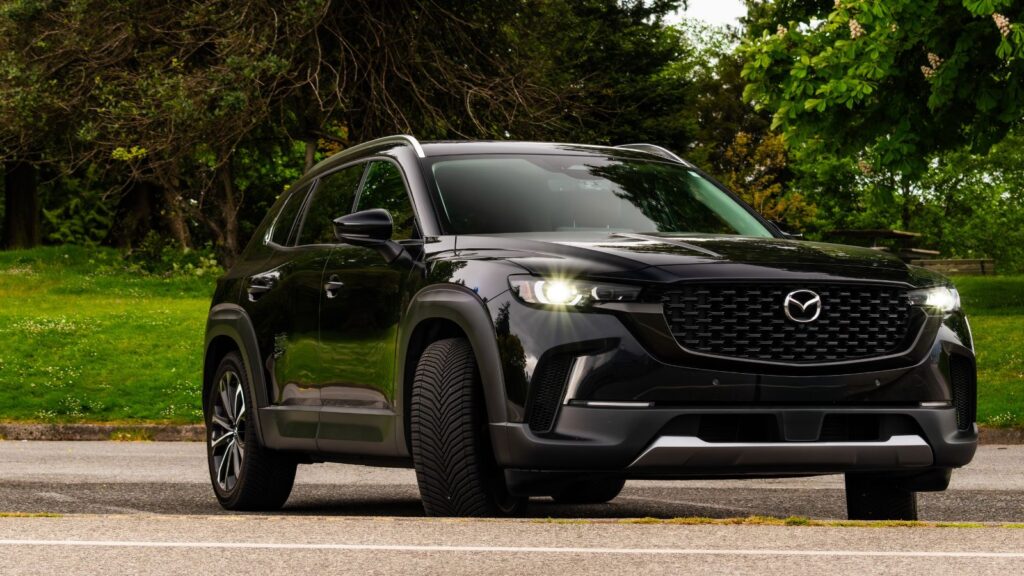
An SUV that once helped drive Mazda’s growth in Canada has virtually disappeared from the automaker’s new-vehicle sales figures. Mazda Canada recorded zero CX-50 sales in October 2026, compared with 177 during the same month last year, representing a staggering 100 per cent year-over-year decline. Through the first ten months of 2026, the crossover managed just 168 sales nationwide.
However, the dramatic figures tell a more complicated story than Canadian drivers simply losing interest. Mazda suspended production of CX-50s destined for Canada in May 2025 amid escalating automotive tariffs between Canada and the United States. While the Alabama-built SUV continues finding buyers south of the border, its Canadian sales have nearly vanished, highlighting how trade policies can reshape vehicle availability and leave dealerships without models that once contributed significantly to their business.
October’s Sales Figures Confirm a Complete Collapse
Mazda Canada’s official sales report, released November 3, 2026, confirmed that not a single CX-50 was recorded as sold during October. The result represents a complete reversal from October 2025, when the automaker reported 177 sales. The 100 per cent decline is mathematically accurate, although the previous year’s monthly total had already fallen substantially from the model’s stronger periods. What makes the latest numbers particularly striking is that the CX-50 was previously an important contributor to Mazda’s Canadian SUV lineup, rather than a niche vehicle with consistently low sales.
The zero-sales figure also requires context. Mazda’s report measures new-vehicle sales, meaning it does not indicate that existing CX-50 owners have abandoned their vehicles or that Canadians have stopped purchasing used examples. More importantly, monthly sales alone cannot distinguish between a vehicle that customers are unwilling to buy and one that dealerships can no longer readily supply. That distinction is central to understanding what happened to the CX-50 in Canada.
Mazda’s Canadian CX-50 Supply Problems Began in 2025
The disappearance of the CX-50 from Canadian sales reports did not begin in October 2026. On April 23, 2025, Mazda North American Operations announced that production of CX-50 vehicles intended for Canada would be temporarily suspended beginning May 12. The decision came during an escalating tariff dispute affecting cross-border automotive trade. Mazda emphasized that the change would not reduce overall production at its Alabama manufacturing facility. Instead, vehicles that would otherwise have served Canada could be redirected toward American customers.
For Canadian Mazda dealerships, the announcement introduced an unusual challenge. A vehicle could remain desirable to potential customers while becoming increasingly difficult to obtain. At the time, Mazda Canada acknowledged that retailers still had limited inventory and vehicles already in transit, allowing some sales to continue. However, those remaining vehicles were not an unlimited supply. As available stock diminished, sales naturally faced growing constraints. The original suspension was described as temporary, but Mazda’s subsequent Canadian sales figures show that the model had not returned to meaningful sales volumes by October 2026.
Canada’s Retaliatory Tariffs Changed the Economics
The CX-50’s Canadian difficulties are closely connected to where the SUV is manufactured. On April 9, 2025, Canada introduced retaliatory tariffs of 25 per cent on certain American-built vehicles in response to U.S. automotive trade restrictions. The measures apply differently depending on whether vehicles comply with the Canada-United States-Mexico Agreement (CUSMA). Non-compliant vehicles face tariffs on their full customs value, while compliant vehicles are subject to tariffs on the portion not originating in Canada or Mexico. This distinction matters because the policy does not automatically add 25 per cent to every American-built vehicle’s retail price.
For Mazda, the consequences extended beyond the possibility of higher prices. The automaker faced a business decision about whether importing CX-50s into Canada remained economically attractive. Mazda subsequently redirected production toward the American market. Canadian government documents confirm that automotive counter-tariffs remained in place during 2026, although targeted relief arrangements were available to qualifying manufacturers. The situation demonstrates how tariffs can reduce vehicle choice without consumers necessarily seeing a dramatic price increase. Sometimes the vehicle simply stops arriving at dealerships.
The Alabama Factory Continued Building CX-50s for Americans
The Canadian sales collapse becomes particularly revealing when compared with what happened at Mazda’s American manufacturing operations. The CX-50 is assembled at Mazda Toyota Manufacturing in Huntsville, Alabama, a joint venture between Mazda and Toyota that began producing the crossover in January 2022. When Mazda suspended Canadian-bound production, it stated that the factory’s overall output would remain unchanged. The company intended to increase production destined for American customers instead, keeping the manufacturing operation running despite the disruption in Canadian sales.
That approach appears to have supported substantial sales in the United States. Mazda reported 8,249 CX-50 sales in America during October 2026, bringing the model’s year-to-date total to 103,600 vehicles, an increase of 17.8 per cent over the corresponding 2025 period. Meanwhile, the Canadian market recorded no October sales whatsoever. Mazda also identified October 2026 as its second-best October for gasoline-powered CX-50 sales in the United States. The contrast highlights that the vehicle itself has not disappeared from North American production or American showrooms. Instead, Mazda has redirected its sales efforts toward the market where the business conditions are more favourable.
From More Than 10,000 Annual Sales to Just 168 Vehicles
The CX-50’s earlier Canadian performance makes its current situation especially unusual. In 2024, Mazda sold 10,759 CX-50s across Canada, an increase of 88.4 per cent from the 5,711 delivered in 2023. The vehicle became Mazda Canada’s fastest-growing model that year, benefiting in part from the introduction of the CX-50 Hybrid. Those results meant the crossover accounted for nearly 15 per cent of Mazda’s 72,226 Canadian vehicle sales in 2024. It had established itself as a meaningful part of the company’s lineup.
The first signs of a major reversal became visible in 2025, when annual CX-50 sales declined to 8,044 vehicles, a decrease of 25.2 per cent. The deterioration became far more severe in 2026. Through October, Mazda recorded only 168 CX-50 sales, compared with 7,816 during the first ten months of 2025. That represents a 97.9 per cent year-over-year decline, equivalent to 7,648 fewer vehicles. For a model that had recently been selling thousands of units annually, the remaining volume is almost negligible. The figures illustrate how quickly an established vehicle can lose its position in a national market when its supply is interrupted.
Six Consecutive Months Without a Single Reported Sale
A closer examination of Mazda’s monthly results reveals that October’s zero-sales figure was not an isolated event. In April 2025, shortly before the Canadian production suspension began, the CX-50 recorded 1,479 sales. That number declined to 907 in May, 650 in June, 423 in August and 177 by October. December 2025 ended with just 88 reported sales. The steady deterioration is consistent with dealerships gradually working through limited remaining inventory, although Mazda’s monthly figures do not identify exactly which vehicles were drawn from existing stock.
The decline continued throughout 2026. During January, Mazda still managed to sell 54 CX-50s, but the remaining supply apparently became increasingly limited. Only six sales were recorded in April, bringing the year-to-date total to 168 vehicles. Mazda subsequently reported zero sales in May, June, July, August, September and October. That makes October the sixth consecutive month without a recorded new-vehicle sale. Rather than representing a sudden collapse in customer demand during a single month, the pattern points toward a prolonged supply disruption that eventually reduced reported sales to nothing.
Canadian Shoppers Also Lost Access to the CX-50 Hybrid
The impact extends beyond drivers interested in a conventional gasoline-powered SUV. Mazda had offered the CX-50 in Canada with standard all-wheel drive and an available turbocharged engine, giving buyers an alternative to the company’s popular CX-5. The automaker also introduced the CX-50 Hybrid for the 2025 model year, combining a 2.5-litre hybrid powertrain with electric all-wheel drive. Mazda advertised estimated combined fuel consumption of 6.2 litres per 100 kilometres, giving the crossover an additional selling point for Canadians concerned about fuel costs.
The interruption therefore affected shoppers considering both conventional and electrified versions of the vehicle. Mazda Canada’s website now identifies the CX-50 and CX-50 Hybrid as sold out, reflecting the shortage of new inventory. Existing vehicles may still be found on the used market, but buying pre-owned does not provide the same freedom to select a preferred new-model trim, colour or equipment package. For a family that previously considered the CX-50 Hybrid as an alternative to other fuel-efficient SUVs, the suspension has effectively narrowed the range of Mazda vehicles available for comparison.
Mazda’s Other SUVs Continue Finding Canadian Buyers
Despite the CX-50’s disappearance, Mazda’s remaining crossover lineup demonstrated considerable resilience during October 2026. The CX-30 recorded 1,472 sales, an increase of 3.3 per cent compared with October 2025 and its strongest October performance on record. The larger CX-70 delivered an even more impressive monthly increase of 28 per cent, reaching 517 vehicles. Meanwhile, the three-row CX-90 recorded 880 sales, representing growth of 22.9 per cent. These results demonstrate that Canadian interest in Mazda SUVs has not disappeared simply because one model has stopped selling.
The year-to-date figures reinforce that distinction. Through October, CX-30 sales reached 14,347 vehicles, an increase of 2.1 per cent, while the CX-70 recorded 4,561 sales, up 2.2 per cent. The CX-90 performed even better, with 8,107 deliveries representing growth of 12.8 per cent. Although these vehicles occupy different positions within Mazda’s lineup, their performance suggests the brand continues attracting Canadian SUV buyers. However, the figures do not establish how many former CX-50 shoppers switched to another Mazda or purchased a competing vehicle.
The CX-5 Remains Mazda’s Most Important Canadian SUV
The Mazda CX-5 continues serving as the foundation of the automaker’s Canadian business. In October 2026, Mazda recorded 2,580 CX-5 sales, making it the company’s best-selling vehicle for the month. That figure represented a 14.2 per cent decline from the 3,007 vehicles sold during October 2025. Nevertheless, the longer-term picture remained positive. Through the first ten months of 2026, Canadian CX-5 sales reached 24,387 vehicles, an increase of 2.2 per cent from the corresponding period last year. Mazda also introduced the redesigned 2026 CX-5 to Canadian showrooms earlier in the year.
For customers who previously considered the CX-50, the CX-5 remains an obvious Mazda alternative, particularly for those seeking a compact SUV with standard all-wheel drive. However, the two vehicles were designed with somewhat different priorities, and their features are not interchangeable. Buyers attracted to the CX-50’s more adventure-oriented positioning or its available hybrid powertrain may not find an exact replacement in the conventional CX-5. The stronger CX-5 year-to-date figures demonstrate that Mazda still has a successful compact SUV, but they do not eliminate the gap created by losing another established model.
The Missing CX-50 Accounts for Most of Mazda’s Overall Sales Decline
Mazda Canada’s broader sales performance appears concerning when viewed without the model-level details. The automaker sold 6,446 vehicles in October 2026, down 5.4 per cent from 6,815 during October 2025. Through the first ten months of the year, overall sales reached 62,594 vehicles, compared with 70,832 during the corresponding 2025 period. That represents an 11.6 per cent decline, equivalent to 8,238 fewer vehicles. However, the CX-50 alone accounted for a year-over-year reduction of 7,648 vehicles, making its disappearance a disproportionately large part of the company’s overall sales decrease.
The mathematics reveal an important distinction. The CX-50’s decline represents approximately 92.8 per cent of Mazda Canada’s net year-to-date sales reduction. Excluding CX-50 sales from both years, Mazda’s remaining models collectively recorded 62,426 sales through October 2026, compared with 63,016 a year earlier. That represents a decline of less than one per cent. This calculation does not prove that every missing CX-50 sale would have occurred without the production suspension. It does demonstrate that Mazda’s overall sales deterioration looks significantly less severe when the impact of its discontinued Canadian supply is separated from the performance of the remaining lineup.
The CX-50 Reflects a Larger Shift Away From American-Built Vehicles
Mazda’s experience is part of a broader change affecting Canada’s automotive marketplace. According to J.D. Power Canada figures reported by Fortune, American-built vehicles accounted for 28.4 per cent of Canadian new-vehicle sales during the first half of 2026, compared with 35.4 per cent during the same period in 2025. That represents a seven-percentage-point decline in market share within a year. Meanwhile, the share of Canadian sales represented by Japanese-built vehicles increased from 13.7 per cent to 16.6 per cent. These changes suggest automotive sourcing patterns have shifted substantially amid ongoing trade restrictions.
For manufacturers, the country where a vehicle is assembled has become an increasingly important consideration when deciding which models to supply to Canada. A vehicle manufactured in Japan or Mexico may face different import costs than an otherwise competitive model built in the United States. That can influence pricing, production allocation and ultimately the choices available to Canadian consumers. The CX-50 provides a particularly clear illustration because Mazda explicitly redirected Canadian-bound production toward American buyers. Its sales collapse therefore reflects more than the fortunes of a single crossover. It demonstrates how trade tensions can influence which vehicles Canadians can purchase, even when those vehicles remain successful elsewhere.
The CX-50’s Canadian Future Depends on More Than Customer Demand
Whether the Mazda CX-50 returns to meaningful sales volumes in Canada remains uncertain. When Mazda first announced the suspension of Canadian-bound production in April 2025, the company described the decision as temporary and indicated that future actions would depend on government negotiations, market conditions and policy developments. Canada’s automotive counter-tariffs remained in place through 2026, although the federal government renewed a remission framework offering relief to eligible manufacturers that meet specified production and investment conditions. Those arrangements do not amount to a universal removal of tariffs on American-built vehicles.
For Mazda, resuming CX-50 sales would require a commercial decision that accounts for import costs, production allocations and the prospects for Canadian demand. As of early November 2026, the available company announcements do not establish a firm timetable for restarting Canadian-bound production. Existing owners can continue operating their vehicles, and shoppers may find pre-owned CX-50s, but neither changes the new-vehicle sales situation. October’s zero-sales result is therefore significant for what it reveals about the consequences of disrupted automotive trade. A crossover that once generated more than 10,000 annual Canadian sales has effectively disappeared from new-vehicle sales reports, not because the company stopped building it, but because the business conditions governing where those vehicles are sold changed dramatically.
