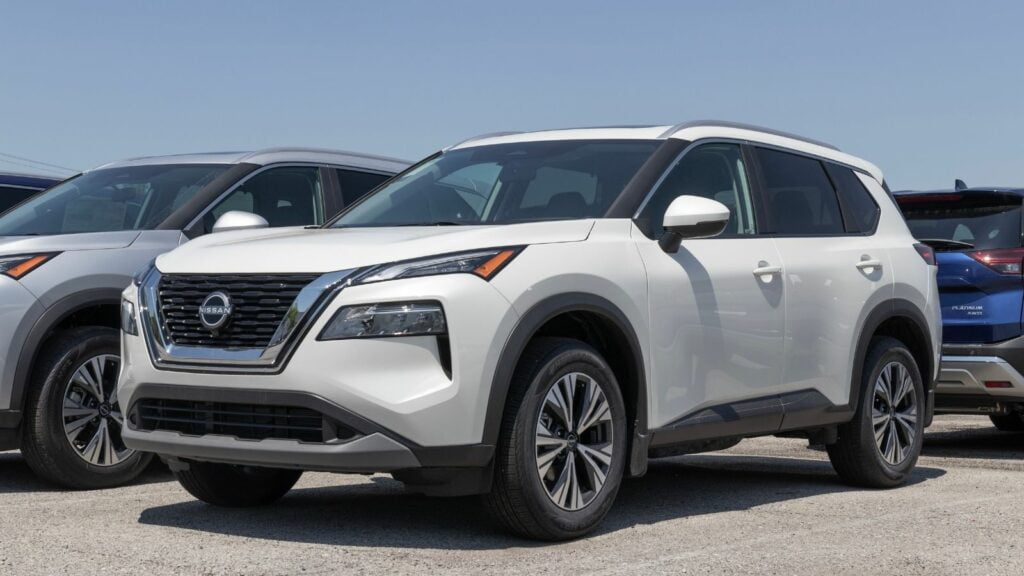
Canadian drivers finally have a new hybrid version of Nissan’s popular Rogue SUV arriving at dealerships, but the initial price is considerably higher than the advertised starting figure. Nissan confirmed on November 12, 2026, that its all-new 2027 Rogue Hybrid has begun reaching Canadian dealers, with the $47,998 SR all-wheel-drive model leading the rollout. The more affordable $39,998 SV won’t arrive until early 2027, creating an $8,000 difference for buyers deciding whether to purchase immediately or wait.
Beyond the pricing, the launch introduces Nissan’s third-generation e-POWER technology to the North American Rogue lineup, promising electric-motor performance without requiring external charging. For Canadian families balancing fuel costs, vehicle prices, and everyday practicality, the newest Rogue presents an interesting choice at an increasingly competitive moment for hybrid SUVs.
Canadian Dealerships Are Receiving the SR Model First
Nissan says the 2027 Rogue Hybrid began reaching Canadian dealerships on November 12, 2026, with the SR all-wheel-drive trim arriving first. The announcement marks an on-sale milestone, not another preview. However, Nissan also describes the initial SR shipments as limited quantities. A national launch does not mean every showroom already has a vehicle available for immediate delivery. Dealership inventories, demonstrations and customer orders may move at different speeds.
For shoppers who have spent months waiting for a hybrid Rogue, the development finally makes a test drive possible. Nissan says customers can contact local dealers for stock information and details on local availability. But the opening phase is aimed at buyers comfortable with a higher-specification version. Those hoping to purchase the least expensive Rogue Hybrid are being asked to make a choice: buy the SR now or hold off until the wider range arrives. Availability should always be confirmed directly with dealers.
The $47,998 Starting Price Does Not Include Every Cost
The first Rogue Hybrid carries a Canadian manufacturer’s suggested retail price of $47,998, but that figure is not the same as the amount shown in Nissan’s selling-price calculation. For the SR, Nissan lists $50,845 before sales tax, licensing and registration. Its published calculation includes $2,080 in freight and pre-delivery inspection, a $100 air-conditioning charge and dealer fees of up to $621. The final offer can vary by retailer.
That difference can catch out shoppers comparing vehicles in advertisements. A family budgeting close to $48,000 might discover that the showroom quote has already crossed $50,000 before tax. Financing interest, optional accessories and protection products can widen the gap further. The sensible comparison is therefore between written, itemized quotes, not just starting prices. Nissan also stresses that dealerships set actual transaction prices, so the advertised figure should be treated as a benchmark rather than a guaranteed final bill.
The $39,998 SV Could Be Worth Waiting Until 2027 For
The headline $39,998 price belongs to the Rogue Hybrid SV AWD, which Nissan schedules for early 2027 rather than the initial November rollout. The manufacturer lists a $42,845 selling price for that version before applicable taxes and registration. That creates an $8,000 MSRP gap between the SV and the SR reaching dealers. For a household replacing an aging vehicle, the savings may be large enough to justify keeping the old car for a few months.
Waiting does not mean settling for a stripped-down hybrid. Nissan lists dual 12.3-inch displays, heated front seats, a heated steering wheel and wireless Apple CarPlay and Android Auto among the SV’s equipment. All-wheel drive is included, too. The SV Premium, priced at $42,998 MSRP, adds another rung before the $47,998 SR, while the Platinum tops the range at $50,998. Those three alternatives are also scheduled for early 2027, making timing central to the buying decision.
Nissan’s e-POWER Technology Makes This an Unusual Hybrid
What makes the Rogue Hybrid unusual is the separation between its gasoline engine and the wheels. Nissan’s third-generation e-POWER system uses a turbocharged 1.5-litre three-cylinder engine to generate electricity, while electric motors provide the actual propulsion. A 1.67-kWh lithium-ion battery stores energy for the system. The gasoline engine can switch off when there is enough stored energy, but it remains essential to driving. This is a gasoline-fuelled hybrid, not a battery-electric vehicle.
Because the engine never mechanically drives the wheels, acceleration can feel closer to an electric SUV than to a conventional gasoline model. There is no external charging cable to connect, and drivers refill the tank at regular gas stations. Nissan says versions of e-POWER have reached nearly two million sales since 2016 in 68 countries, although the Rogue application is new to Canada. The architecture is established internationally, but Canadian ownership experience with this model is only beginning.
Standard All-Wheel Drive and 225 Horsepower Add to the Appeal
Under the hybrid’s hood, Nissan’s gasoline engine acts as an onboard generator, but the performance drivers feel comes from electric motors. Together, the system is rated at 225 horsepower. One motor powers the front axle and another powers the rear, making dual-motor all-wheel drive standard. Nissan says its controls adjust power distribution for traction and cornering, while drivers can select modes including Snow, Off-Road, Eco and Sport for different driving conditions. Those are tangible features in Canada.
The technology has earned recognition from independent judges. The Rogue Hybrid appeared on WardsAuto’s 2026 list of 10 Best Engines and Propulsion Systems, alongside other electrified vehicles. Canadian reviewer AutoTrader also reported smooth acceleration and composed handling after driving the new SUV on roads in California. Neither an award nor a warm-weather drive, however, guarantees how the Rogue will behave through several Canadian winters. Early buyers will be among those testing that question in ordinary ownership.
Fuel Economy Could Deliver Meaningful Savings for Canadians
The Rogue Hybrid SR’s estimated fuel consumption is 5.9 L/100 km in the city, 6.6 on the highway and 6.2 combined, according to Nissan’s launch announcement. For perspective, Nissan lists the 2026 gasoline Rogue AWD at 7.6 L/100 km combined in its specifications. The comparison suggests a saving of about 1.4 litres for every 100 kilometres driven, although the vehicles belong to different generations and the hybrid’s figures are still estimates.
At an illustrative 20,000 kilometres annually, that difference would mean 280 fewer litres of gasoline over a year. The dollar benefit depends on pump prices, personal driving habits and actual consumption, not a guaranteed number on a window sticker. Hybrid systems generally recover energy during braking, making city driving important. The Rogue’s estimated city figure is lower than its highway figure, consistent with that advantage. Cold weather, winter tires and long highway journeys could change results for Canadian owners.
One-Pedal Driving and Smooth Stop Aim to Improve Daily Comfort
Nissan is also selling the Rogue Hybrid on how relaxed it feels in daily traffic. Its e-Pedal setting increases regenerative braking enough for the vehicle to slow to a complete stop when the accelerator is released. Another system, called Smooth Stop, adjusts braking pressure near the end of a stop to reduce the forward head movement of passengers. The aim is subtle: less lurching at intersections, fewer abrupt stops and calmer commutes.
Independent first-drive impressions give those claims support. AutoTrader’s Canadian reviewer described quiet, responsive acceleration and praised the Rogue’s stability on uneven California roads. Its gasoline engine can operate quietly in the background while the motors handle propulsion, although it still starts when energy is needed. The driving experience may especially appeal to people curious about electric vehicles but reluctant to depend on charging infrastructure. Still, road tests performed in mild conditions cannot fully predict regenerative-braking behaviour on icy Canadian streets.
Family-Focused Space and Features Make a Practical Difference
For families, the strongest improvements may be the ones noticed outside the driver’s seat. Nissan says the redesigned rear doors open almost 90 degrees, creating a wider opening for lifting a toddler into a child seat or helping an older passenger aboard. Five LATCH anchors in the rear seating area are intended to allow more flexibility in positioning child restraints, including a centre-seat installation. Actual compatibility still depends on the child seat and the vehicle’s owner’s manual.
Cargo capacity also remains substantial. Nissan specifies up to 880.7 litres behind the second row and 1,866.1 litres with the seats folded. A revised liftgate area increases usable length, while a small compartment beside the cargo floor retains a convenient place for items such as windshield-washer fluid. The interior combines modern displays with physical climate controls, a decision that can make simple adjustments easier while travelling. Everyday practicality, rather than just horsepower or screen size, may be what wins over established Rogue owners.
Screens and Driving Aids Vary With the Trim
The price difference between trims brings a technology difference as well. Every Rogue Hybrid receives a 12.3-inch central touchscreen with wireless Apple CarPlay and Android Auto. The SR and Platinum expand that to a 14.3-inch display with Google built-in, including Maps and the Gemini assistant, while the Platinum adds a 10-speaker Bose audio system. Nissan also offers wireless phone charging. Some connected functions may require subscriptions after introductory periods, making ownership costs worth checking before signing.
Driver assistance is another reason the initial SR commands a premium. Nissan lists updated ProPILOT Assist, while higher trims offer automatic lane-change assistance and hands-off support in low-speed highway traffic under specific conditions. Those capabilities are not the same as self-driving: the person behind the wheel remains responsible for monitoring the road and taking control. For shoppers who chiefly want a fuel-efficient family SUV, the SV’s smaller screens may be perfectly adequate. Others may find the SR’s extra equipment worth its higher price.
The Plug-in Hybrid and Gas Rogue Offer Different Choices
The new e-POWER Rogue is not the only electrified version Nissan has offered in Canada. Earlier in 2026, the company introduced a Rogue Plug-in Hybrid Platinum AWD at a starting MSRP of $58,698, with an estimated 61 kilometres of electric driving on a charge. Unlike the e-POWER model, that vehicle can be connected to an external charger and used for many shorter trips without starting its gasoline engine, provided conditions and battery charge permit.
The conventional gasoline Rogue provides another reference point. Nissan’s February 2026 pricing announcement placed its starting MSRP at $34,398, considerably below the newly arriving SR Hybrid. These vehicles serve different needs and include different equipment, so the price gaps should not be mistaken for exact upgrade costs. A household with home charging might value the plug-in’s electric range; another might favour the lower-priced gasoline model. The e-POWER Rogue occupies the middle ground, promising hybrid efficiency without the charging routine or the plug-in’s higher initial price.
Toyota and Honda Provide Serious Hybrid Competition
Nissan is entering a crowded Canadian compact-SUV hybrid market. Toyota’s Canadian-built 2026 RAV4 LE AWD starts at $37,500 MSRP and carries a manufacturer-estimated 5.5 L/100 km combined rating. Its price undercuts the forthcoming $39,998 Rogue Hybrid SV, while its fuel economy compares favourably with Nissan’s published 6.2 L/100 km estimate for the SR. The Rogue SV’s own official consumption rating should be checked when available. Honda’s 2027 CR-V Sport Hybrid, meanwhile, has an MSRP of $46,500 and an estimated combined consumption of 6.4 L/100 km.
Those numbers show why the Rogue’s price and equipment strategy matters. Nissan’s opening SR is priced above Honda’s Sport Hybrid, but its future SV promises a lower initial outlay. A comparison based only on the lowest price could miss meaningful differences in screens, driver assistance, cargo room or road manners. Reviewers have praised the Rogue’s refinement, yet RAV4 and CR-V remain credible alternatives. Actual dealership quotes and back-to-back test drives will matter more than a single specification.
The Deciding Question Is Whether to Buy Now or Wait
The arrival of the Rogue Hybrid gives Nissan an important new product, but it also creates an unusual timing dilemma. Buying the SR in late 2026 means access to the latest e-POWER drivetrain, generous technology and potentially earlier delivery. Waiting until early 2027 opens the door to the $39,998 SV, the $42,998 SV Premium and the $50,998 Platinum. For buyers whose current vehicle is reliable enough to keep, that broader selection could be worth more than being first.
The larger question is long-term value. Nissan says the hybrid battery carries an eight-year or 100,000-kilometre limited warranty, whichever comes first, and the new Rogue Hybrid will be assembled in Japan. Those details are worth checking against competitors’ coverage, financing offers and a household’s annual mileage. With initial Canadian stock limited, buyers should confirm availability, warranty terms and the full tax-inclusive price in writing. The new Rogue’s technology looks promising; choosing the right trim may prove just as important.
