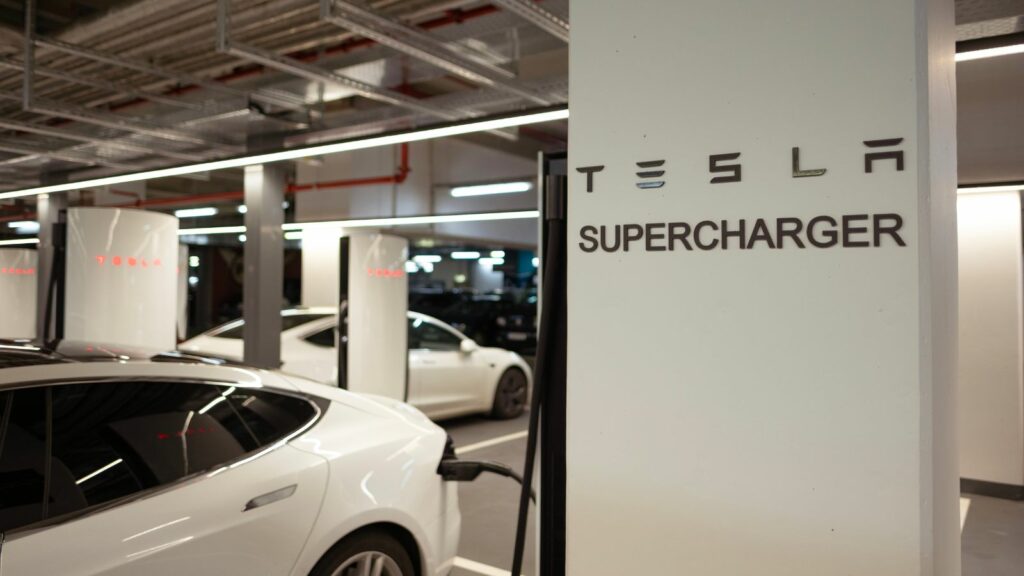
Electric-vehicle drivers travelling through British Columbia’s Okanagan have gained a faster charging option that is no longer reserved for Tesla owners. Tesla has opened a second Supercharger station in Penticton, installing eight V4 charging posts at Skaha Centre on Skaha Lake Road. The new equipment can deliver up to 325 kW, while compatible non-Tesla vehicles can use the site through Tesla’s expanding North American Charging System network. Current pricing is 28 cents per kilowatt-hour for Tesla drivers and eligible members and 38 cents per kWh for non-Tesla EVs. The station effectively doubles Tesla’s Supercharger presence in Penticton to 16 stalls across two locations and arrives as NACS compatibility spreads rapidly across new electric vehicles. For road-trippers, the development is as much about accessibility and charging choice as outright speed.
Penticton Now Has a Second Tesla Fast-Charging Site
The new station is located at Skaha Centre, 3094 Skaha Lake Road, in the southern portion of Penticton. Tesla first identified the location as a future Supercharger site in September 2025, while construction began in June 2026. The finished facility contains eight V4 Supercharger posts, each capable of supporting charging speeds of up to 325 kW under suitable vehicle and battery conditions. It sits a short distance from Highway 97, an important north-south route through British Columbia’s Okanagan Valley.
The opening gives Penticton two Tesla fast-charging locations. The older Riverside Village site at 300 Riverside Drive also has eight stalls but uses V3 equipment rated at up to 250 kW. That station opened in late 2021 and remains available around the clock. Together, the two sites provide 16 Tesla-operated charging stalls roughly four kilometres apart. For local owners, that provides more capacity during busy periods. For travellers heading between communities such as Osoyoos, Kelowna and destinations farther north, it reduces reliance on a single Tesla location when traffic, maintenance or seasonal tourism increases demand.
Non-Tesla Drivers Pay 38 Cents per Kilowatt-Hour
Pricing is one of the most notable aspects of the new site. Current published information shows Tesla owners and eligible members paying 28 cents per kWh at the Skaha Road Supercharger, while non-Tesla users are charged 38 cents per kWh. That means the standard non-Tesla price carries a 10-cent-per-kWh premium over the Tesla/member rate. Tesla pricing can change, however, so drivers should verify the current rate in the Tesla app before beginning a session rather than assuming the launch price will remain permanent.
The 38-cent figure is competitive with several public fast-charging alternatives in British Columbia. BC Hydro increased its fast-charging tariff to 39.69 cents per kWh before tax on April 1, 2026. Penticton’s city-operated Level 3 stations currently charge 39 cents per kWh. Those networks are not directly equivalent because charging speeds, locations, connector availability and potential roaming costs differ, but the comparison puts Tesla’s non-owner price into useful context. Rival EV drivers are not necessarily paying an unusually high premium simply because they are using a Tesla-branded station.
Rival EVs Need the Right NACS Connection
Opening a Supercharger to other brands does not mean every electric vehicle can simply arrive and plug in. Tesla classifies compatible sites as NACS Partner locations. Vehicles already equipped with a North American Charging System port can connect directly, while many CCS-equipped EVs require an approved NACS DC fast-charging adapter supplied or authorized by the vehicle manufacturer. Tesla specifically advises against using unsupported third-party adapters for Supercharging.
The list of automakers with access has expanded dramatically. Tesla currently identifies brands including Ford, General Motors, Honda, Acura, Hyundai, Kia, Genesis, Nissan, Rivian, Volvo, Polestar, Mercedes-Benz, BMW, Toyota, Subaru, Volkswagen, Audi, Porsche, Stellantis, Lucid and Jaguar Land Rover among manufacturers whose compatible vehicles can use participating NACS Superchargers. Access can still vary by model and software configuration. The safest approach is to enter the specific vehicle in Tesla’s app, which shows compatible locations. For drivers who spent years treating Tesla stations as unavailable territory, that represents a fundamental change in the public-charging experience.
V4 Hardware Solves an Old Supercharger Problem
Tesla’s V4 posts are particularly important for non-Tesla vehicles because their charging ports are not all located in the same place. Older Superchargers were designed largely around Tesla vehicles, which traditionally positioned the port near the left rear corner. Some competing EVs place it near the front fender, nose or opposite side of the vehicle. At older stations, that can force a non-Tesla driver to occupy an adjacent space simply to make the cable reach, potentially blocking two stalls with one vehicle.
Tesla says V4 posts use longer charging cables specifically to improve access across different EV designs. The company states that its latest V4 configuration can reach vehicles while they remain in the appropriate Supercharger stall. That seemingly mundane change can make a significant difference as more manufacturers gain access to the network. A fast charger is less useful if connecting requires awkward parking or leaves another charger inaccessible. The Penticton installation therefore brings not only additional power but hardware better suited to Tesla’s increasingly multi-brand customer base.
The 325-kW Rating Is a Maximum, Not a Guarantee
A 325-kW charger does not mean every vehicle will receive 325 kW throughout a charging session. Charging speed depends on the vehicle’s battery architecture, maximum DC charging capability, battery temperature, state of charge and software. Tesla itself notes that the charger and vehicle communicate to determine an appropriate rate. Even cars capable of very high peak speeds generally reduce charging power as the battery fills, especially as they approach a high state of charge.
Tesla’s own vehicles illustrate the distinction. The company says Model S, Model 3, Model X and Model Y can currently receive up to 250 kW at North American V4 Superchargers, while Cybertruck can reach as much as 325 kW at compatible V4 equipment. Some non-Tesla EVs also have charging limits below the station’s rated output. Battery preconditioning can materially improve performance by bringing the pack closer to an ideal temperature before arrival. For drivers, the practical advantage of a powerful charger is headroom: the infrastructure is less likely to become the limiting component when a capable EV requests a high charging rate.
Tesla’s Older Penticton Site Remains Useful
The new Skaha Centre site does not replace the eight-stall Supercharger at Riverside Village. Tesla’s official location information continues to list the Riverside facility at 300 Riverside Drive as operating 24 hours a day with maximum charging speeds of 250 kW. It is also listed for compatible non-Tesla charging, meaning Penticton now offers Tesla-network access to other brands at more than one part of the city.
Having two geographically separated sites can be more useful than simply doubling the number of plugs in one parking lot. Penticton stretches along Okanagan Lake and toward Skaha Lake, so drivers entering or leaving from different directions may no longer have to cross as much of the city to find a Supercharger. During summer, when tourism increases traffic through the Okanagan, a second station also provides another option if one site becomes congested. Charging infrastructure is ultimately judged not only by peak power but by whether a working stall is available where and when a driver needs one.
Tesla’s Price Is Slightly Below BC Hydro’s Current Fast-Charging Rate
The new station arrives during a broader shift toward energy-based public charging. BC Hydro currently charges 39.69 cents per kWh before tax at fast chargers rated at 25 kW or higher, following an April 2026 tariff adjustment. Once a vehicle stops accepting energy, a 40-cent-per-minute idle fee can apply after a five-minute grace period. The utility has moved away from billing fast charging primarily by time because per-kWh pricing more directly reflects the electricity delivered to each customer.
Penticton’s own municipal network follows a similar approach, with four city-operated Level 3 chargers currently priced at 39 cents per kWh. Those stations are located at City Hall, the Community Centre, Riverside Parking Lot and Skaha Lake Park. Tesla’s 38-cent non-owner price at the new V4 site is therefore slightly lower on an energy basis than those published alternatives, while offering substantially higher theoretical peak power than many older public chargers. Still, price alone does not determine the best stop. Connector compatibility, real-world charging speed, availability and a vehicle’s battery condition can matter just as much.
NACS Is Rapidly Becoming a Common Canadian Charging Standard
The significance of opening Tesla stations has increased because NACS is no longer merely a proprietary Tesla connector in practical market terms. SAE International standardized the design as J3400, creating an industry specification covering its electrical, physical, safety and performance requirements. Natural Resources Canada now describes NACS as a preferred connector type for vehicles in Canada and notes that it has become available for adoption by all automakers.
That transition is gradually reducing one of the headaches of early EV ownership: fragmented charging standards. Many existing Canadian EVs still use CCS1 ports and will depend on adapters for years, while CHAdeMO remains in use on a smaller number of older models. Newer vehicles increasingly arrive with NACS connections or manufacturer-backed access to Tesla’s network. That does not make every charger universally compatible overnight, but it moves the industry toward a common physical interface. The Penticton V4 location is an example of what that transition looks like on the ground—a Tesla-built station designed to serve customers who may never own a Tesla.
British Columbia Is Building High-Power Chargers Beyond Tesla
Tesla is not alone in increasing fast-charging speeds in British Columbia. BC Hydro has been expanding both the number and output of its public chargers. By January 2026, the utility reported more than 800 charging ports across the province and opened its highest-powered installation at the British Columbia Institute of Technology campus in Burnaby. That site includes two 400-kW chargers alongside 180-kW equipment and supports multiple connector types, including CCS, NACS and CHAdeMO in various configurations.
BC Hydro plans to grow its network to 3,500 public charging ports by 2035. Its newer locations increasingly include NACS connectors alongside established formats, reflecting the same industry shift affecting Tesla’s network. The competition is useful for drivers because no single charging provider can conveniently cover every route, town and travel pattern. Tesla’s strength remains its large, established Supercharger footprint, while utilities and other networks can fill geographic or connector gaps. In Penticton, the new V4 site becomes another part of a wider regional charging ecosystem rather than the only public fast-charging choice.
Penticton’s Expansion Makes EV Road Trips Easier to Plan
Charging stops influence electric road trips differently from gasoline refuelling because drivers often plan around charger availability, vehicle compatibility and battery state. Penticton is strategically useful in that regard. Highway 97 connects communities throughout the Okanagan, and the city sits between destinations toward the U.S. border and larger population centres farther north. Adding eight more high-power stalls creates additional flexibility for drivers who need energy before continuing through the region.
The real value may become more visible during busy travel periods than on an ordinary weekday. A station capable of 325 kW can serve compatible vehicles quickly, but eight stalls also mean multiple drivers can charge simultaneously. Opening those stalls to rival brands further increases their usefulness, especially as vehicles from Ford, GM, Hyundai, Kia, Honda, Toyota and other manufacturers migrate toward NACS compatibility. The station does not eliminate the need to check routes, adapters or charging status before travelling. It does, however, make one common problem simpler: in Penticton, a Tesla logo above the chargers no longer necessarily means drivers of other EVs have to keep looking.
The Bigger Change Is Who Can Use Tesla’s Network
Tesla describes its Supercharger network as having more than 80,000 chargers globally and says opening the system to other EVs is part of its effort to encourage broader electric-vehicle adoption. In North America, that process has happened manufacturer by manufacturer as automakers secured Supercharger access, distributed adapters and began introducing NACS-equipped vehicles. A growing number of V4 installations are being designed for that mixed fleet from the beginning.
The Penticton opening captures that transition in a relatively small Canadian city. The headline numbers—325 kW and 38 cents per kWh—matter because they determine how quickly and affordably a compatible EV can recharge. But the more lasting development is interoperability. A Ford, Hyundai, Chevrolet or other supported EV may now be able to use the same high-speed infrastructure once associated almost exclusively with a Model 3 or Model Y. For drivers, charging networks become more useful when the badge on the hood matters less. Penticton’s newest Supercharger is another step in that direction.
