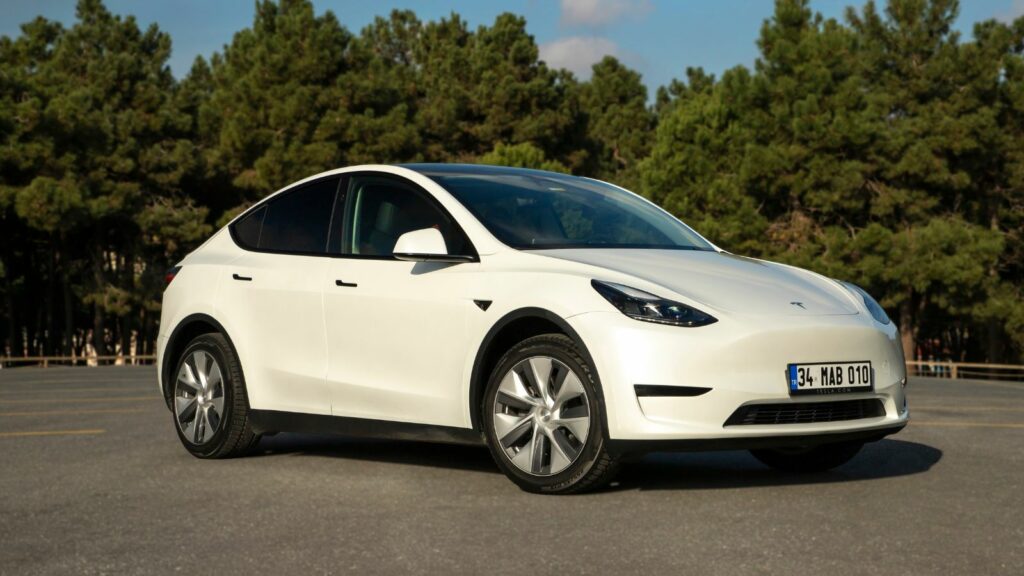
A useful EV feature can feel surprisingly different depending on which side of the border a vehicle is registered. Tesla has expanded access in the United States to an Outlet Adapter that lets compatible Model Y vehicles send up to 2.4 kW of AC power from the traction battery to everyday devices. In Canada, however, Tesla’s own storefront and Model Y documentation still leave Canadian Model Y owners outside that capability.
The distinction is important because this is not full home backup. It is vehicle-to-load power: enough for selected appliances, tools and electronics through a compatible adapter and Gen 3 Mobile Connector. Even so, the U.S.-Canada split gives Canadian owners a new reason to watch Tesla’s regional feature rollouts closely.
Tesla’s U.S. Expansion Is Broader — But Not Universal
Tesla’s U.S. shop now lists the $80 Outlet Adapter as compatible with Model Y Premium, Model Y Performance and Cybertruck. The adapter is rated at 120 volts and 20 amps, with a maximum output of 2.4 kW. It works with Tesla’s Gen 3 Mobile Connector, which plugs into the charge port and provides the pathway for sending battery power outward to connected devices.
The change matters because Cybertruck received Tesla’s most prominent bidirectional-power features first. Still, an important qualifier belongs beside the headline: this does not mean every Model Y sold in the United States can suddenly provide 2.4 kW. Compatibility remains tied to supported configurations. Teslarati reported the Premium expansion on August 14, 2026, while Tesla’s current U.S. shop page names Premium and Performance alongside Cybertruck. That makes the storefront the clearest current indicator of who Tesla considers eligible, even as other documentation may lag behind.
Canadian Model Y Owners Still Face a Clear Regional Wall
Tesla’s Canadian storefront tells a different story. The same Outlet Adapter is listed at C$110 and carries the same rating — 120 volts, 20 amps and 2.4 kW maximum — but Tesla Canada currently says it is available only with Cybertruck. That leaves Model Y owners without Tesla’s official Canadian accessory pathway for a feature now available more broadly south of the border.
Tesla’s Canadian Model Y manual reinforces the exclusion. Its section on powering devices through the charge port says the Outlet Adapter is available for Model Y Performance but explicitly excludes Canada. The manual also ties availability to market region. For owners comparing similar vehicles across North America, that wording makes the gap difficult to dismiss as a marketing omission. Tesla’s Canadian documentation currently draws the line. No official Canadian rollout date for Model Y was published in the sources reviewed, so U.S. expansion should not be treated as a Canadian launch.
What 2.4 kW Actually Means in Daily Use
A 2.4-kW output turns an EV battery into a useful portable electricity source, but not a replacement for professionally installed whole-home backup. Tesla says compatible Model Y vehicles can use the Outlet Adapter for devices including space heaters, e-bikes and power tools. Owners can also set a discharge limit and start or stop Powershare from the touchscreen or Tesla mobile app.
There are practical limits. Tesla specifies a 20-amp maximum at 120 volts, and Powershare will not start when the high-voltage battery is below 5 percent. Owners must use the Gen 3 Mobile Connector; older versions are not supported. Most importantly, Model Y vehicle-to-load power should not be confused with Cybertruck’s home-backup capability. Tesla says Cybertruck Powershare Home Backup can deliver up to 11.5 kW with dedicated equipment. The Model Y setup is best understood as a mobile outlet for selected loads, not a system designed to energize an entire house.
The Canadian Exclusion Matters Most When the Grid Goes Dark
Canada is a market where portable backup power has practical appeal. The federal government notes that all parts of the country experience occasional outages and identifies freezing rain, hailstorms, high winds and wildfires among common causes. That makes a vehicle capable of powering selected essentials more than a camping novelty, especially for households familiar with storm warnings and restoration estimates measured in hours or days.
Recent history gives the issue weight. The Canada Energy Regulator reported that a major Ontario ice storm in March 2025 left more than one million customers without electricity, with some outages lasting more than a week. A 2.4-kW Model Y outlet would not keep an entire house operating through an event of that scale and should not be presented as whole-home backup. But the ability to run selected electronics, tools or compatible appliances can still be useful when service disappears. That is why regional feature gaps become more noticeable during severe weather.
Tesla Is Not Introducing an Unfamiliar Idea to Canadian EV Buyers
Vehicle-to-load capability is already part of the Canadian EV market. Hyundai Canada says the IONIQ 5 and IONIQ 6 support V2L, allowing the vehicles to act as power sources for appliances, phones and laptops. Hyundai also highlighted a Canadian Arctic road trip in which an IONIQ 5’s V2L capability powered an electric kettle while its driver camped in remote conditions. That example makes the technology easy to understand.
Ford has also sold Canadian vehicles with substantial onboard power. Ford Canada says its Pro Power Onboard system provides 2.4 kW as standard on the F-150 Hybrid and F-150 Lightning, although the battery-electric Lightning is being phased out. The comparison is not perfectly like-for-like because the vehicles and systems differ, but it shows Canadian buyers are familiar with vehicles serving as mobile electricity sources. Tesla’s restriction therefore lands less like an experimental delay and more like a regional capability gap that competitors have already helped normalize.
What Canadian Owners Can Safely Conclude — and What They Cannot
The strongest conclusion today is simple: Tesla’s official U.S. and Canadian support paths are different. The U.S. shop lists Model Y Premium and Performance as compatible with the Outlet Adapter, while Tesla Canada limits the accessory to Cybertruck and explicitly excludes Canada in Model Y documentation. What the public record does not establish is why. Tesla has not provided, in the sources reviewed, a clear Canadian explanation involving hardware, regulation, certification or an activation date.
That uncertainty makes unofficial workarounds a risky substitute for official support. Tesla’s Canadian warranty guidance says damage caused by third-party vehicle adapters or chargers is not covered, and the Outlet Adapter listing warns about third-party bidirectional equipment. Canadian owners therefore have little reason to gamble an expensive battery system on unsupported hardware. The milestone worth watching is a change in Tesla Canada’s shop, manual or support pages. Until that happens, U.S. availability should not be treated as proof that Canadian activation is imminent.
