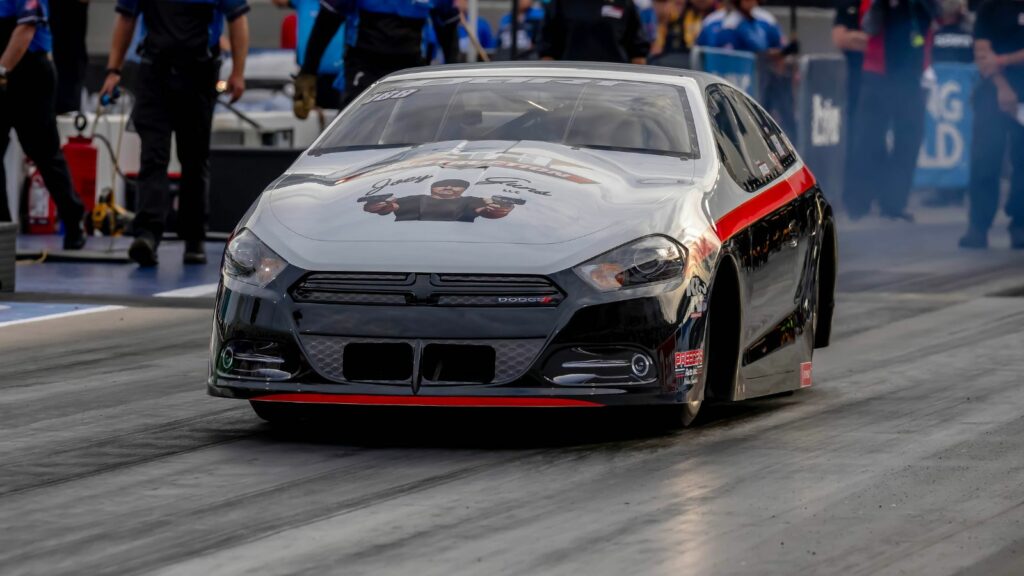
The sound of high-horsepower doorslammers is back at Toronto Motorsports Park as the Canada Heads Up Shootout Series stages Race 4 of its 2026 campaign in Cayuga, Ontario. Scheduled for August 15 and 16, the weekend brings together Pro 10.5, X275, Super Street, EZ Street, Street275 and several other car and motorcycle categories.
The timing makes this round particularly important. The 2026 campaign opened in June as a six-event season, meaning the August stop moves competitors deep into the championship schedule. For Ontario’s fast-door-car community, Cayuga is more than another date on the calendar. It is a familiar proving ground where small tires, enormous power and razor-thin starting-line margins can turn months of preparation into a decision lasting only a few seconds.
Race 4 Brings the Heads-Up Crowd Back to Cayuga
Toronto Motorsports Park officially lists Canada Heads Up competition for both Saturday, August 15, and Sunday, August 16. The track’s current schedule places the event squarely in a busy late-summer stretch that also includes Race Cayuga Sportsman Series weekends, NHRA bracket competition and the Labour Day Weekend program. Canada Heads Up, however, occupies its own niche because many of its headline categories are built around direct, side-by-side competition rather than drivers attempting to match predetermined elapsed-time dial-ins.
That distinction creates a straightforward spectacle. When two heads-up cars leave the starting line, the objective is essentially to reach the finish first while staying within the rules of the category. There is little room for hesitation when cars capable of covering an eighth-mile in roughly four seconds are involved. A driver can have a mechanically excellent pass and still lose because the other lane produced a better reaction, a slightly cleaner launch or a stronger final few hundred feet. That immediacy has become central to the identity of Canada Heads Up racing.
Pro 10.5 Has Already Entered Three-Second Territory
Pro 10.5 arrives at Race 4 after a significant performance milestone earlier in the 2026 Canada Heads Up season. Canadian drag-racing coverage reported that Bill Riddle delivered the first three-second performances for a CHU Pro 10.5 car during the June round at Cayuga. That achievement gives the August competition a new benchmark: the category is no longer chasing the possibility of a three-second run at a Canada Heads Up event because the barrier has already been broken.
The numbers illustrate how extreme modern small-tire doorslammer racing has become. In other major Pro 10.5 competition, Drag Illustrated describes cars using 10.5-inch-wide rear slicks while dealing with power levels exceeding 3,500 horsepower. Exact technical regulations vary by series, so those figures should not be treated as the CHU rulebook, but they show the engineering environment surrounding the category. Horsepower alone is not enough. Teams must decide how aggressively to apply it through the tire without spinning, shaking the tires or forcing a driver to lift before the finish.
X275 Makes a Small Rear Tire a Major Engineering Challenge
X275 approaches the same problem from a different direction. The category was developed around the use of a 275-series drag radial, creating a form of heads-up racing in which the tire itself becomes one of the most important performance limitations. Current X275-style rule sets used by major promoters continue to describe the class as eighth-mile, heads-up competition and tightly regulate combinations in an effort to keep different engines and power adders competitive.
Ontario racers have demonstrated that they can compete at a high level under those conditions far beyond Cayuga. Earlier in 2026, Inside Track Motorsport News reported that Canada Heads Up promoter and racer Ian Hill qualified first in X275 at the Lights Out 17 event at South Georgia Motorsports Park. Hill recorded a 4.117-second pass at 175.50 mph and advanced to the semifinals before a mechanical problem ended his run. A performance like that helps explain why X275 attracts attention at home: seemingly modest rear tires are being asked to handle acceleration that would have sounded extraordinary in street-car-based racing not long ago.
The Starting Line Can Decide a Race Before Full Power Arrives
Heads-up racing may showcase engines, turbochargers, superchargers and nitrous systems, but reaction time remains one of the most human parts of the equation. Established X275 formats commonly use a .400-second Pro Tree, where all amber lights illuminate together before green rather than counting down individually. The system rewards anticipation, repetition and the ability to stay composed while sitting beside another loud, highly strung race car preparing to launch at the same instant.
That can make a slower car the winner on a particular pass. If one driver leaves noticeably earlier while remaining legal, the opponent may spend the entire eighth-mile trying to erase the starting-line deficit. Conversely, leaving too early can end a round immediately with a red light. It is one reason the racing can remain compelling even when qualifying numbers suggest that one machine has an advantage. Crew chiefs can tune engines and chassis through data, but a driver still has to stage the car consistently, react under pressure and keep it positioned correctly when thousands of horsepower begin reaching the track.
The Weekend Extends Well Beyond Pro 10.5 and X275
Although Pro 10.5 and X275 provide two of Race 4’s natural headline attractions, Toronto Motorsports Park’s event information lists a much broader collection of categories. Super Street, EZ Street and Street275 are included alongside Pro Bike, short-wheelbase motorcycle competition, index categories and Junior Dragsters. The mixture allows radically different types of machines to share one race weekend without asking them to compete under a single technical formula.
That variety has long been part of the Canada Heads Up formula. During the 2026 season opener on June 6 and 7, Inside Track Motorsport News described the tour as featuring a wide range of classes and noted that the first round also incorporated Ian Hill Racing Productions’ new Pro Mod series. Earlier Canada Heads Up seasons have produced performances ranging from four-second street-style cars to motorcycles and junior racers learning the sport at substantially lower speeds. For spectators, that means the program changes character repeatedly rather than presenting one nearly identical pair of vehicles after another.
Cayuga Remains One of Ontario’s Busiest Drag-Racing Stages
Toronto Motorsports Park’s calendar helps explain why Cayuga continues to occupy such a visible place in Canadian drag racing. The facility operates a quarter-mile drag strip alongside its road-course activities and hosts everything from Friday test sessions to sportsman racing, major feature weekends and heads-up events. Its 2026 schedule includes the Canada Heads Up dates, Race Cayuga Sportsman Series rounds, NHRA bracket finals and a Labour Day Weekend Spectacular, among other programs.
The track also hosted its Nitro Nationals in July 2026, with Toronto Motorsports Park advertising NHRA Top Fuel dragsters, nitro Funny Cars and other exhibition machinery. That breadth matters to grassroots racers. A venue capable of accommodating major professional-calibre machinery can also provide a regular home for local competitors developing cars over an entire season. Canada Heads Up fits neatly between those worlds. Its quickest cars can produce astonishing numbers, yet the pits retain the recognizable atmosphere of regional racing, where family members, friends, engine builders, fabricators and small performance shops often form the crew behind a competitive entry.
Race 4 Comes in the Second Half of a Six-Event Season
The August meeting carries additional weight because Canada Heads Up opened 2026 with a six-event schedule. Inside Track Motorsport News identified the June 6–7 opener as the first of those six rounds. Toronto Motorsports Park’s current calendar subsequently lists additional Canada Heads Up weekends on September 12–13 and October 3–4 after the August 15–16 meeting, leaving competitors limited opportunities to recover from a poor result as the season moves toward autumn.
That creates a different mentality from an early-season race. In June, a broken component or missed tune-up leaves considerable calendar space for recovery. By Race 4, every lost elimination round can become more difficult to replace. Teams chasing season honours also have to balance aggression against reliability. The quickest possible tune may provide a qualifying advantage, but damaged engines, driveline components or tires can consume time and money before the next event. Championship racing therefore becomes partly an exercise in restraint: a car has to be fast enough to win without repeatedly exceeding what the combination can survive.
Ontario Racers Are Testing Their Combinations Against Bigger Fields
One reason the Cayuga competition continues to evolve is that Ontario racers do not operate in isolation. Several competitors connected with the region regularly measure themselves against major American small-tire and doorslammer events. Ian Hill’s X275 performance at Lights Out 17 is one example. Another came at the 2026 World Series of Pro Mod in Florida, where Inside Track reported that Canadian Nick Agostino qualified second in the Pro 10.5 field with a 3.899-second run.
Those trips can feed directly back into Canadian competition. Racing against deeper fields exposes teams to different track surfaces, weather conditions and combinations, while giving tuners more data about how a car responds under pressure. It also raises expectations when those machines return to Ontario. A racer who has qualified near the front at a major U.S. event is no longer judged only against local history; the performance can be compared with some of the quickest similar cars anywhere. Cayuga therefore functions both as a home track and as another test of increasingly international-calibre Canadian equipment.
Track Preparation and Power Management Can Matter as Much as Peak Horsepower
Modern heads-up cars create a paradox: teams spend heavily to produce enormous horsepower, then devote much of their tuning effort to preventing the engine from delivering too much of it too early. A small rear tire can only accept a limited amount of torque before traction disappears. Crew chiefs therefore manipulate boost, ignition timing, fuel delivery, transmission behaviour and other variables to shape how power reaches the pavement during the first portion of a run.
Canada Heads Up history shows what becomes possible when the track and car combination line up correctly. In its review of the 2024 championship finale, Inside Track reported that Toronto Motorsports Park provided strong racing conditions throughout that season and noted that Rob Orofiamma’s EZ Street combination established a 4.37-second class mark. The specific numbers and rules are different from Pro 10.5 or X275, but the underlying challenge is similar. A successful pass is not simply the product of the largest engine. It is a coordinated sequence involving tire temperature, suspension movement, surface grip, power delivery and driver correction.
Cayuga’s August Round Sets Up the Championship Run-In
Once Race 4 concludes, the Canada Heads Up calendar does not leave teams with a long summer to regroup. Toronto Motorsports Park currently lists the series returning September 12–13 and again October 3–4. Those dates turn the August meeting into a gateway to the final portion of the championship rather than an isolated midseason appearance. Every clean run also generates information teams can use when the series comes back to the same facility.
That continuity is one of the advantages of staging the series at Cayuga. Competitors become deeply familiar with the facility, but familiarity does not make every race identical. Temperatures change, track conditions evolve, mechanical combinations improve and rivals discover additional performance between rounds. The car that appeared dominant earlier in the summer may find another team has closed the gap by September. For Pro 10.5 and X275 racers in particular, where small improvements can separate qualifiers and elimination winners, Race 4 offers both immediate stakes and a preview of how difficult the final two weekends could become.
