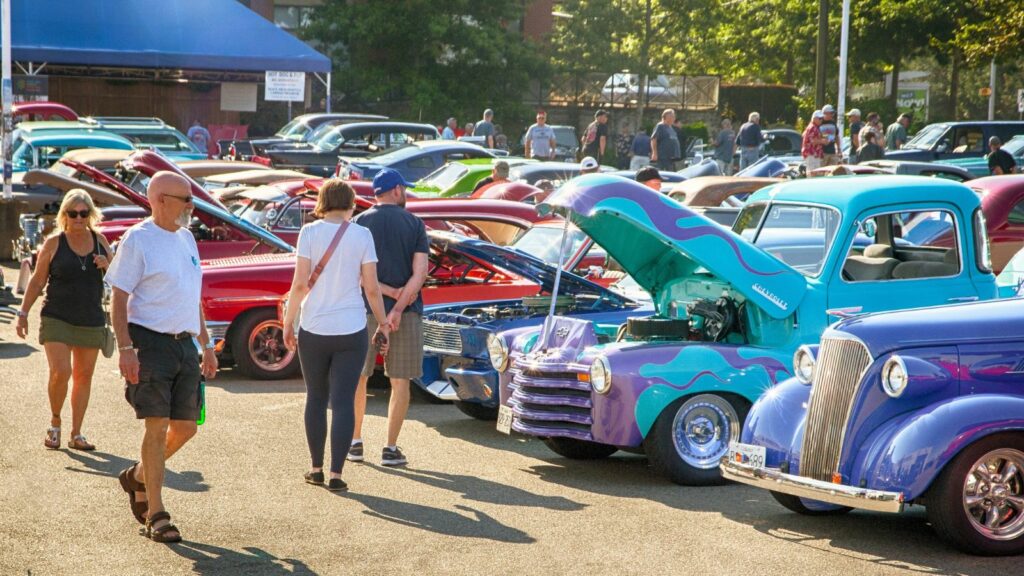
A summer tradition built around polished chrome, carefully preserved engines and community giving is returning to Barrhaven for an eighth year. The Barrhaven Classic Car Show is scheduled for Sunday, August 16, at Clarke Fields Park, bringing vintage vehicles and their owners together while raising money for CHEO. Running from 9 a.m. to 3 p.m., the event combines automotive nostalgia with food, vendors, live entertainment, contests and opportunities to donate. What began as a local idea has developed into an annual gathering sustained by volunteers, sponsors and enthusiasts who still enjoy seeing the vehicles of earlier generations. Its charitable purpose gives the show another dimension: money raised helps support a pediatric health organization that recorded more than 700,000 visits across its programs and services during its 2024-25 reporting year.
The Eighth Edition Brings the Classics Back to Barrhaven
The Barrhaven Classic Car Show is scheduled to return to Clarke Fields Park from 9 a.m. until 3 p.m. on Sunday, August 16, marking the event’s eighth edition. CHEO Foundation’s event calendar describes a gathering featuring a broad variety of vehicles alongside vendors, food, live music and activities. A 50/50 draw and a car quiz offering prizes are also planned. Donations supporting CHEO can be made at the event, tying what might otherwise be a straightforward gathering of automotive enthusiasts to a larger charitable purpose. The format gives families and casual visitors several reasons to attend even if they cannot identify an engine by its sound or distinguish one model year from another.
The event is also distinctly local. Barrhaven sits in Ottawa’s south end, and Clarke Fields has become the show’s recurring home rather than a temporary stop on a travelling automotive circuit. Organizer Keith Goebel told the Barrhaven Bugle that the event is heading into its eighth year at the park, while CHEO Foundation separately lists the 2026 gathering as its eighth edition. That consistency matters for community events: returning to the same neighbourhood year after year allows familiar faces, vehicle owners, volunteers and sponsors to build traditions around it. Instead of presenting classic cars as museum pieces behind barriers, the gathering places them in an informal community setting where owners can explain the histories behind vehicles they have maintained, restored or preserved.
A Local Car Enthusiast Saw an Opportunity Close to Home
The show grew from a straightforward observation by organizer Keith Goebel. After attending automotive gatherings elsewhere in the surrounding region, he believed Barrhaven offered a more central location for local enthusiasts and wondered why a comparable event could not be established there. Goebel told the Barrhaven Bugle that people he spoke with in the community responded positively to the idea. Eight editions later, that initial observation has become an established summer event. His explanation for continuing is equally uncomplicated: people remain interested in seeing what he calls the “classics of yesterday.” That enduring curiosity gives the event a foundation that goes beyond trends in the modern automobile market or whatever happens to be sitting in dealership showrooms this year.
Goebel also emphasizes that the event has never been a one-person operation. He credited Darrell Bartraw as the first person to help get the show moving and said Bartraw continues to assist. His wife, Rosemary, and numerous friends have also contributed over the years. That volunteer-driven structure helps explain how relatively small community gatherings can survive long enough to become traditions. A car may provide the reason for somebody to stop and stare, but people provide the labour required to bring hundreds of individual details together. In this case, the result is an event that links one organizer’s interest in classic vehicles with a broader neighbourhood effort and an ongoing fundraising relationship with CHEO.
One Day at the Park Requires Months of Behind-the-Scenes Work
A six-hour public event can conceal a surprising amount of preparation. Goebel has described the work behind the Barrhaven show as extensive “legwork,” including telephone calls and emails to sponsors and vendors, arranging music and food, securing insurance, organizing toilets, advertising the gathering, finding volunteers and communicating with the city. Each element may appear minor when visitors arrive at the park, but together they determine whether an event actually functions. Outdoor gatherings add another variable organizers cannot control: weather. Goebel specifically cited the hope that conditions cooperate after all the planning has been completed, underscoring how much work can ultimately depend on a single summer day.
That behind-the-scenes effort also provides some perspective on what it means for a community event to reach an eighth edition. A returning show is not simply copied and pasted from one calendar year to the next. Sponsors must be contacted again, vendors coordinated, volunteers recruited and practical arrangements rebuilt. CHEO Foundation itself provides guidance for independently organized community events, including procedures for registering fundraisers and submitting donations. Its community-engagement operation supports a much wider network of fundraising activities throughout the region. The Barrhaven gathering fits into that grassroots model: an event developed outside the hospital system can turn a recreational interest into financial support for pediatric care while giving participants an enjoyable reason to contribute.
The Cars Can Become Rolling History Lessons for Younger Visitors
For longtime enthusiasts, the attraction of a classic-car gathering may be obvious: distinctive bodywork, mechanical simplicity, rare trims and memories attached to vehicles that were once ordinary sights on Canadian roads. Younger visitors can experience the same machines very differently. Goebel said one rewarding part of organizing the Barrhaven event is seeing children encounter the vehicles and learn about history. That observation highlights a role classic-car gatherings can play beyond collecting. A decades-old automobile can demonstrate how transportation changed before touchscreens, electronic driver assistance and computerized controls became standard parts of the modern driving experience. Details that seem unusual today were once simply how cars were built.
The event’s broader programming makes that history accessible without requiring every visitor to arrive as a dedicated collector. CHEO Foundation lists food, vendors, live music, a car quiz with prizes and a 50/50 draw among the planned attractions. That mix gives families something to do while vehicle owners have an opportunity to discuss their cars with people who may be discovering a particular make or era for the first time. The human stories often become as memorable as the machines themselves: an owner may have spent years searching for parts, maintaining an inherited vehicle or restoring something resembling the family car from decades earlier. Those conversations are difficult to reproduce by simply viewing photographs of vintage automobiles online.
The Fundraising Has Added Up Over Multiple Years
The Barrhaven show’s support for CHEO has produced measurable results over its earlier editions. After the sixth annual gathering, organizers reported that the event had raised $2,560 that year. That brought cumulative donations to CHEO over the first six years to $12,360, according to the show’s own published update. The figure is useful because it illustrates how recurring community fundraisers can build impact gradually rather than depending on a single enormous cheque. A few thousand dollars raised during one afternoon can seem modest beside major corporate campaigns, but repeating that effort year after year changes the scale considerably.
The 2026 event continues the relationship, with CHEO Foundation confirming that donations in support of CHEO can be made on site. No final fundraising total for the eighth edition should be assumed before the event has concluded and its proceeds have been counted. What is already established is a history of giving that predates this year’s gathering. That record also gives returning participants a concrete sense of what their registration, contribution or other support can collectively accomplish. Instead of the charitable element functioning merely as a name attached to promotional material, previous fundraising totals show that money has actually moved from a neighbourhood automotive event into support for the children’s health organization.
CHEO’s Patient Volumes Put Those Donations in Perspective
The beneficiary is an organization operating at a scale far beyond what visitors see during one fundraising afternoon. CHEO reported 709,438 total visits between April 1, 2024, and March 31, 2025, including 630,717 outpatient visits. Within that period, its Emergency Department recorded 71,273 visits, while the organization reported 7,448 inpatient admissions and 7,318 surgeries. Other programs handled tens of thousands of encounters, including more than 30,000 mental-health visits and more than 19,000 hematology and oncology visits. The figures help explain why CHEO has such a visible place in fundraising activities throughout Ottawa and surrounding communities.
CHEO’s reach also extends well beyond central Ottawa. The organization provides specialized pediatric care to children and youth from eastern and northern Ontario, western Quebec, Nunavut and other areas. Its main hospital opened in 1974, but its services now encompass hospital care, outpatient treatment, research, developmental and rehabilitation services, mental-health programming and community-based care. The institution has also embarked on a long-term redevelopment intended to modernize pediatric services. Against that scale, a neighbourhood car show will never be the largest fundraising campaign on CHEO’s calendar. Its importance lies somewhere different: it allows residents to contribute through an activity already meaningful to them, bringing the hospital’s charitable support base into ordinary community life.
Donor Money Supports More Than Hospital Rooms
Fundraising for CHEO is not limited to paying for the most visible parts of hospital care. CHEO Foundation says donor support can help improve access to treatment, purchase innovative medical technology and fund initiatives that affect the day-to-day experiences of children and their families. Its examples include music and clown therapy for children facing extended hospital stays as well as assistance designed to reduce financial pressures on families dealing with unexpected medical costs. Donor impact information also covers areas including mental health, oncology, development and rehabilitation, research and urgent needs, demonstrating how charitable contributions can reach different corners of the pediatric-care system.
The community fundraising network supporting those efforts is substantial. CHEO Foundation says it manages money connected to more than 250 events annually, in addition to campaigns, corporate fundraising, bequests and other forms of giving. Independent events can range from major organized gatherings to much smaller initiatives developed by individual residents or community groups. The Barrhaven Classic Car Show belongs to that broader ecosystem. Its distinguishing feature is not simply that classic vehicles are present, but that an existing interest has been turned into a repeatable fundraising platform. People can spend an afternoon admiring cars and enjoying music while the event simultaneously channels community generosity toward services used by children and families across a large region.
Eight Years Show What a Simple Community Idea Can Become
There is an appealing simplicity to how the Barrhaven Classic Car Show began. Goebel saw people travelling to shows elsewhere, concluded that Barrhaven could host one of its own and received encouragement from residents. The complicated part came afterward: securing sponsors, coordinating vendors, arranging entertainment, finding volunteers and repeating the entire process year after year. Reaching an eighth edition suggests the underlying idea continues to resonate. Goebel has said that talking with classic-car owners, seeing happy visitors and watching children learn about automotive history are among the rewards that make the work worthwhile.
The charitable connection gives that longevity additional significance. The show’s first six editions had already generated more than $12,000 for CHEO, and the eighth edition once again gives visitors an opportunity to donate. CHEO Foundation’s own calendar places the gathering among a wide range of independently organized community events supporting children and families. There is no need to exaggerate what one car show can accomplish. Its strength is precisely that it is local and manageable: enthusiasts bring vehicles, volunteers build the day around them, families come to look, and donations accumulate. Eight years after the idea took shape, old cars are still providing Barrhaven with a reason to gather—and a way to support pediatric care at the same time.
