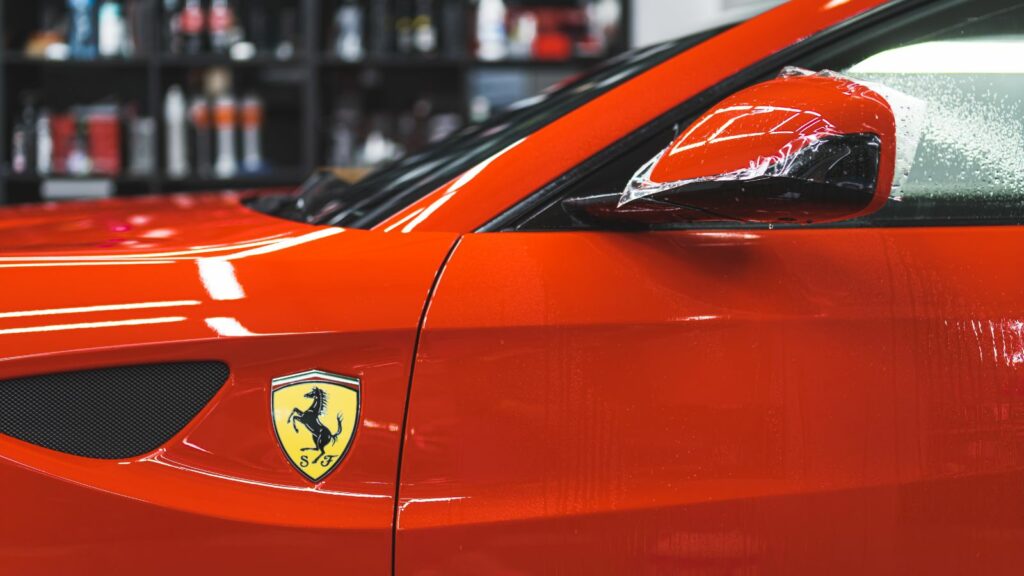
Ferrari’s first fully electric production car has already entered the record books for a reason that has little to do with range or acceleration. A one-off Ferrari Luce known as “Chassis 0” sold for an extraordinary $40 million during RM Sotheby’s Monterey auction, setting a new world record for a new car sold at auction. The result overwhelmed a pre-sale valuation of more than $1.1 million and demolished the $26 million benchmark established by another bespoke Ferrari only a year earlier.
The transaction is remarkable even by Monterey Car Week standards. Yet the price needs context. This was the first production chassis of Ferrari’s first EV, given a unique Tailor Made specification and offered for charity. It was less a conventional vehicle purchase than a collision of automotive history, philanthropy, exclusivity and collector psychology.
A $40 Million Bid Rewrote the New-Car Auction Record
The Ferrari Luce crossed the block at RM Sotheby’s Monterey sale for exactly $40 million, an almost surreal number for a vehicle that had been valued before the auction at more than $1.1 million. The winning amount was more than 36 times that presale figure. More importantly, Ferrari said the transaction established a world record for the highest price ever paid at auction for a new automobile. The unidentified buyer secured a car carrying chassis number ZFF21BUA8T0338000, but its more memorable designation is simply “Chassis 0.”
Timing added to the symbolism. Ferrari unveiled the Luce only in May 2026, making the record-setting auction one of the first major public tests of how collectors might value the company’s electric era. Just three months after a divisive debut, the first production chassis had become an eight-figure collectible. The bidding therefore produced something Ferrari could never achieve through a conventional advertising campaign: a highly visible financial demonstration that at least one collector considered the first electric Ferrari an important piece of the company’s history.
Chassis 0 Is Far More Than an Ordinary Ferrari Luce
The car that commanded $40 million was deliberately separated from normal production Luces. Ferrari’s Tailor Made operation created a special specification based around the theme of light. Its Madreperla Semi-Gloss exterior incorporates a dedicated pigment designed to produce iridescent reflections that change from green toward violet as lighting conditions and viewing angles shift. Ferrari extended the unusually pale treatment to the wheels, brake calipers and even the background of the Prancing Horse branding.
The cabin is equally distinctive. Ferrari specified Perla Le Mans metallic leather made from selected Swiss hides, while secondary elements normally finished in black were rendered in Grigio Corvara. A dedicated plaque identifies the car as the first production chassis in the Luce program. Even after paying $40 million, the buyer does not immediately take it home: RM Sotheby’s says the car will return to Maranello after the auction and is scheduled for final delivery during the first quarter of 2027. That combination of provenance, specification and delayed ceremonial delivery makes it closer to a factory-created collectible than a standard showroom purchase.
Ferrari Broke a Record It Had Set Only One Year Earlier
The Luce did not merely edge past the previous new-car record. It increased it by roughly 54%. At RM Sotheby’s Monterey auction in August 2025, a one-of-one Ferrari Daytona SP3 Tailor Made sold for $26 million. That car had itself been extraordinary: Ferrari created an additional SP3 beyond the original allocation of 599 cars and gave it a distinctive exposed-carbon and Giallo Modena treatment before offering it for charity.
At the time, RM Sotheby’s called the $26 million Daytona SP3 the most valuable new car ever sold at auction. The record survived almost exactly one year. Ferrari’s ability to replace its own benchmark with a dramatically larger number is significant because the two cars represent opposite ends of its engineering story. The Daytona SP3 celebrates Ferrari’s combustion-engine tradition with a naturally aspirated V12, while the Luce abandons the combustion engine entirely. One record celebrated Ferrari’s past; the other effectively placed a multimillion-dollar collector stamp on its electric future.
The Luce Still Has Serious Ferrari Performance Numbers
The attention surrounding the auction price can obscure what Ferrari actually engineered underneath the Luce. Its electric drivetrain uses four motors, allowing individual control of all four wheels. Ferrari lists maximum output at 1,050 cv, enough to propel the car from zero to 100 km/h in approximately 2.5 seconds. Maximum speed is about 310 km/h, while Ferrari claims more than 530 kilometres of driving range on a full charge.
Energy comes from a large 122-kWh battery pack, part of an electric architecture intended to provide both the performance and precise vehicle control expected from a Ferrari. Those specifications are notable because the Luce is not packaged like a conventional two-seat supercar. It has four doors, all-wheel drive and seating for five. That forces Ferrari to balance acceleration and handling with the practical requirements of a significantly roomier vehicle. The result represents a different interpretation of performance: instead of simply replacing a V8 or V12 with electric motors, Ferrari has used electrification to create a format that would have been unusual for the company even with a combustion engine.
Its Design Produced One of Ferrari’s Most Divisive Debuts
Record bidding is particularly striking because the Luce was hardly greeted with universal applause. Its May unveiling generated sharp criticism from enthusiasts and some prominent figures connected with the Ferrari world. The four-door, five-seat proportions looked dramatically different from the low, tightly packaged sports cars traditionally associated with Maranello. Former Ferrari leader Luca Cordero di Montezemolo publicly criticized the vehicle, while social-media reaction produced unflattering comparisons with much cheaper mass-market cars.
Financial markets noticed the controversy as well. Ferrari’s Milan-listed shares closed down 8.4% the day after the unveiling, according to Reuters. Central to the debate was the involvement of LoveFrom, the creative collective founded by former Apple design chief Sir Jony Ive and designer Marc Newson. Their influence helped push Ferrari toward a cleaner and less conventional visual language. That made the Luce more than a technological gamble. It became a test of how far one of the world’s strongest automotive identities could change before traditional customers felt that something essential had been lost.
The $40 Million Result Does Not Make Every Luce a $40 Million Car
One of the easiest mistakes is to treat the auction result as evidence that ordinary Ferrari Luces suddenly have eight-figure market values. They do not. Ferrari introduced the production Luce at a starting price of about €550,000, while RM Sotheby’s valued the unique Chassis 0 at more than $1.1 million before the sale. The extraordinary gap between that valuation and the $40 million winning bid reflects circumstances that cannot be reproduced by another normally ordered example.
Scarcity was only one factor. The buyer was bidding for the first production chassis of Ferrari’s first EV, a one-off factory specification and a permanent place in the marque’s history. The transaction was also structured as a charity auction, meaning normal value calculations were unlikely to behave the same way they would in a dealer showroom or ordinary collector-car sale. For future Luce owners, the result may strengthen the model’s historical profile. It does not establish a conventional $40 million comparable price for production examples that eventually reach the resale market.
The Charity Structure Changed the Economics of the Sale
The money involved has another important destination. Ferrari is donating the proceeds to The Ferrari Foundation for educational initiatives. RM Sotheby’s also waived its buyer’s premium on the Luce lot. Normally, major collector-car auctions add a percentage-based premium on top of the hammer price, meaning the buyer’s total expenditure can be noticeably greater than the final bid. For Chassis 0, that premium was waived, allowing the headline $40 million figure to flow into the charitable transaction.
Ferrari has used this formula before. The $26 million Daytona SP3 sold in 2025 was likewise donated by Ferrari to benefit the foundation and its educational work. Charity auctions can create an unusual bidding environment because participants may be valuing several things simultaneously: the physical object, the public significance of acquiring it, their relationship with the manufacturer and the philanthropic outcome. That helps explain why the Luce’s result should not be evaluated like an ordinary used-car transaction. The auction sold a piece of Ferrari history while also functioning as a major fundraising event.
Customer Demand Has Been Stronger Than the Initial Backlash Suggested
The Luce’s hostile reception in some corners did not translate cleanly into weak orders. During Ferrari’s second-quarter results presentation on July 30, CEO Benedetto Vigna said the company was “very pleased” with how orders were progressing and that demand was in line with expectations. He said buyers included both existing Ferrari customers and newcomers, while interest was geographically broad rather than concentrated in one country.
Separate reporting by the Financial Times indicated that Ferrari had already reached an internal 2026 Luce target of just under 500 cars within roughly two months of the model’s launch, helped by demand from China. Ferrari itself did not publicly confirm that numerical target, so the figure should be treated as reported rather than official guidance. What Ferrari did confirm was the broader strength of its business. At the end of July, the company said its overall order book completely covered 2027. The $40 million auction therefore arrived against a backdrop in which the controversial EV was attracting actual buyers despite the noise surrounding its styling.
Ferrari Is Still Taking a Measured Approach to Electrification
The Luce may be Ferrari’s first fully electric model, but Ferrari has not committed to replacing its combustion range wholesale. The company’s longer-term plan calls for a deliberately mixed portfolio. Its stated 2030 ambition is for roughly 20% of its model line-up to be fully electric, with hybrids and internal-combustion vehicles each accounting for about 40%. That strategy leaves substantial room for the V6, V8 and V12 experiences that continue to define the marque for many customers.
That makes the Luce less an announcement that traditional Ferraris are disappearing and more an attempt to add another type of Ferrari to the portfolio. The timing is noteworthy because broader demand for expensive performance EVs has been uncertain, and Ferrari previously revised its electrification expectations from a more aggressive target. The auction does not resolve those industry-wide questions. What it demonstrates is that Ferrari can turn its first electric production chassis into an object of extreme collector interest while maintaining a business model built around scarcity, customization and a mix of powertrain technologies.
The Record Is Historic, but It Needs the Right Label
Calling the Luce the most expensive car ever sold at auction would be incorrect. Its $40 million result is the record for a new car sold at auction. The overall record remains in a completely different league. In May 2022, one of the two surviving 1955 Mercedes-Benz 300 SLR Uhlenhaut Coupés sold through RM Sotheby’s for €135 million, making it the most valuable automobile ever auctioned. Its price was more than three times the Luce’s already remarkable result.
That distinction does not diminish what happened in Monterey. New cars generally lack the decades of racing history, famous ownership, rarity created by attrition and cultural mythology that propel historic machines into the highest levels of the collector market. Chassis 0 essentially skipped that waiting period. Before its eventual owner had even received the finished car, it had already become a record holder. Whether future collectors eventually treat early electric Ferraris with the reverence given to landmark V12 models will take decades to determine. For now, Ferrari’s electric era has begun with a $40 million exclamation point.
