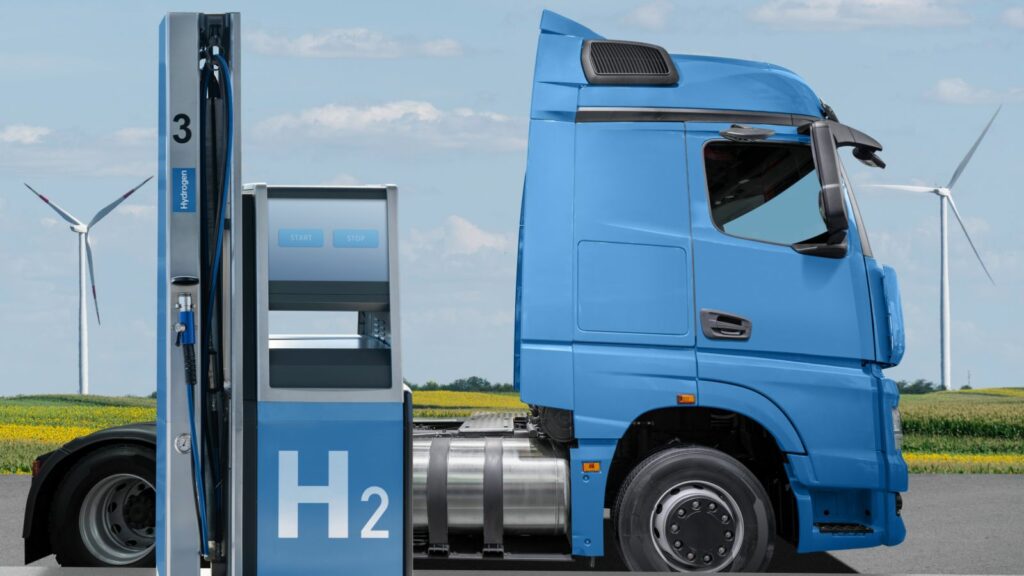
Hydrogen trucking in British Columbia has moved another step from demonstration projects toward larger-scale infrastructure. Next Hydrogen Solutions Inc., a Mississauga-based electrolyzer manufacturer, says it has completed the basic engineering design for a planned 10-megawatt hydrogen fuelling station in B.C. for an undisclosed customer.
The milestone is significant, but it is not yet a construction announcement. A final investment decision is anticipated by the end of 2026, with construction contemplated for late 2027 or early 2028 if the project advances. Its timing nevertheless stands out. Heavy-duty hydrogen trucks are already being demonstrated on B.C. roads, dedicated commercial fuelling infrastructure has begun opening, and the province’s largely clean electricity supply creates a potentially attractive foundation for producing hydrogen through electrolysis.
A Design Milestone, Not a Construction Start
Next Hydrogen announced on August 18 that it had completed a Basic Design Engineering Package, or BDEP, for the planned 10-MW station. The company said the work gives its confidential customer a more complete definition of the proposed facility and the information required to refine costs before deciding whether to commit capital. Next Hydrogen expects that final investment decision by the end of 2026. If it is positive, the company’s current schedule anticipates construction beginning in late 2027 or early 2028.
That distinction matters when assessing the announcement. Next Hydrogen has not disclosed the customer, precise site, total expected investment, final hydrogen-production volume or an unconditional construction contract. The BDEP instead represents an important engineering gate between an early concept and a project that can be evaluated more seriously for financing and execution. For the trucking sector, where hydrogen infrastructure has often developed through relatively small pilots, reaching the detailed-design stage on a 10-MW concept signals greater ambition. Whether that ambition becomes a physical station will depend on the commercial decisions still ahead.
What a 10-MW Hydrogen Station Could Mean in Practice
Ten megawatts is substantial for an electrolyzer-based transport project. Next Hydrogen’s published specifications for its commercial systems list energy consumption of roughly 45 to 55 kilowatt-hours per kilogram of hydrogen. As a simple scale illustration, a 10-MW electrolyzer operating continuously at that efficiency range would theoretically correspond to approximately 4.4 to 5.3 tonnes of hydrogen production per day. That is not a forecast for the B.C. project: actual output would depend on equipment configuration, operating hours, auxiliary energy consumption and other station-specific design choices that have not been disclosed.
The figure nevertheless helps put the project’s nameplate power into context. Next Hydrogen currently markets modular systems ranging from hundreds of kilograms of nominal daily production upward, including 0.75-MW and 1.5-MW units. A 10-MW installation therefore represents a multi-megawatt application rather than a small demonstration electrolyzer. For fleets, larger production capacity can become increasingly important as operators move from proving that several hydrogen trucks work to asking whether dozens—or eventually larger groups—can refuel reliably without waiting for hydrogen to be delivered from distant production sites.
Containerized Electrolysis Is Central to the Concept
Next Hydrogen’s technology is based on pressurized alkaline water electrolysis, a process that uses electricity to split water into hydrogen and oxygen. Its current NH-X product line is designed as a modular platform for multi-megawatt projects. The company lists a 10% to 100% operating range for the equipment and says its systems are designed to respond rapidly to changing electrical loads. That ability is particularly relevant when an electrolyzer is paired with power systems that may experience changing demand or variable renewable generation.
The physical packaging matters as much as the chemistry. Next Hydrogen promotes pre-assembled, containerized equipment that can be manufactured and tested before arriving at a project site. In principle, that reduces the amount of bespoke assembly required in the field and makes it easier to expand capacity using repeatable modules. The company specifically highlighted this standardized approach when announcing the B.C. design milestone. It also argues that locating hydrogen production close to where the fuel will be consumed can simplify logistics. Those advantages remain company claims until demonstrated at the planned station, but they explain the engineering strategy behind the project.
Heavy Trucks Sit at the Centre of the Opportunity
Hydrogen has struggled to establish a large market in passenger vehicles, but heavy commercial transport presents a different operating problem. Long-haul and high-utilization trucks need to move substantial loads for many hours, and every lengthy stop can affect fleet productivity. The U.S. Department of Energy notes that fuel-cell vehicles can offer advantages for certain heavy-duty duty cycles because hydrogen can provide longer range and relatively fast refuelling compared with some battery-electric configurations. Fuel cells also power electric motors, giving trucks the high low-speed torque associated with electric drivetrains.
That does not make hydrogen an automatic winner. Battery-electric trucks are improving rapidly and can be more economical for routes where vehicles return regularly to depots and have enough time to charge. The stronger case for hydrogen is therefore likely to emerge in particular operations rather than every trucking job. B.C. has been testing precisely that question. Provincial support has helped bring Class 8 fuel-cell trucks and other hydrogen heavy-duty vehicles into real commercial environments, giving fleet operators experience with range, fuelling procedures, maintenance and payload requirements that cannot be learned from laboratory specifications alone.
B.C.’s Electricity Supply Strengthens the Low-Carbon Case
Producing hydrogen through electrolysis only delivers a strong emissions benefit when the electricity supplying the process is sufficiently low carbon. British Columbia enters that equation with a major structural advantage. The provincial government says more than 98% of electricity generated in B.C. comes from clean or renewable resources, with hydroelectricity accounting for the dominant share. That makes the province considerably better positioned for electricity-based hydrogen production than jurisdictions whose power grids remain heavily dependent on coal or unabated natural gas.
It is one reason Next Hydrogen specifically emphasized producing hydrogen on-site or close to demand. Instead of manufacturing the fuel far away and transporting it by truck, a station with its own electrolyzer can convert electricity and water into hydrogen near the vehicles consuming it. There are still important energy requirements for purification, compression, storage and dispensing, and hydrogen should not be described as emission-free simply because it comes from an electrolyzer. Yet access to B.C.’s comparatively clean electricity can materially improve the carbon equation. It also links the project to the province’s broader hydrogen strategy and transportation-decarbonization goals.
B.C. Is Already Building a Heavy-Duty Hydrogen Network
The proposed Next Hydrogen installation would not arrive in an empty market. In June 2026, HTEC opened a commercial heavy-duty hydrogen station on Tsawwassen First Nation industrial lands that the company describes as Canada’s first 700-bar commercial facility dedicated to heavy-duty clean-hydrogen applications. The station can dispense hydrogen at both 350 and 700 bar and has a stated capacity of about 400 kilograms per day. It is designed to serve Class 7 and Class 8 fuel-cell trucks as well as other commercial hydrogen vehicles.
That facility forms part of a broader infrastructure effort. B.C. previously announced support for HTEC’s H2 Gateway program, which envisioned as many as 20 hydrogen stations alongside new hydrogen-production capacity. Fourteen of the planned sites were expected to have heavy-duty capability, with the wider project designed to create a connected supply-and-fuelling system rather than isolated pumps. Not every proposed station should be treated as completed infrastructure, but the direction is important: the province is attempting to solve the chicken-and-egg problem of trucks needing fuel stations while fuel stations need enough trucks to justify investment.
Real Trucks Are Beginning to Supply the Demand Test
One of the clearest signs of change is that hydrogen trucks in B.C. are no longer restricted to static demonstrations. In 2025, Loblaw and a group of partners began a sustained commercial demonstration using a hydrogen-powered Class 8 truck. HTEC reported that the vehicle completed multiple trips between the Lower Mainland and Squamish, accumulating hundreds of kilometres while carrying out zero-tailpipe-emission deliveries. The project involved organizations including FortisBC, the Alberta Motor Transport Association, the B.C. Trucking Association and government partners.
Other demonstrations have targeted port freight, an especially demanding use case because drayage and yard vehicles can operate intensively around terminals and logistics corridors. An earlier provincially supported ports project included plans for fuel-cell yard tractors and Class 8 drayage trucks associated with the Port of Vancouver. These programs matter to a prospective 10-MW station because infrastructure needs repeat customers. A handful of experimental vehicles will not support a large fuelling hub indefinitely. Repeated commercial routes, growing fleet deployments and predictable daily hydrogen consumption are what can eventually convert technical demonstrations into a bankable fuel market.
Economics Will Determine Whether Hydrogen Can Scale
Engineering a hydrogen station is only half of the challenge. The harder question is whether hydrogen can be produced, compressed and dispensed cheaply enough—and used frequently enough—to make both the station and the trucks competitive. International Energy Agency analysis of heavy-duty vehicles shows how important fuel and infrastructure costs remain. In major markets it studied, hydrogen-related energy costs represented a meaningful share of fuel-cell truck total cost of ownership, while refuelling infrastructure could add another substantial component. Battery-electric trucks can already offer stronger economics for some applications.
Station utilization is particularly important. Expensive production and dispensing equipment becomes difficult to justify if only a small fleet uses it occasionally. Conversely, high, predictable throughput spreads capital costs across far more kilograms of hydrogen. On-site electrolysis brings its own trade-off: it can reduce the cost and complexity of transporting hydrogen from another plant, but the station must carry the capital cost of production equipment itself and may not enjoy the economies of scale of a much larger centralized facility. For the B.C. project, securing dependable demand could therefore prove just as important as achieving strong electrolyzer performance.
The Project Is Important to Next Hydrogen’s Commercial Story
Next Hydrogen is an established technology developer, but it remains a relatively small public company compared with the industrial groups competing across the global hydrogen sector. Founded in 2007 and headquartered in Mississauga, it develops and manufactures water electrolyzers and trades on the TSX Venture Exchange. Its second-quarter 2026 results illustrate the scale of the business today: revenue was approximately C$879,000 for the quarter, while the company recorded a net loss of about C$2.93 million. Cash stood at approximately C$12.17 million at June 30.
Against that backdrop, engineering a potential 10-MW station is strategically meaningful even though Next Hydrogen has not disclosed the project’s contract value or said that the customer has ordered the complete facility. The company has been trying to move its technology further into commercial applications while emphasizing standardized, modular systems rather than one-off prototypes. It is also going through a leadership transition, with Jocelyne Moyer scheduled to become president and chief executive on September 1, 2026. Converting engineering work into funded projects will be an important test of that commercialization strategy.
The Next Big Gate Is Investment, Not Engineering
The most important date in the project’s near-term future is therefore not its prospective construction start. It is the targeted final investment decision by the end of 2026. Across the global low-emissions hydrogen industry, the gap between announced projects and committed projects remains substantial. The International Energy Agency has identified high costs, uncertain demand, infrastructure constraints, regulation and difficulties securing reliable offtake among the reasons hydrogen developments can stall before reaching final investment decisions. In other words, completing engineering does not guarantee that shovels reach the ground.
For this B.C. hub, several future disclosures would make the outlook much clearer: confirmation of the investment decision, the customer’s identity or fleet demand, a final site, expected kilograms of hydrogen produced and dispensed per day, capital cost and a firm construction schedule. Those details will show whether the 10-MW concept can cross from engineering into an operating commercial asset. B.C.’s policy environment provides a reason to try—the province maintains a legislated goal of reducing greenhouse-gas emissions 40% below 2007 levels by 2030—but the next stage will ultimately be decided by economics, customers and committed capital.
