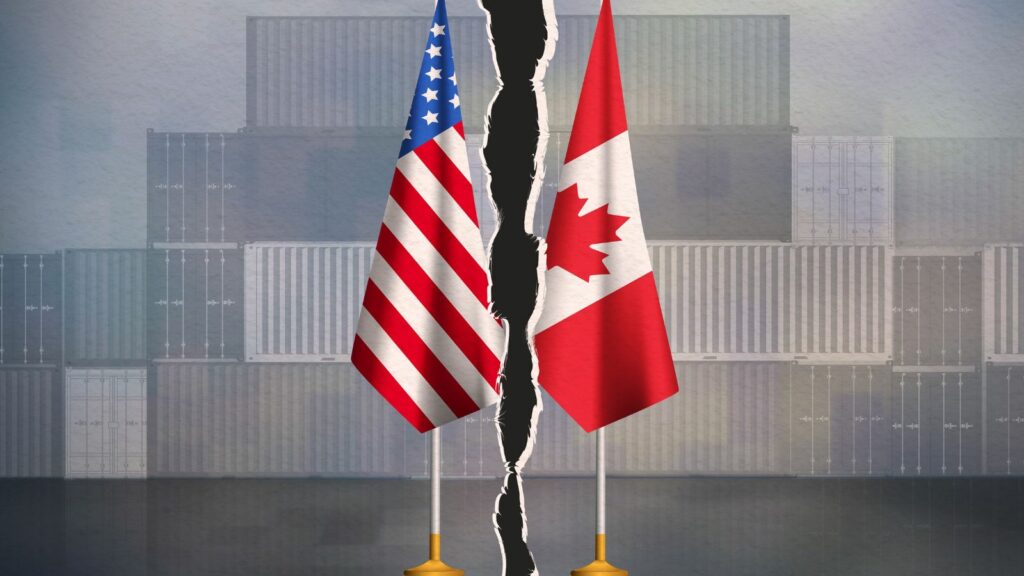
Canada and the United States are edging toward a trade agreement that could ease one of the most damaging disputes confronting the Canadian auto industry. The latest signal came from the White House, which said Canada had expressed a commitment to remove measures Washington considers discriminatory or an “unequal” treatment of American motor vehicles.
The wording is significant, but the details remain unsettled. Washington has temporarily postponed additional 50% duties on selected Canadian goods until August 22, while negotiators work on a broader package. Reports indicate that U.S. tariffs on Canadian-built cars and trucks could fall from 25% to 15%, potentially lowering the effective rate even further once American content is deducted. Ottawa, however, has not publicly spelled out exactly what it has promised to change.
A Three-Day Tariff Pause Came With a Significant Canadian Commitment
The most important development is buried inside the White House proclamation that delayed a new round of tariffs. The document says senior U.S. officials reported that Canada had “expressed a commitment” to remove the disputed measures at the centre of three American complaints covering alcoholic beverages, dairy and motor vehicles. President Donald Trump consequently moved the effective date of the additional duties from August 19 to August 22.
That language goes considerably further than simply saying negotiations are progressing. In the automotive case, the underlying U.S. proclamation specifically identifies Canada’s tariff and tariff-remission system for American vehicles as the disputed treatment. What remains unclear is how far Ottawa’s commitment extends. Canada has not publicly released a detailed list of promised automotive changes, making it premature to conclude that every Canadian countermeasure will disappear or that a final agreement has already been signed.
Canada Currently Imposes a 25% Counter-Tariff on Certain U.S. Vehicles
Canada’s automotive measures date back to April 9, 2025, when Ottawa imposed a 25% tariff on U.S.-made vehicles that do not comply with the Canada-United States-Mexico Agreement. For CUSMA-compliant American vehicles, the Canadian tariff is more targeted: it applies to the portion of the vehicle considered neither Canadian nor Mexican in origin rather than automatically applying to the entire value.
Those measures were introduced as retaliation after the United States imposed its own automotive tariffs on Canadian vehicles. Ottawa has consistently described the Canadian duties as countermeasures rather than an attempt to establish permanent protection against American vehicles. The distinction is politically important. Prime Minister Mark Carney has argued that Canada merely matched U.S. action, while the Trump administration argues that Canada’s response now gives American vehicles worse treatment than automobiles arriving from countries that were never targeted by the counter-tariffs.
Ottawa Built a Tariff Exemption System Around Canadian Production
Not every qualifying U.S.-assembled vehicle entering Canada has necessarily been subject to the Canadian counter-tariff. Shortly after introducing the duties, Ottawa created a remission program allowing automakers with Canadian manufacturing operations to import specified quantities of CUSMA-compliant American vehicles without paying the additional tariff.
The catch is that access is tied to production and investment in Canada. Companies maintaining Canadian assembly operations and meeting investment commitments can receive tariff relief, while their allowances can be reduced if Canadian production falls. The federal government has reviewed those quotas and adjusted them as manufacturers changed their production plans. Ottawa presented the system as a way to acknowledge the extraordinary integration of the North American automotive industry while discouraging companies from shifting Canadian production south. Washington increasingly viewed the same mechanism as an obstacle placed specifically in front of U.S.-assembled vehicles.
Washington Says Those Production Conditions Crossed the Line
The White House’s objection goes beyond Canada’s basic 25% retaliatory tariff. Its July proclamation also targeted the remission framework, arguing that company-specific limits on tariff-free U.S. vehicles pressured automakers to retain manufacturing operations in Canada. U.S. Trade Representative Jamieson Greer similarly accused Canada of putting a cap on American vehicle exports from companies moving production into the United States.
Canada’s own documentation confirms that tariff-free import allowances can change according to Canadian production. During reviews of the program, Ottawa adjusted individual manufacturers’ remission volumes when production plans changed. That does not settle the political argument over whether the measure is justified retaliation or unfair discrimination, but it explains why automotive negotiations have become so complicated. The dispute is not simply about lowering one tariff percentage. It also involves the industrial policy Canada has been using to protect factories, investment commitments and manufacturing employment.
The U.S. Could Cut Its Canadian Auto Tariff From 25% to 15%
A major Canadian gain under the emerging arrangement could come on the other side of the border. Reuters reported that the proposed agreement is expected to reduce the top-line U.S. tariff on Canadian-built cars and trucks from 25% to 15%, according to a source familiar with negotiations. Canadian negotiators were reportedly pressing Washington for an even lower 10% rate.
Trump has publicly acknowledged that an auto reduction is being discussed, saying Canada had been paying a high rate and that Washington was reducing it somewhat. Still, the 15% figure should not yet be treated as a completed policy change. Negotiators were continuing their work in Washington, and Reuters reported that important details had not been finalized. The outcome matters enormously because Canadian officials have repeatedly identified relief from existing American sectoral tariffs—including those covering automobiles—as a central objective of negotiations.
The Effective U.S. Tariff Could Be Considerably Below 15%
Even if negotiators settle on a 15% headline tariff, Canadian vehicles would not necessarily face a 15% charge on their entire value. Under the existing American system, CUSMA-compliant vehicles assembled in Canada can have their U.S.-origin content excluded when tariffs are calculated. Reuters reported that this content deduction is expected to remain under the proposed lower rate.
That could make the real tariff substantially less than the headline number for some models. Canadian government documentation notes that roughly half of the value of Canadian vehicles exported to the United States can originate in American parts. The precise content varies considerably by vehicle and manufacturer, but the principle demonstrates how intertwined production has become. A vehicle assembled in Ontario may contain engines, transmissions, electronics or other components produced in the United States, meaning a tariff aimed at Canadian manufacturing can also indirectly affect American suppliers.
Few Canadian Industries Have More Riding on the Outcome
Canada’s automotive industry is unusually exposed to American trade policy. Federal figures show that more than 90% of Canadian-made vehicles and about 60% of Canadian-made auto parts are exported to the United States. The sector directly supports roughly 125,000 jobs and contributes more than $16 billion annually to Canadian GDP, while the broader automotive economy supports more than 500,000 workers.
Production is heavily concentrated in Ontario, where vehicle assembly plants are surrounded by extensive networks of parts manufacturers, logistics companies and specialized suppliers. Canada produced more than 1.2 million passenger vehicles in 2025. That scale explains why even apparently modest differences between a 25%, 15% or 10% U.S. tariff can influence investment calculations. Automakers make factory decisions years in advance, and persistent uncertainty over border costs can determine whether the next model or production line lands in Canada, the United States or elsewhere.
The Auto Supply Chain Makes Tariffs Especially Difficult to Contain
Unlike many finished consumer products, automobiles do not move through the Canada-U.S. relationship in a simple one-way direction. Prime Minister Carney has said components for an average vehicle can cross the border as many as eight times before the finished product reaches a showroom. That means the economic nationality of a North American vehicle is often far more complicated than the location of final assembly.
This integration developed over decades as automakers organized production around a continental market. A plant in Ontario can depend on American parts while American factories depend on components made by Canadian suppliers. Tariffs therefore risk affecting companies and employees on both sides of the border. That is also why rules governing which portions of a vehicle count as American, Canadian or Mexican content have become so important. Small changes in tariff calculations can translate into large differences when applied across hundreds of thousands of vehicles.
U.S. Vehicle Exports to Canada Have Already Fallen Sharply
The Trump administration says Canada’s retaliatory system has already altered trade flows. In its July motor-vehicle proclamation, the White House reported that Canadian imports of U.S. vehicles fell by roughly 22% when comparing April 2025 through March 2026 with the corresponding earlier period. The value cited by Washington declined from approximately $25.9 billion to $20.3 billion.
The administration also pointed to rising Canadian vehicle imports from other countries. It said imports from Mexico increased substantially, while imports from Japan, South Korea and Germany also climbed. Those figures form an important part of Washington’s argument that Canadian measures specifically disadvantaged American producers rather than simply reducing Canadian vehicle demand overall. Ottawa sees the chronology differently: its measures were introduced in direct response to American automotive tariffs. Both descriptions help explain why negotiators are trying to unwind interconnected retaliatory policies rather than negotiating an ordinary tariff reduction from scratch.
The Trade Agreement Still Has a Deadline Attached
Despite increasingly optimistic statements, the agreement is not yet something Canadian manufacturers can treat as permanent. The August 18 White House proclamation did not repeal the additional Section 338 tariffs. It merely changed their effective date to 12:01 a.m. Eastern time on August 22, providing negotiators with three additional days to complete their work.
Reuters reported that Canadian and American negotiators were meeting again as the deadline approached, with Trade Minister Dominic LeBlanc and chief negotiator Janice Charette continuing discussions with U.S. Trade Representative Jamieson Greer. Trump has said the countries are likely to have a deal, while Carney has described Canada and the United States as moving toward an agreement. That difference in language is worth noting. Until final documents establish tariff rates, implementation dates and Canada’s precise commitments, businesses are still operating under an emerging settlement rather than a completed one.
The Auto Fight Is Connected to a Much Bigger CUSMA Argument
Even a bilateral tariff agreement would not resolve every question hanging over North American automotive trade. The first six-year CUSMA joint review took place on July 1, 2026, and the United States declined to renew the agreement in its current form. That does not mean CUSMA has immediately disappeared: Canadian officials stress that the pact remains legally in force until 2036 and can still be renewed during the continuing review process.
Automobiles are expected to remain one of the most sensitive areas in those discussions. Rules of origin determine how much North American content a vehicle must contain to qualify for preferential treatment, making them central to investment decisions across Canada, Mexico and the United States. Washington has also emphasized preventing companies from outside North America from using the region as a route into the U.S. market. Today’s tariff negotiations may therefore ease immediate pressure without ending the longer automotive negotiations.
The Fine Print Will Determine Whether Canada Really Secured Relief
For Canadian automakers and workers, the next announcement will matter less for its political language than for its technical details. The biggest questions are whether Washington formally lowers its automotive tariff to 15% or another rate, how U.S.-origin content will be calculated, when the new treatment starts and whether additional sectoral tariffs can be reinstated under specified conditions.
Canada’s side of the bargain will require equally close attention. Ottawa may modify its 25% counter-tariffs, change the production-linked remission framework, or combine several adjustments. The White House has clearly stated that Canada expressed a commitment to remove treatment Washington considers discriminatory, but it has not published Canada’s complete undertaking. Until those provisions are released by both governments, the most defensible conclusion is narrower: the auto dispute has moved considerably closer to a settlement, but the price of that settlement—and its consequences for Canadian manufacturing—remain to be fully disclosed.
