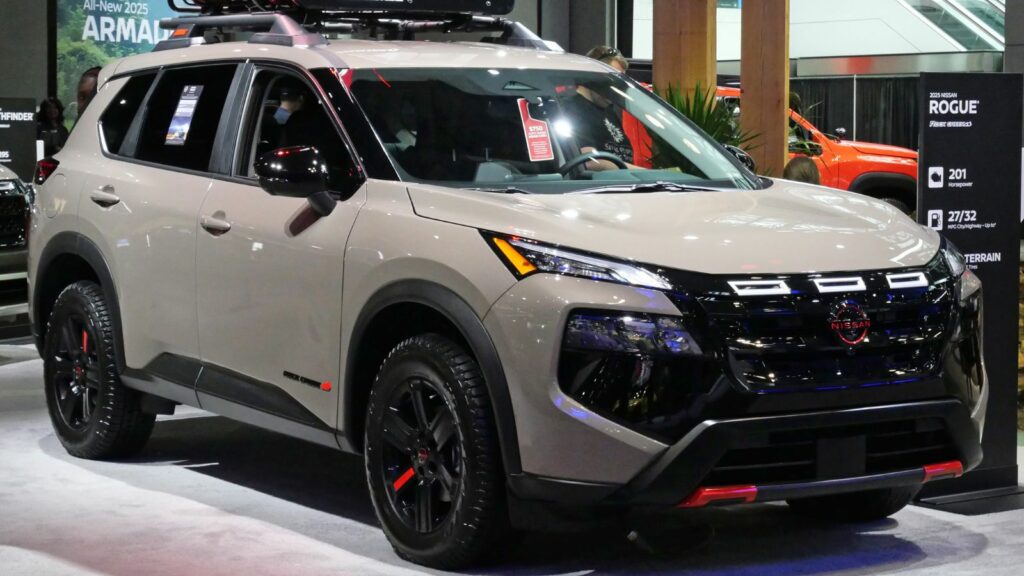
Canada’s used-vehicle market is producing a striking shift in familiar nameplates. The Nissan Rogue has accelerated from a dependable top-10 seller into one of the market’s strongest movers, while the Honda Civic and Ram 1500 face a more complicated mix of softer pricing, changing body-style preferences and higher purchase costs. The headline’s 22% Rogue gain is not reproduced by the latest publicly available national datasets: CarGurus data for June show Rogue used sales up 50.6% year over year, with Civic and Ram still positive at 2.2% and 8.4%. That distinction matters. Across other datasets, the Rogue is gaining rank and share as SUVs take a record portion of used purchases, while cars continue to lose ground and trucks remain expensive. The broader story is less about one percentage point than a Canadian market reorganizing around value, utility and affordability.
Rogue Has Moved Into the Market’s Sweet Spot
The Rogue’s rise is visible across more than one marketplace. CarGurus data for June 2026 placed it at the top of the year-over-year growth table among high-volume used models, with sales up 50.6%. Clutch, using a separate national dataset of 2016-and-newer vehicles with fewer than 200,000 kilometres, ranked the Rogue third by June sales volume. It captured 2.43% of sales, narrowly behind the Ford F-150 and Honda CR-V nationally.
That position is a meaningful change from 2025. AutoTrader ranked the Rogue sixth among its most-sold used vehicles for that full year, but by the first quarter of 2026 it had climbed to second on the marketplace, behind only the F-150. For dealers, that kind of movement can turn an ordinary trade-in into desirable inventory. For buyers, it means a model once overshadowed by the RAV4 and CR-V is increasingly appearing on the same practical shopping shortlists across Canada today.
SUV Demand Is Doing the Rogue a Major Favour
The Rogue is also benefiting from a body-style shift much larger than Nissan itself. Clutch says SUVs accounted for a record 63.5% of used purchases in June, up from 60.5% a year earlier and 57.3% two years earlier. Cars fell to 21.7% of sales, while trucks held near 15%. That steady migration gives compact crossovers a larger pool of shoppers before brand preference even enters the discussion.
CARFAX Canada reports a similar supply-side pattern, with SUVs representing about 56% of used listings. The appeal is easy to understand in practical terms: a compact SUV can handle a weekday commute, child seats, groceries and a weekend trip without the size or fuel appetite of a full-size truck. When more households want one vehicle to perform several jobs, mainstream crossovers gain an advantage. The Rogue is arriving in that sweet spot with abundant used supply and comparatively approachable prices today for buyers.
Price Is Giving Nissan an Opening
Affordability may be the Rogue’s strongest competitive weapon. Clutch’s June data put its average selling price at $24,400. The Honda CR-V averaged $30,464 and the Toyota RAV4 $33,309, leaving the Rogue thousands of dollars below two of the segment’s most recognizable rivals. For a household shopping to a fixed budget, that gap can mean moving to a newer model year, accepting fewer kilometres, or keeping more cash available for insurance and maintenance.
The same advantage appears at the lower end of the market. Among SUVs selling for less than $20,000, Clutch recorded an average Rogue price of $14,938, compared with $14,817 for the Ford Escape and $16,811 for the Nissan Kicks. Those figures do not prove every Rogue is a bargain; condition, history and trim matter enormously. They do show why the model can attract shoppers who want crossover utility without stretching into the price range of a RAV4 or CR-V.
The Civic Is Still Popular, but Cars Are Losing Ground
The Civic’s situation is more nuanced than a simple demand collapse. In Clutch’s June ranking it remained Canada’s fourth-highest-volume used model, accounting for 2.23% of sales. CarGurus also recorded a 2.2% year-over-year increase in June sales among high-volume models. Those numbers make clear that Canadians have not suddenly abandoned a nameplate that has spent decades near the centre of the country’s passenger-car market or used-car shopping lists.
What has weakened is the environment around it. Clutch says cars represented only 21.7% of used sales in June as SUV share reached a record high. The average Civic in Clutch’s data sold for $21,650, 3.8% less than a year earlier on the report’s model-level price comparison. CARFAX has likewise identified sedans, including the Civic, among models experiencing notable valuation declines as attention shifts toward SUVs. A Civic can still sell briskly; it simply competes in a shrinking body-style category today.
Ram Buyers Face a Much Bigger Price Commitment
The Ram 1500 tells a different story. It remained a top-10 used model in Clutch’s June data, with a 1.51% sales share and an average price of $43,091. CarGurus measured June sales up 8.4% from a year earlier, so the latest public figures do not support describing national Ram sales as falling outright. The pressure is more plausibly visible in affordability and the relative strength of other vehicle segments.
AutoTrader’s first-quarter data show why the truck purchase is a different financial decision. Canadians paid an average of $51,719 for a used truck, compared with $34,241 for a used SUV. Even within Clutch’s budget category, a Ram 1500 under $30,000 averaged $22,214, while an under-$20,000 Rogue averaged $14,938. A contractor who needs towing or payload may see that premium as necessary. A household that mainly needs passenger space and winter versatility has more reason to migrate toward a crossover instead today.
More Inventory Is Giving Buyers Room to Compare
The broader used market is becoming less frantic than it was during the pandemic-era shortage. CARFAX Canada counted 277,361 used-vehicle transactions in June, up 1.3% from May but down 2.9% from June 2025. For the first half of 2026, transactions totalled roughly 1.49 million, 4.2% below the same period a year earlier. At the same time, inventory increased, giving buyers a wider selection and reducing scarcity pressure that once supported unusually high prices.
That matters because choice changes how shoppers behave. When suitable alternatives are scarce, a buyer may take the Civic, Ram or Rogue that happens to be available. When inventories improve, price gaps, kilometres, accident history and body style carry more weight. CARFAX put the national average listing price at $31,487 in June, down 4.7% year over year. In a market slowly normalizing, models with a clear value proposition have more opportunity to pull share from familiar rivals.
Search Interest and Actual Purchases Are Not the Same Thing
One of the more revealing signals comes from AutoTrader’s first-quarter marketplace data. The Rogue did not appear among the 10 most-searched vehicles, yet it was the second-most-sold used model on the platform. By contrast, the Toyota RAV4 was the second-most searched but only the 10th most sold. That gap between browsing and buying shows why search traffic alone can produce a misleading picture of demand.
A shopper may begin with a Civic, RAV4 or pickup in mind, then change direction after seeing monthly payments, kilometres and available inventory. The Rogue’s performance suggests it often wins later, when aspiration meets the actual deal on the screen. This is why sales, search share, price movement and listing counts should not be treated as interchangeable statistics. A model can lose pricing power while remaining a volume leader, or gain sales even when it is not generating the most online curiosity.
Canada’s Used Market Is Absorbing More Budget-Conscious Demand
The Rogue’s momentum also fits a broader move toward used vehicles. Clutch reported new-vehicle sales down 5.1% through the first four months of 2026 while used retail sales rose 5.8% year over year in the latest official month cited in its June report. The national average used selling price was $34,134 in June, essentially unchanged from the previous month and modestly higher than a year earlier because buyers were choosing newer and larger vehicles.
Underneath that average, comparable vehicles were about 1.3% cheaper than a year earlier when model and age were held constant. Clutch found 39 of the 50 most-purchased models were cheaper on that like-for-like basis. That creates a market where households can trade sideways on price while moving upward in size or age. A competitively priced crossover such as the Rogue is positioned to capture that behaviour, particularly when a new vehicle or used truck would require a much larger outlay.
What Matters Next Is Whether the Gap Persists
The next few months will show whether the Rogue’s surge is a temporary inventory effect or a durable change in Canada’s used-vehicle hierarchy. It already has several supporting trends: SUVs are taking a larger share of purchases, its average transaction price sits below key Japanese crossover rivals, and multiple marketplaces now rank it near the top of used sales. Those forces are more significant than any single month’s percentage change.
Civic and Ram remain formidable used nameplates, so their presence near the top of sales tables should temper claims of a sudden collapse. The more important shift is relative. Sedans are operating inside a smaller category, while full-size pickups ask buyers to absorb higher prices. The Rogue sits between those extremes, offering the body style Canadians increasingly choose at a price closer to a mainstream car than a full-size truck. If affordability continues to shape purchase decisions, that middle ground could remain unusually valuable.
