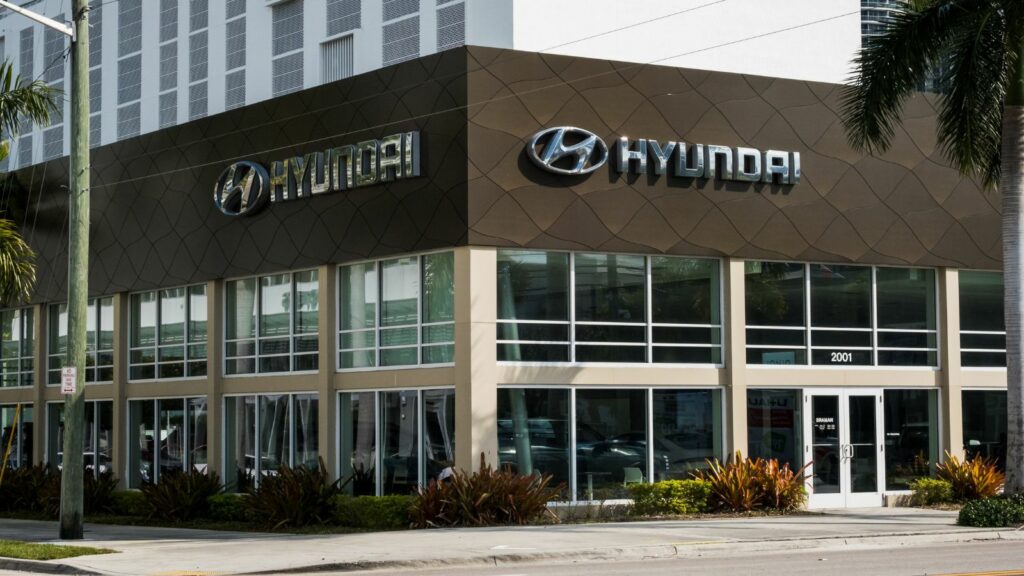
Hyundai’s transformation from a major importer into an increasingly American-made automaker is gathering speed. Chief Executive José Muñoz says the company is considering another major expansion of Hyundai Motor Group Metaplant America in Georgia, potentially lifting annual capacity to between 700,000 and 800,000 vehicles by 2028. At the same time, Hyundai is pushing toward having more than 80% of the vehicles it sells in the United States built domestically, up sharply from roughly 40% in 2024. The shift comes as tariffs make imported vehicles more expensive, U.S. demand for Hyundai products remains strong, and hybrids emerge as an increasingly important part of the market. What began as a dedicated electric-vehicle project outside Savannah is rapidly becoming the centrepiece of a much broader American manufacturing strategy.
Hyundai Is Accelerating Its Push Toward U.S.-Built Vehicles
Hyundai had already set an ambitious localization target before the latest Georgia expansion emerged. At its 2025 CEO Investor Day, the automaker said it intended to produce more than 80% of the vehicles it sells in the United States domestically by 2030, while increasing the share of locally sourced supply-chain content from roughly 60% to 80%. More recently, reporting on Muñoz’s August 20, 2026 interview with CNBC indicated that Hyundai is now targeting the greater-than-80% production level by 2029. That would represent a dramatic change from 2024, when only about 40% of Hyundai vehicles sold in the United States were produced domestically.
The goal reflects how important the American market has become to Hyundai. In March, the company described North America as a central part of a product strategy involving 36 new or significantly updated vehicles across the U.S., Canada and Mexico through 2030. Muñoz has also described the United States as Hyundai’s most important market outside its home country of South Korea. Building more vehicles close to American customers can shorten supply chains, reduce exposure to international shipping disruptions and give the automaker more flexibility when government trade policy changes. For Hyundai, therefore, the 80% figure is not simply a manufacturing statistic. It represents a fundamental restructuring of where its American business is supplied from.
The Georgia Factory Has Already Outgrown Its Original Blueprint
Hyundai Motor Group Metaplant America was considerably smaller on paper when the project was announced. The company broke ground in Bryan County, Georgia, in October 2022 with an initial annual production target of 300,000 vehicles and an investment of approximately $5.54 billion associated with the new vehicle and battery facilities. Production moved quickly: the first U.S.-built IONIQ 5 rolled off the line in October 2024, less than two years after construction began. By the Metaplant’s formal grand opening in March 2025, Hyundai had already committed to lifting planned annual vehicle capacity to 500,000 units.
The next possible jump is much larger. Muñoz said Hyundai is examining whether HMGMA can reach between 700,000 and 800,000 vehicles annually by 2028. At 800,000 units, the factory would have more than two and a half times the capacity envisioned when Hyundai broke ground in 2022. The company has stressed, however, that this latest expansion remains under consideration rather than a finalized investment decision. The earlier move to 500,000 vehicles involved a further $2.7 billion investment and was expected to add 3,000 direct and indirect jobs. Reaching the newly discussed range would therefore mark another major stage in a facility whose intended scale has repeatedly grown since its announcement.
U.S. Tariffs Have Made Local Production More Valuable
Trade policy has added urgency to Hyundai’s localization plans. Under the U.S.-South Korea trade arrangement, automobiles and auto parts from South Korea are subject to a 15% U.S. tariff framework, replacing the substantially higher tariff burden Korean automakers faced during an earlier phase of Washington’s trade measures. Although 15% is less punitive than the 25% rate previously applied to Korean vehicle imports, it still creates a meaningful cost difference between imported cars and vehicles assembled inside the United States. Muñoz acknowledged that tariffs have helped accelerate Hyundai’s localization strategy, while emphasizing that the company had started building up its American manufacturing footprint before the newest trade barriers arrived.
That timing matters. Building an assembly plant and its supporting supply network is a multi-year undertaking, so an automaker cannot simply move hundreds of thousands of vehicles into domestic production when tariffs suddenly change. Hyundai had already opened its Alabama factory in 2005, while Kia has operated its West Point, Georgia, plant since 2009. HMGMA adds a third major vehicle-production centre to the group’s U.S. network. Expanding those facilities gives Hyundai and Kia a larger pool of vehicles that can reach American dealerships without crossing the U.S. customs border as finished imports. In an industry where several percentage points can materially affect vehicle profitability, avoiding or reducing tariff exposure can become a significant competitive advantage.
HMGMA Is Becoming Much More Than an EV Factory
The Georgia Metaplant was originally presented as Hyundai Motor Group’s first dedicated mass-production electric-vehicle facility, but its role has evolved along with the U.S. market. HMGMA began building the Hyundai IONIQ 5 in October 2024 and added the three-row IONIQ 9 in March 2025. Then, in June 2026, the plant started assembling the Kia Sportage Hybrid. The Sportage marked three firsts for HMGMA: its first Kia model, its first hybrid and its third production vehicle. Hyundai says the facility was engineered to accommodate different brands and propulsion systems with relatively limited production-line modifications and can support as many as 10 vehicle models.
That flexibility looks increasingly valuable as American electrification develops unevenly. U.S. Energy Information Administration data show that hybrids captured a record 16% of U.S. light-duty vehicle sales in the second quarter of 2026, while battery-electric vehicles accounted for about 6%, down from 7% a year earlier. Cox Automotive similarly estimated first-half hybrid sales would rise about 9% even as the broader new-vehicle market weakened. Hyundai has experienced the trend directly: it reported record North American hybrid demand during the first half of 2026. A plant capable of moving production among EVs and hybrids can therefore respond more readily when customer preferences shift instead of depending entirely on one propulsion technology.
The Georgia Expansion Sits Inside a $26 Billion U.S. Investment Program
Hyundai’s Georgia plans are only one component of a much larger American investment strategy. Hyundai Motor Group increased its planned U.S. spending to $26 billion for the 2025-to-2028 period, $5 billion above the $21 billion commitment announced earlier in 2025. The company says the money will support three major areas: vehicle manufacturing, domestic supply chains and future technologies. Hyundai’s current shareholder materials break that commitment into approximately $12 billion for increasing U.S. annual vehicle production capacity to 1.2 million units, $7 billion for parts and logistics, and another $7 billion for autonomous driving, artificial intelligence, robotics and related technologies.
The supply-chain component could be just as important as final assembly. Hyundai Steel is developing a Louisiana steel mill intended to provide automotive-grade material for the group’s U.S. factories. Earlier plans put its annual capacity at approximately 2.7 million tons, with commercial steel production expected to begin in 2029. Hyundai is also planning a U.S. robotics facility capable of producing 30,000 units annually. Taken together, those investments help explain why the company wants U.S. supply-chain content to rise toward 80%. A Hyundai vehicle assembled in Georgia but filled with imported components would still leave the company heavily exposed to trade disruption. Deeper localization shifts more of the entire manufacturing chain onto American soil.
Hyundai Has the Sales Momentum to Justify More Capacity
An expansion toward 800,000 vehicles would be difficult to justify without strong demand, and Hyundai enters the discussion after several years of U.S. growth. Hyundai Motor America sold 901,686 vehicles in the United States in 2025, an 8% increase from 836,802 a year earlier and the company’s third consecutive annual sales record. The Tucson alone accounted for 234,230 units, while the Santa Fe reached 142,404 and the Palisade nearly 124,000. Electrified vehicles represented 30% of Hyundai’s retail mix, with hybrid sales rising 36% and EV sales increasing 7% during the year. Those numbers give Hyundai considerably more scale than it had when its current localization strategy was conceived.
The momentum continued into 2026. Hyundai reported 489,656 U.S. retail deliveries during the first six months, up 3%, while total North American sales reached a record 595,457 vehicles. The company specifically credited strong demand for the Tucson, Palisade and an expanding hybrid lineup. Kia provides another source of demand for HMGMA because the Georgia plant can build vehicles for multiple Hyundai Motor Group brands. Kia sold a record 852,155 vehicles in the United States in 2025, including 182,823 Sportages, its highest-volume model. Adding U.S.-built Sportage Hybrid production at HMGMA therefore gives the plant access to one of the group’s strongest-selling nameplates rather than relying only on comparatively younger EV products.
Georgia’s Economic Footprint Is Growing, but 800,000 Vehicles Is Not Guaranteed
The Metaplant has already become one of Georgia’s most significant industrial projects. The state describes Hyundai’s $7.59 billion vehicle-plant investment as supporting at least 8,500 on-site jobs at full development. By July 2026, the facility had hired nearly 2,000 workers while continuing its production ramp. Hyundai-related suppliers had separately announced roughly $2.5 billion of investment and around 6,900 jobs across Georgia. When battery ventures and other Hyundai Motor Group investments are included, the broader Georgia commitment reaches approximately $12.6 billion. Estimates cited by Hyundai and state officials suggest the group’s Georgia operations could eventually support nearly 40,000 direct and indirect jobs and $4.6 billion in annual individual earnings.
Still, the proposed 700,000-to-800,000 capacity should not be treated as completed expansion. Hyundai said after Muñoz’s interview that the higher production range was being reviewed, and no new workforce figure or finalized construction budget for that stage has been publicly announced. Market conditions could also change substantially before 2028. U.S. EV demand remains less predictable than hybrid demand, vehicle affordability is under pressure, and trade policy continues to shift. What makes HMGMA strategically important is therefore not simply its potential size. Its ability to manufacture Hyundai, Kia and eventually Genesis products across multiple electrified powertrains gives the group options. If Hyundai ultimately approves the full expansion, Georgia would become the clearest expression yet of its strategy to sell more American-built vehicles while relying less on imports.
