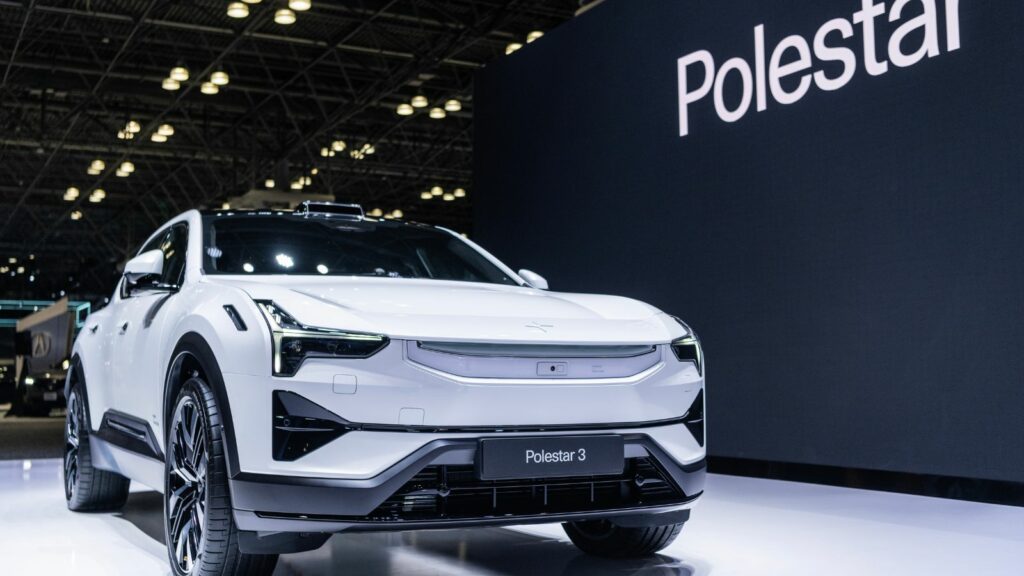
Polestar is expanding its electric lineup at a moment when the North American EV market is being pulled in sharply different regulatory directions. The new Polestar 4 SUV, formally unveiled on September 2, brings a more conventional and practical body to the 4 family while targeting as much as 630 kilometres of WLTP range in rear-wheel-drive form.
For Canadians, however, the vehicle carries significance beyond its specifications. Polestar remains active in Canada and has indicated the SUV will reach the Canadian market, while new Polestar vehicles are effectively being pushed out of the United States from the 2027 model year under Washington’s Connected Vehicle Rule. The contrast shows how two neighbouring markets that once moved largely in tandem on vehicles are increasingly taking separate approaches to EVs with Chinese corporate and technology connections.
Polestar Gives the 4 a More Traditional SUV Shape
The Polestar 4 has always been unusual. The original SUV-coupé eliminated the conventional rear window and instead gave the driver a camera-fed digital rear-view display. That decision helped Polestar create a low roofline without squeezing rear passengers, but it also became the model’s most divisive feature. The new Polestar 4 SUV takes a more familiar approach, adding a taller rear section and conventional rear glass while maintaining much of the existing car’s front-end design and overall proportions.
That seemingly straightforward change makes the new version easier to understand as a family vehicle. Polestar has stretched the roof farther toward the rear and adopted a more upright tailgate, giving the 4 SUV something closer to an electric sport wagon or low crossover profile. The company is not abandoning the original 4, which is now positioned as the coupé-style member of the family. Instead, the two versions are intended to serve buyers with different priorities: one emphasizing visual drama and aerodynamics, the other putting greater weight on luggage capacity, visibility and day-to-day flexibility.
The 630-Kilometre Range Figure Needs Canadian Context
The headline number is a targeted range of up to 630 kilometres for the rear-motor Polestar 4 SUV. That figure is based on Europe’s WLTP testing procedure, however, rather than the range methodology Canadian shoppers typically see alongside vehicles sold in North America. Polestar itself cautions that WLTP results are laboratory-based and that real-world range depends on speed, temperature, driving behaviour, wheel choice and other conditions.
The distinction matters because the current Canadian-market Polestar 4 demonstrates how dramatically testing standards can differ. Its Long range Single motor version is rated at up to 499 kilometres using EPA methodology, while the Dual motor version is rated at 451 kilometres. The new SUV’s 630-kilometre WLTP target should therefore not be read as a promise that Canadian certification will also show 630 kilometres. Canadian figures have not yet been published for the new body style. Even so, the target suggests Polestar has managed to preserve strong efficiency despite adding a more upright and practical rear body.
Performance Still Runs From 272 to 544 Horsepower
Under the bodywork, Polestar has kept the formula relatively familiar. The rear-drive model uses a 200-kW electric motor producing 272 horsepower and 343 Nm of torque. The Dual motor version adds another 200-kW motor at the front, bringing combined output to 400 kW, or 544 horsepower, and 686 Nm. Polestar lists 0-to-100-km/h acceleration at approximately 7.3 seconds for the rear-motor SUV and 3.9 seconds for the dual-motor version.
Both use a 100-kWh lithium-ion battery and a 400-volt electrical architecture. Maximum DC fast-charging power remains 200 kW, with Polestar estimating a 10-to-80 per cent recharge in roughly 30 minutes under suitable conditions. That is competitive rather than class-leading as several newer premium EV platforms move toward 800-volt technology and substantially higher peak charging speeds. Polestar is instead relying on a proven electrical package, efficiency improvements and chassis tuning. The Dual motor version also incorporates a front-motor disconnect system that can reduce energy consumption when full all-wheel-drive performance is unnecessary.
The Bigger Change Is Space Rather Than Speed
Practicality is where the SUV begins to separate itself most clearly from the existing Polestar 4 coupé. With the rear seats upright, the new model provides about 530 litres of luggage space beneath the parcel shelf and roughly 655 litres when cargo is measured to the roof. The rear seats use a 60:40 split, giving owners greater flexibility for combinations of passengers and longer items.
The taller rear body also improves the usefulness of a cabin that was already unusually spacious for a vehicle with sporty proportions. Polestar has retained features such as reclining rear seatbacks on appropriately equipped versions, while the SUV adds lifestyle-oriented functionality including Camping mode. Vehicle technology remains central to the experience, with over-the-air updates, 5G connectivity, Google-based services and driver-assistance hardware. Buyers can also choose options such as an electrochromic panoramic roof and a digital interior mirror. In practical terms, the SUV appears designed for customers who liked the 4’s performance and interior but hesitated over its unconventional rear design or cargo limitations.
South Korean Production Has Become Strategically Important
The Polestar 4 SUV is being manufactured in Busan, South Korea, rather than relying exclusively on Chinese assembly. That follows Polestar’s broader decision to add South Korean production of the existing Polestar 4, which had originally been built in Hangzhou Bay, China. Contract production in Busan gives the company another manufacturing base and reduces its dependence on a single country for one of its most important models.
That diversification has become increasingly valuable as EV trade policy fragments. A few years ago, production location was often discussed mainly in terms of logistics, labour and cost. Now it can determine whether a vehicle faces punitive tariffs or even whether an automaker can enter a market at all. Building in Korea does not solve every regulatory problem for Polestar because Washington’s newest restrictions look beyond assembly location to corporate control and connected-vehicle technology. For Canada, however, Busan production gives Polestar more flexibility and avoids tying the new SUV directly to rules that specifically target vehicles physically manufactured in China.
U.S. Restrictions Go Much Further Than an Import Tariff
Polestar’s American problem is not simply a large border tax. The U.S. Commerce Department’s Connected Vehicle Rule prohibits certain transactions involving connected vehicles, software and communications hardware linked to China or Russia. Beginning with model year 2027, the rules prohibit sales by connected-vehicle manufacturers considered owned by, controlled by or subject to the jurisdiction or direction of China or Russia, as well as vehicles incorporating specified covered software.
Polestar applied for authorization but said in June that the U.S. Bureau of Industry and Security had declined to grant it permission to continue selling vehicles from model year 2027 onward. Polestar is majority-owned by China’s Geely Holding, even though it is headquartered in Sweden and manufactures vehicles in multiple countries. The company can continue selling qualifying existing Polestar 3 and Polestar 4 inventory and has promised continued servicing for American owners. But future models, including the new 4 SUV, effectively lose the U.S. as a normal retail market unless the regulatory situation changes.
Canada Is Moving in a Noticeably Different Direction
Canada has taken its own measures toward Chinese EVs, but its policy direction in 2026 is now markedly different from Washington’s. Ottawa originally imposed a 100 per cent surtax on Chinese-made EVs in October 2024. That surtax was repealed effective March 1, 2026, as part of a new arrangement allowing an initial annual quota of 49,000 Chinese EVs to enter Canada at the normal 6.1 per cent most-favoured-nation tariff.
The Canadian policy is based primarily on trade, industrial strategy and managed market access rather than a blanket prohibition tied to an automaker’s Chinese ownership. That distinction matters for Polestar even though the new 4 SUV itself is built in South Korea. Polestar continues operating a Canadian sales network and currently markets the regular Polestar 4 and Polestar 3 here. Canadian automotive publications have reported that the new 4 SUV is expected to arrive in Canada in early 2027. The result could be a striking situation in which Canadians can order a newly launched Polestar that Americans living only kilometres away cannot buy new.
Existing Canadian Pricing Shows Where the New SUV Could Sit
Polestar has not yet announced Canadian pricing for the 4 SUV, so any exact dollar figure would be premature. The existing Polestar 4 nevertheless provides a useful benchmark. In Canada, the 2026 Long range Single motor currently carries an MSRP starting at $64,900 before freight, taxes and other charges, while the Long range Dual motor begins at $69,900. Additional equipment packages can push transaction prices considerably higher.
The new SUV will therefore enter a crowded premium electric crossover market rather than competing as a mass-market EV. Its appeal will likely depend on whether buyers value its Scandinavian-style interior, distinctive design and high-performance dual-motor option enough to choose it over an expanding selection of electric SUVs. Polestar has also been using aggressive incentives on existing Canadian inventory, including a $5,000 manufacturer EV bonus and low-rate financing offers on certain configurations. Those promotions illustrate how intense the EV sales environment has become. A more practical 4 may broaden the audience, but pricing will remain central to whether interest translates into meaningful Canadian volume.
Polestar Needs the 4 Family to Carry More Weight
The expansion arrives while Polestar is still trying to increase global scale. The company reported estimated first-half 2026 retail sales of 30,423 vehicles, including 17,296 during the second quarter. Polestar has described the 4 as an important product for its sales mix, and its regulatory problems in the United States make success elsewhere even more important.
Europe currently accounts for close to 80 per cent of Polestar’s retail sales volume, while 94 per cent of first-quarter 2026 volume came from markets outside the United States. That gives management some insulation from the American restrictions, but losing access to a major automotive market still limits long-term growth opportunities. The company has responded by increasing its strategic focus on Europe while continuing to target Canada, South Korea, Australia and other markets. The 4 SUV fits directly into that strategy: rather than developing an entirely separate platform, Polestar is extracting another body style and another potential customer group from technology it already has in production.
Canadian EV Buyers May See More Models Americans Cannot Buy
The larger story is becoming less about one vehicle and more about the fragmentation of the global auto market. Canada and the United States still share deeply integrated vehicle manufacturing and supply chains, yet their policies toward Chinese-linked EV companies are increasingly diverging. Washington is moving toward technology-based exclusions that can apply regardless of where a vehicle is assembled. Ottawa, meanwhile, has reopened controlled access to Chinese-made EVs and continues allowing brands with Chinese corporate ties to compete.
For Canadian shoppers, that could mean access to an expanding list of vehicles unavailable in the United States, even as other trade disputes complicate North American manufacturing. The Polestar 4 SUV provides a particularly clear example because it comes from a Swedish-headquartered brand, is built in South Korea, is majority-owned by a Chinese group and uses a globally sourced technology ecosystem. Its 630-kilometre WLTP target may attract the immediate attention, but the more consequential detail is geography: in 2027, the border between Canada and the United States may increasingly determine which electric cars consumers are even allowed to consider.
