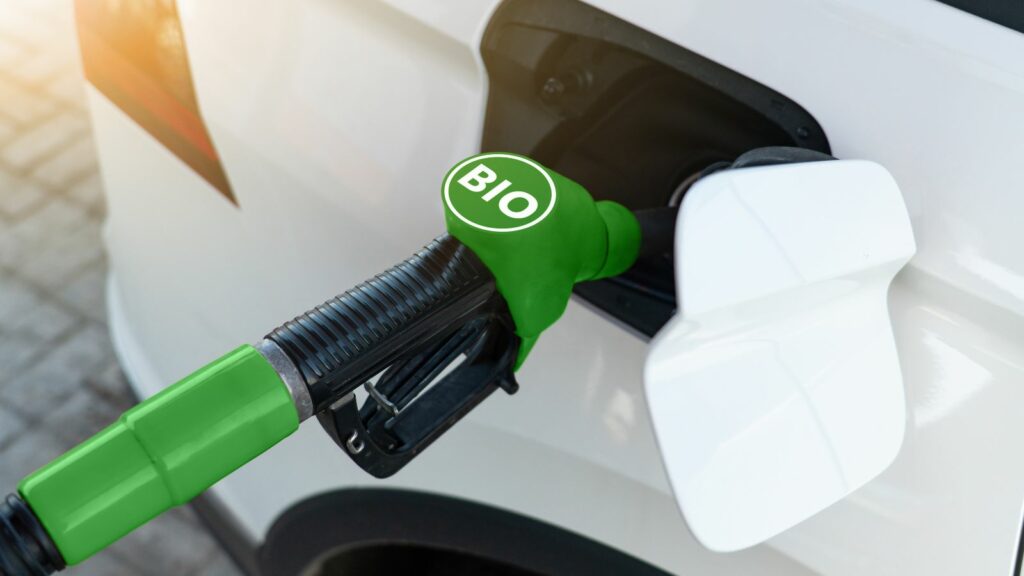
Canada’s automotive transition is beginning to look less like a straight line from gasoline to batteries and more like a widening collection of technologies. Kautex Textron, one of the world’s major suppliers of plastic automotive fuel systems, is preparing to put bio-based plastic fuel tanks into production in Canada and the United States in 2026. The move takes an established component of gasoline and hybrid vehicles and changes part of the material supply chain behind it.
That matters at a time when automakers are recalibrating electric-vehicle plans, hybrid demand has strengthened, and Canadian manufacturing policy is increasingly focused on keeping factories useful across multiple powertrain technologies. Rather than betting exclusively on one propulsion system, suppliers such as Kautex are trying to lower the environmental footprint of components that could remain in production for years.
Bio-Based Tanks Are Moving From Development to Production
Kautex’s latest step is significant because it takes renewable-content fuel systems beyond a demonstration program. Automotive industry reporting says production of the company’s bio-based plastic fuel tanks is scheduled to begin in the United States and Canada during 2026. The manufacturing sites involved are expected to use certification systems intended to provide traceability for the renewable material entering the supply chain. Kautex had introduced its Green+ concept in 2024 and moved the portfolio toward commercialization in 2025.
Under Kautex’s own Green+ criteria, a product can carry the designation when it contains at least 20% renewable or biomass-based material, or at least 25% recycled material. Fuel systems are among the products covered by the program. That makes the Canadian production plan more than a cosmetic change in branding: it brings renewable feedstocks into a component that must satisfy demanding requirements for durability, fuel permeability, crash behaviour and long-term reliability.
“Bio-Based” Does Not Mean the Tank Will Biodegrade
The terminology can be misleading. A bio-based automotive fuel tank is not designed to decompose like compostable packaging. Kautex describes its biomass materials as mass-balanced, drop-in solutions. In practice, renewable raw material is introduced into an established industrial feedstock system and its contribution is tracked through certification and accounting processes. The resulting polymer is intended to perform like the conventional material it replaces, allowing manufacturers to reduce dependence on fossil-derived feedstock without asking an automaker to redesign the entire fuel system.
That distinction is important because durability is precisely what an automotive fuel tank requires. Research on bio-based plastics also shows why environmental claims need to be evaluated carefully. Life-cycle studies generally find potential for lower fossil-resource use and, in some cases, lower production-stage greenhouse-gas emissions. However, results vary substantially according to feedstock, energy sources, manufacturing methods, carbon-accounting rules and end-of-life treatment. Renewable origin alone does not automatically make a plastic environmentally benign.
Hybrids Give Advanced Fuel Tanks a Longer Runway
Fuel tanks might appear to belong to an industry moving toward the past, but the vehicle market has become considerably more complicated. Conventional hybrids still carry gasoline and therefore require a complete fuel-storage system. Plug-in hybrids do as well. Kautex has spent years developing pressurized and lightweight systems specifically for electrified vehicles, including its NGFS architecture and all-plastic hybrid-tank technology. In hybrids, controlling vapour emissions can be particularly important because the combustion engine may remain off for extended periods.
Canadian purchasing patterns reinforce the business case. Statistics Canada reported that registrations of conventional hybrid-electric vehicles jumped 36.1% in 2025 even as battery-electric registrations fell sharply. The picture shifted again in early 2026, when battery-electric and plug-in-hybrid registrations rebounded while conventional hybrids were roughly flat year over year. The volatility demonstrates why suppliers hesitate to design factories around a single forecast. A production line capable of serving gasoline, hybrid and increasingly sustainable-material applications offers a valuable hedge against rapidly changing consumer demand.
Canada Has Been Part of Kautex’s Fuel-Tank Story for Decades
The Canadian connection is not new. Kautex says it entered the North American market by opening a Windsor, Ontario, plant in 1986. Historical federal industry directories from the period identify Kautex of Canada as an automotive gas-tank manufacturer in Windsor. The company later became an important global specialist in blow-moulded fuel systems, including multilayer plastic tanks that helped replace heavier and corrosion-prone metal designs across much of the auto industry.
Today, Kautex describes itself as a Tier One supplier operating more than 30 plants in 13 countries and producing conventional and hybrid fuel systems alongside battery enclosures and other automotive technologies. That history gives the bio-based tank decision an industrial dimension that is easy to overlook. Introducing a new feedstock into an established process can preserve value in existing moulding equipment, tooling and engineering expertise. For manufacturing communities, adapting an existing product can sometimes be as consequential as announcing an entirely new factory.
Suppliers Are Hedging Rather Than Abandoning Electrification
The bio-based fuel-tank program should not be read as evidence that Kautex is turning away from EVs. The company has simultaneously expanded its Pentatonic battery-enclosure business. It announced a major battery-housing contract for a battery-electric platform in 2025 and another Pentatonic business award in June 2026 involving a next-generation hybrid-electric vehicle platform. Its portfolio now deliberately spans conventional fuel systems, hybrid technology and battery structures.
That strategy mirrors a broader adjustment taking place in the auto business. Honda indefinitely suspended its proposed Ontario EV value-chain project in May 2026 after previously planning an investment of roughly C$15 billion, citing changing market conditions and a revised global strategy. Its existing Alliston operations continue producing Civic and CR-V models, including hybrids. The lesson for suppliers is straightforward: electrification remains strategically important, but the speed and composition of the transition can change quickly. Flexible factories have become a form of insurance.
The Carbon Benefit Depends on the Whole Supply Chain
Kautex has tied Green+ to a broader environmental strategy that includes reducing direct operational emissions as well as emissions embedded in purchased materials. The company says Scope 3 sources account for roughly 80% of its emissions and has set targets that include a 30% reduction in Scope 3 emissions by 2030. It also evaluates products using life-cycle assessment, considering raw-material production, transportation, manufacturing, vehicle use and end-of-life treatment.
That broader accounting is essential for bio-based plastics. Academic reviews show that replacing fossil carbon with renewable carbon can improve greenhouse-gas performance, particularly at the resin-production stage, but outcomes are not universal. Agricultural inputs, land use, electricity generation, processing energy and disposal methods can materially change the result. One 2024 meta-analysis of polylactic-acid studies, for example, found substantially different climate results depending on whether assessments stopped at the factory gate or examined the complete life cycle. Bio-based material therefore represents an emissions-reduction tool, not an automatic environmental guarantee.
Canada’s Auto Strategy Is Becoming More Technology-Flexible
Ottawa’s own policy has moved in a similar direction. In February 2026, the federal government unveiled an auto strategy that maintained significant support for EV manufacturing while replacing the previous Electric Vehicle Availability Standard with tighter fleet-wide greenhouse-gas standards. The government argued that the approach would allow manufacturers to use a broader range of technologies while still pushing vehicle emissions downward. It also committed C$3 billion from the Strategic Response Fund and up to C$100 million through the Regional Tariff Response Initiative to support automotive investment, retooling and diversification.
For suppliers, that flexibility may be increasingly valuable. A factory that can reduce the carbon intensity of hybrid and combustion-vehicle components while also developing parts for battery vehicles is less exposed to a sudden change in one market. Kautex’s bio-based fuel tanks illustrate that middle ground. Canada’s auto future may ultimately be dominated by electric vehicles, but the factories competing to survive the transition are increasingly preparing to make money from several stages of it at once.
