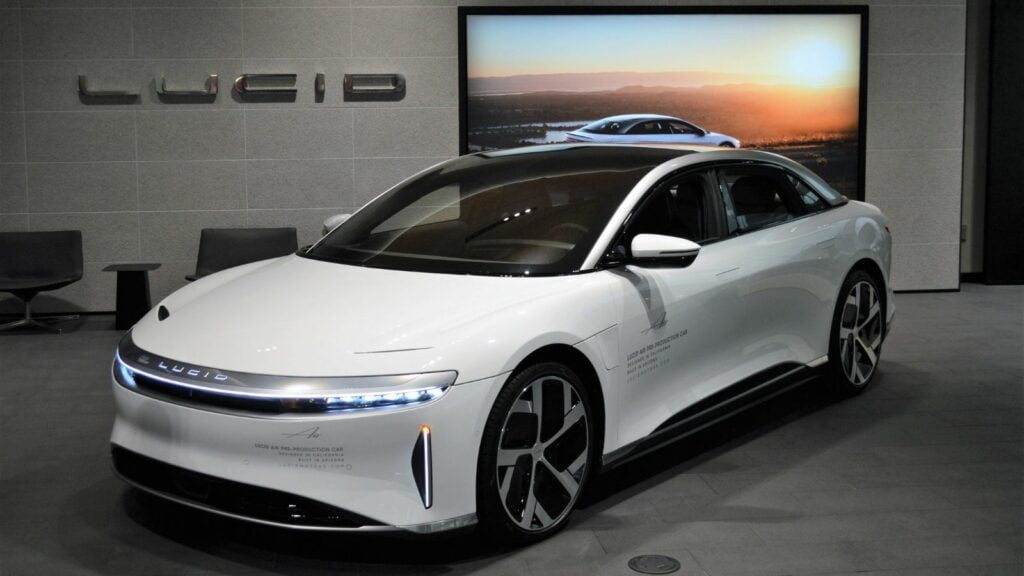
A safety problem involving something as ordinary as exterior lighting has triggered one of Lucid’s largest recalls yet. U.S. regulators say 27,185 Lucid Air sedans from the 2022 through 2026 model years are being recalled because software controlling low-voltage lighting circuits may allow excessive current to continue flowing, potentially causing overheating, smoke or fire. Owners with vehicles that have not received the remedy have been told to park outside and away from structures.
The issue arrives as Lucid continues selling the Air as a technology-heavy luxury EV in Canada, where the current Air Pure starts at $99,900 CAD. Importantly, the safety defect is not described as a failure of the Air’s high-voltage propulsion battery. Instead, the problem centres on electronic overcurrent protection for exterior lights — and Lucid says software can correct it.
What the U.S. Recall Actually Covers
The National Highway Traffic Safety Administration assigned the campaign number 26V540 to the recall, covering certain 2022 through 2026 Lucid Air sedans. Lucid identified 27,185 customer vehicles in the U.S. recall population, with production stretching from October 11, 2021, through July 27, 2026. The company estimated that 100% of the vehicles in that population contain the underlying defect. That does not mean every one of those cars will overheat or catch fire; it means the software configuration requiring correction is believed to be present across the entire identified population.
The defect involves the Air’s low-voltage exterior-lighting system. Lucid found that software controlling an electronic fuse, or eFuse, may provide insufficient protection when excess current flows through certain circuits. Instead of shutting a fault down soon enough, the system can permit continued energization at excessive amperage. That creates the possibility of overheating. NHTSA also points to a second safety concern: if the problem disables the centre brake light or front lighting, reduced vehicle visibility could increase the likelihood of a crash.
The Fire Risk Starts in a Low-Voltage Lighting Circuit
The technical detail matters because an EV fire recall can easily be interpreted as a traction-battery problem. This case is different. Lucid’s regulatory filing specifically identifies software logic governing low-voltage exterior-lighting circuits. The protection strategy was supposed to intervene when electrical current became excessive, but the company concluded that gaps in that strategy could allow components to become hot enough to produce smoke or, in limited circumstances, fire. Drivers may notice a burning smell, visible smoke or dashboard warnings related to exterior-light malfunctions before a serious thermal event.
Lucid’s investigation developed over several years rather than from a single incident. A company-owned 2023 Air suffered a fire in its front-left area in June 2023. Investigators could not establish a definitive cause but could not rule out the front combination lamp. By 2026, Lucid had identified three fire events involving front lighting over roughly three years. The review also found four smoke incidents between October 2025 and April 2026 associated with overheating of the centre high-mounted stop-lamp circuit, plus 33 additional warranty reports involving potentially related wiring-harness damage.
A Software Update Is the Fix
Despite the seriousness of the warning to park outside, Lucid does not expect owners to need a major hardware replacement. The remedy is software version 2.10.0 or later, which the company began distributing over the air in July 2026. The revised programming lowers the eFuse protection thresholds so the system intervenes sooner when abnormal current is detected. It also prevents a faulted circuit from being repeatedly re-energized during the same key cycle, closing another pathway that Lucid determined could contribute to overheating.
A large share of affected cars had already received the corrective software before the formal recall became public. Lucid told regulators that telematics data showed 20,719 customer vehicles had installed version 2.10.0 or newer when its Part 573 report was prepared. That left 6,466 vehicles still requiring the remedy. NHTSA says the update is provided free of charge, and owner-notification letters are expected to be mailed on October 16, 2026. Until the remedy is completed, the official U.S. guidance is unusually direct: affected vehicles should be parked outside and away from structures.
Canadian Owners Are Part of the Safety Story
The U.S. number is far larger, but the issue is not entirely confined to American roads. Canadian reporting based on Transport Canada recall information lists 128 Lucid Air vehicles in Canada, putting the combined Canadian and U.S. population above 27,300 vehicles. For Canadian owners, the most important distinction is therefore not simply where the vehicle was purchased, but whether its software has been brought to version 2.10.0 or a later release containing the revised electrical-protection logic.
That makes this a comparatively straightforward recall to check compared with repairs requiring scarce parts or a lengthy service-centre visit. Software-defined vehicles allow manufacturers to change some safety-critical behaviour remotely, and this campaign is a clear example of that advantage. At the same time, an over-the-air remedy still depends on the car actually receiving and completing the update. An owner who has delayed software installations, keeps the vehicle disconnected for long periods or is uncertain about its recall status should verify the VIN and installed software rather than assuming the car was automatically fixed.
At $99,900, the Air Remains a Serious Luxury Purchase
The recall lands while Lucid continues positioning the Air well above the mass-market EV segment in Canada. Lucid’s current Canadian lineup lists the 2027 Air Pure from $99,900 CAD, followed by the Air Touring from $112,800 and Grand Touring from $161,200. The three-motor Sapphire sits in another category entirely at $327,300 fully equipped. Those prices mean the recall affects a product whose buyers are reasonably likely to expect not just dramatic performance and range, but a premium level of software validation and post-sale support.
The specifications help explain the Air’s positioning. The rear-wheel-drive Pure is rated at up to 430 horsepower, with a projected maximum range of 676 kilometres and a claimed 0-to-100-km/h time of 4.7 seconds. The Grand Touring moves to 819 horsepower and a projected range of as much as 824 kilometres, while the Sapphire reaches 1,234 horsepower and an approximately two-second sprint to 100 km/h. Those headline figures are central to Lucid’s technology story, but recalls such as this one highlight a less glamorous side of advanced vehicles: software controlling a comparatively small electrical circuit can still carry genuine safety consequences.
The Recall Is Large Relative to Lucid’s Sales Volume
A 27,185-vehicle U.S. campaign would be routine for an automaker selling millions of cars a year, but it is substantial relative to Lucid’s scale. The company delivered 15,841 vehicles globally during all of 2025, a 55% increase from 2024. In other words, the U.S. recall population alone is considerably larger than Lucid’s entire company-wide delivery volume last year, although the recalled Airs were produced across several model years rather than during one annual sales period.
Lucid is also in the middle of what management has called an operational reset. During the second quarter of 2026, it produced 4,774 vehicles and delivered 3,953, while revenue rose to about $405 million. The company has said its priorities include customer experience, quality, accountability and reducing cash burn. That context makes execution on a large safety campaign especially important. The existence of a recall does not by itself establish that a vehicle or manufacturer is unreliable; recalls are common throughout the auto industry. What matters increasingly for Lucid is how quickly it identifies problems, gets remedies installed and demonstrates that the same failure mode has been eliminated from vehicles leaving its control.
What Owners and Potential Buyers Should Watch Next
For an affected owner, the practical checklist is relatively narrow. The vehicle should be checked against Lucid’s or the regulator’s VIN recall information, its software version should be confirmed, and version 2.10.0 or newer should be installed if required. Before the remedy is complete, U.S. regulators specifically advise parking outside and away from structures. Smoke, a burning odour or warnings indicating an exterior-lighting malfunction are among the signs Lucid identified as possible indications of the defect and should not be dismissed as an ordinary lighting glitch.
Prospective buyers have a different advantage: Lucid told NHTSA that, beginning July 27, all vehicles in its possession were being brought to version 2.10.0 or later at the factory or during pre-delivery inspection, and inventory vehicles would be updated before reaching customers. That substantially changes the issue for a new Canadian Air priced from $99,900 compared with an older used example that may have missed updates. The recall therefore does not erase the Air’s performance or range strengths, but it gives buyers one more concrete item to verify before taking delivery.
