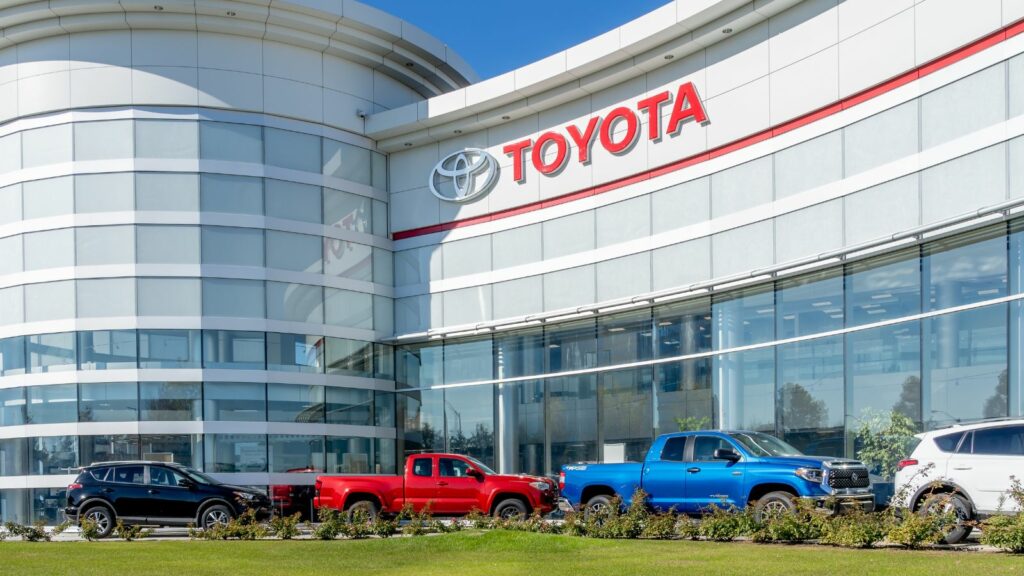
A Canadian automotive retailer has taken ownership of a property tied to the earliest days of Toyota’s rise in America. Edmonton-based Go Auto has acquired Toyota of Hollywood in Los Angeles, pushing its U.S. network to eight dealerships and its California presence to three stores.
The deal carries significance beyond another rooftop on a dealership map. Toyota’s Hollywood operation dates to the Japanese automaker’s first steps into the U.S. market, when its sales were counted in the hundreds rather than the millions. For Go Auto, the purchase adds a major Toyota franchise as the Canadian group continues an American expansion that began only in 2023. The company now says it operates 70 dealerships across North America representing 26 automotive brands.
Go Auto Adds a Historic Toyota Store to Its Portfolio
Go Auto announced the Toyota of Hollywood acquisition on September 1, saying the transaction increases its American footprint to eight dealerships, including three in California. The company did not disclose a purchase price in its announcement. President Phil Abram called the store a special addition because of its connection to Toyota’s beginnings in the United States, while also thanking Toyota Motor Sales, U.S.A. and former operator Mike Sullivan for their support during the acquisition. The deal brings Go Auto’s reported North American dealership count to 70 locations.
That is significant scale for a business that traces its roots to a single Canadian dealership in 1996. Go Auto now says its stores represent 26 automotive brands, making the Hollywood purchase part of a much broader multi-brand strategy rather than a one-off acquisition. The deal also deepens an existing relationship with Toyota: Go Auto already operates Toyota dealerships, including Toyota of Bellingham in Washington. Adding a high-profile Los Angeles location puts another important Toyota franchise inside the company’s growing U.S. platform.
Toyota of Hollywood Reaches Back to the Brand’s Earliest U.S. Days
Toyota’s Hollywood history comes with an interesting dating nuance. Go Auto and the dealership itself describe Toyota of Hollywood as having opened in 1957 and as Toyota’s first dealership in North America. Toyota’s detailed corporate history says Toyota Motor Sales, U.S.A. was established in Hollywood on October 31, 1957, while a separate retail operation named Hollywood Toyota was formally established in February 1958. Toyota’s modern corporate materials nevertheless describe the company as beginning its American journey with a single dealership in Hollywood.
The distinction does little to diminish the location’s historical importance. Toyota entered a U.S. market dominated by domestic manufacturers, initially offering the Toyopet Crown and Land Cruiser. Sales in 1958 amounted to only 288 vehicles: 287 Crown sedans and a single Land Cruiser. The Crown proved poorly suited to American highway driving and was eventually withdrawn. What began as a difficult experiment in Hollywood eventually became one of the largest automotive businesses in the country, giving the newly acquired dealership an unusually direct connection to that transformation.
Go Auto’s U.S. Expansion Only Began in 2023
Go Auto was still overwhelmingly a Canadian dealership group just a few years ago. Its first acquisitions outside Canada came in early 2023, when it bought Toyota of Bellingham and Mercedes-Benz of Bellingham in Washington state. At the time, Go Auto reported 59 dealerships and described the purchases as the beginning of a broader North American growth strategy. Abram said the group deliberately started close to its Western Canadian base before looking farther south.
That strategy accelerated dramatically in 2025. Industry reporting shows Go Auto added three dealerships in Washington’s Seattle-Tacoma area and then entered California by purchasing Sunrise Ford Fontana and Sunrise Ford North Hollywood. Those transactions took its American holdings to seven stores by December 2025. Toyota of Hollywood now becomes the eighth. The geographic change is striking: in less than four years, a Canadian retailer that initially crossed the border into nearby Bellingham has built a footprint stretching all the way to Los Angeles, one of North America’s most competitive automotive markets.
California Has Become a Much Bigger Part of Go Auto’s Strategy
The Hollywood purchase gives Go Auto three dealerships in California, following its acquisition of the two Sunrise Ford locations in late 2025. When those Ford deals were announced, the company described California as an important step in its American expansion and said it was actively seeking additional dealerships and employees. Toyota of Hollywood suggests that the California push was not simply about establishing a beachhead. Go Auto has returned to the market for another acquisition within roughly nine months.
The Toyota franchise also gives the California portfolio greater brand diversity. The first two properties were Ford dealerships; the Hollywood store introduces Toyota, which operates at enormous scale in the United States. Toyota Motor North America sold more than 2.5 million Toyota and Lexus vehicles in the U.S. during 2025, an 8% increase from the previous year. That kind of national volume matters to a dealership buyer because it provides exposure to a large installed base of owners who need financing, maintenance, parts, trade-ins and replacement vehicles long after the initial sale.
Toyota Is Entering the Deal From a Position of Sales Strength
Go Auto is adding the Hollywood franchise while Toyota is enjoying substantial U.S. demand. Toyota Motor North America reported 2,518,071 U.S. sales during 2025. Nearly 1.18 million of those vehicles were classified by Toyota as electrified models, including hybrids, plug-in hybrids, battery-electric vehicles and fuel-cell vehicles. Electrified products represented 47% of the company’s annual U.S. volume, showing how important hybrid technology has become to Toyota’s retail mix.
The shift accelerated in 2026. Toyota reported 212,793 U.S. vehicle sales in June, while electrified vehicles accounted for 122,063 units, or 57.4% of that month’s total. Second-quarter sales reached 673,971 vehicles. Those numbers do not reveal Toyota of Hollywood’s individual profitability or sales volume, which Go Auto has not disclosed, but they illustrate the environment surrounding the acquisition. A dealership group buying into Toyota today is gaining exposure to a manufacturer with a broad conventional, hybrid and electrified lineup rather than relying on a single propulsion strategy at a time of rapid change in consumer demand.
Dealerships Remain Enormous Businesses Beyond New-Car Sales
A franchised dealership can be easy to view primarily as a place where new vehicles change hands, but the economics extend much further. National Automobile Dealers Association data show the United States had 16,990 franchised light-vehicle dealerships in 2025. Together, those businesses sold 16.2 million light vehicles and generated more than US$1.3 trillion in total sales. Service departments were also extremely busy, writing more than 276 million repair orders during the year.
Service and parts revenue exceeded US$164 billion nationally, underscoring why established dealerships can remain attractive acquisition targets even when new-car margins fluctuate. Every Toyota sold years ago can eventually return for brakes, tires, warranty work, maintenance or repairs. Dealers can also earn revenue from used vehicles, financing, insurance products and trade-ins. Go Auto already operates businesses across those functions. Buying Toyota of Hollywood therefore adds much more than access to Toyota’s current new-vehicle inventory; it adds an established customer base and an operating platform in a dense metropolitan market.
The Purchase Fits a Broader Dealership Consolidation Wave
Go Auto is expanding during an unusually active period for automotive dealership acquisitions. Haig Partners counted 616 U.S. franchised dealerships bought or sold during 2025, roughly 50% more than the annual average between 2015 and 2019. Dealership earnings have declined from some of the extraordinary pandemic-era highs, but acquisition interest remains strong, particularly for larger stores, high-volume franchises and businesses with dependable service operations.
Haig estimated the average “blue sky” value of publicly owned dealerships — essentially the intangible franchise and goodwill value excluding physical assets — at US$19 million in 2025, up 2.2% from the previous year. That figure cannot be applied directly to Toyota of Hollywood because transaction terms and store-level financial information have not been released. It does, however, illustrate why dealership groups are competing aggressively for quality franchises. Scale can spread technology, advertising, accounting and management costs across more locations while creating a larger pool of vehicles, customers and employees.
The Toyota Relationship May Matter as Much as the Real Estate
Franchised auto retail differs from many other acquisition-heavy industries because buyers are not simply purchasing buildings and inventory. Automakers have an important role in dealership ownership transitions, making relationships with manufacturers an important part of expansion. Go Auto specifically thanked Toyota Motor Sales, U.S.A. for its “trust and support” in connection with Toyota of Hollywood, signalling the importance the company places on that relationship.
Go Auto already had Toyota representation on both sides of the border before the Hollywood acquisition. Its American expansion began partly with Toyota of Bellingham, while the group has continued adding Toyota operations in Canada as well. The Hollywood deal therefore expands an existing manufacturer relationship instead of creating one from scratch. That can be strategically useful for a large dealership operator because strong franchise representation provides access to new-vehicle allocation, factory training, parts networks, warranty programs and brand-specific customer systems. The store’s historical significance makes this particular Toyota franchise more visible than a typical dealership purchase, but its day-to-day value will still depend on ordinary retail execution.
Go Auto Is Becoming More North American Than Its Origins Suggest
Go Auto remains headquartered in Edmonton and continues to be identified closely with Canadian auto retail, yet its expansion increasingly looks continental. Its first U.S. stores arrived in 2023. By the end of 2025, its holdings reached Washington and California. Now its eight-store U.S. footprint includes three locations in California, while its overall business spans 70 dealerships and 26 brands according to its latest corporate announcement.
The company’s growth also illustrates how Canadian dealership groups can move in the opposite direction of much cross-border corporate investment. Instead of a large American retailer buying Canadian stores, Go Auto is deploying Canadian ownership capital into U.S. franchises. Its strategy comes as the broader dealership sector becomes increasingly consolidated, with well-capitalized groups buying businesses from independent or smaller family operators. Go Auto says it has also donated more than $27 million to charities over its history, an indication that the group is trying to preserve a community-focused identity even as its footprint becomes considerably larger and more geographically dispersed.
Toyota of Hollywood Could Become a Test of Go Auto’s U.S. Ambitions
The most revealing part of the deal may be what comes after it. Go Auto has previously described its American expansion in explicitly growth-oriented terms, and Toyota of Hollywood arrives after a burst of acquisitions that transformed the company’s U.S. presence. Moving from two stores near the Canadian border to eight American dealerships in several years suggests the company is building a permanent U.S. platform rather than merely experimenting with cross-border ownership.
At the same time, size alone does not guarantee success. U.S. dealership margins are normalizing, vehicle affordability remains an industry challenge and large dealer groups must integrate employees, technology and operating practices without damaging local customer relationships. Toyota of Hollywood also comes with nearly seven decades of brand history and its own identity in Los Angeles. Go Auto’s task will be to capture the advantages of scale without stripping away what made the store valuable in the first place. If it succeeds, the dealership Toyota once used to establish itself in America could become a symbolic launch point for another automotive company moving south.
