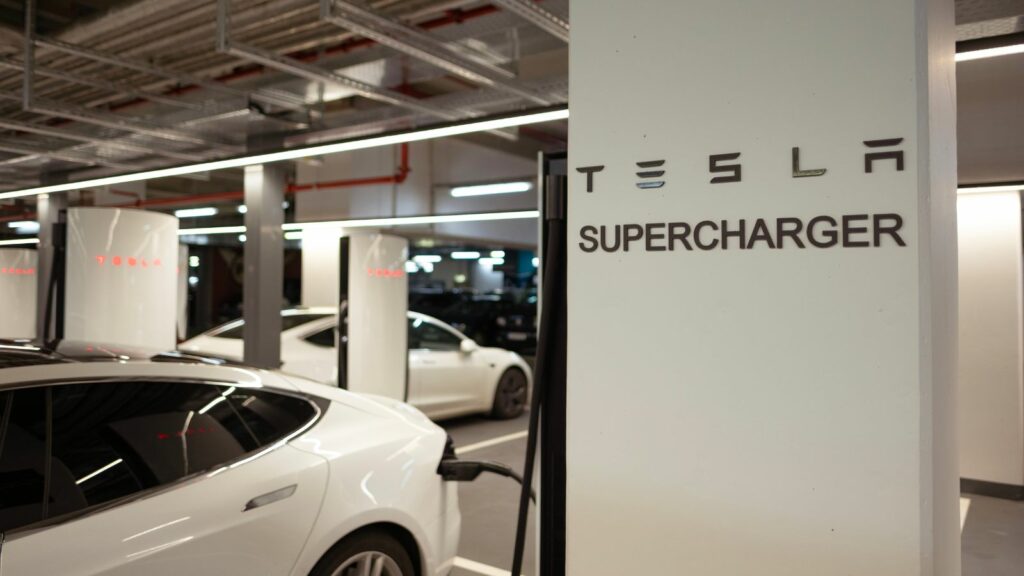
Five months can feel like an eternity when the hardware is already sitting in a parking lot. On August 30, 2024, Tesla finally energized Canada’s first V4 Supercharger site at RioCan Langley Centre in British Columbia, ending a wait that began after construction was reported in early April. The 16-stall station marked a visible step forward for Tesla’s Canadian charging network, but the headline came with an important technical caveat: at launch, the V4 posts still relied on V3-era power cabinets and were limited to 250 kW.
What changed immediately was usability. The taller V4 dispensers brought longer cables and easier access for non-Tesla EVs using compatible NACS adapters, while the retail-centre location gave drivers practical places to eat, shop or run errands during a charging stop.
The Five-Month Wait Finally Ends
Tesla’s Langley project moved quickly at first. Construction was confirmed on April 8, 2024, at RioCan Langley Centre near 200th Street and the Langley Bypass. Early site photos showed a large work zone that suggested a dozen or more stalls. The finished installation ultimately delivered 16 charging posts, making it a substantial addition rather than a small neighborhood stop.
Then progress appeared to stall. The V4 hardware was in place, but the station remained unavailable for months while drivers watched and waited. Tesla finally switched it on August 30, just before the end of the month. The nearly five-month gap between construction confirmation and activation became part of the story because the equipment had been visibly present for so long. For local EV owners, the milestone was less about a ribbon-cutting moment and more about seeing a fenced-off promise finally become usable infrastructure for everyday trips across the Lower Mainland.
V4 Hardware, But V3-Speed Power at Launch
The new dispensers looked different from Tesla’s familiar V3 units, but opening-day charging speeds did not leap forward. The Langley site initially topped out at 250 kW because the V4 posts were paired with the same generation of power cabinets used at V3 locations. That is why some Tesla-focused outlets described early North American V4 installations as “V3.5” sites: new posts, older backend hardware.
That distinction matters because charger branding can imply more performance than a vehicle will actually receive. Tesla’s own support information says V3 Superchargers can deliver up to 250 kW, while later V4 deployments in North America support higher output for compatible vehicles. Langley’s first-day advantage was therefore not raw speed. It was the redesigned dispenser, longer cable and a layout better suited to a wider range of EVs. For drivers, that was a usability upgrade before it became a power upgrade on the road that day.
The Bigger Change Was Access for Non-Tesla EVs
V4’s most noticeable benefit in Langley was the longer charging cable. Earlier Supercharger layouts were designed around Tesla vehicles, whose charge ports tend to sit in predictable locations. Other EVs can place their ports on the front, rear, left or right side, making short cables awkward and sometimes forcing a vehicle to occupy the neighboring stall.
The Langley V4 posts were built to reduce that friction. At launch, non-Tesla drivers with compatible vehicles could use the station with a NACS adapter, and Tesla’s current locator still identifies the site as open to non-Tesla EVs that meet its compatibility requirements. That turns the station into more than a Tesla-owner amenity. It becomes part of a broader charging network at a time when North American automakers have been moving toward the Tesla-developed connector. The longer cable sounds like a small design change, but it can determine whether charging is simple or frustrating.
Launch Pricing Made the Site Stand Out
When the Langley station opened, charging was reported at about C$0.21 per kilowatt-hour for Tesla owners and C$0.26 per kilowatt-hour for non-Tesla drivers. Those launch prices were low enough to make the site notable even before considering its new hardware, especially for drivers comparing public fast-charging costs across the Lower Mainland.
A simple example shows the difference. A 60-kWh charging session at the reported Tesla-owner rate would have cost about C$12.60, while the same energy at C$0.26 per kWh would have been about C$15.60. Real sessions vary because drivers rarely arrive at zero percent or charge to 100 percent, and Tesla’s pricing can change by site and demand. Still, the launch rates helped make Langley attractive as more than a technology showcase. For commuters, shoppers and road-trippers, a fast charger becomes far more useful when the economics are competitive as well as the hardware for drivers watching every charging dollar.
Why RioCan Langley Centre Was a Practical Choice
The location was not accidental. RioCan Langley Centre sits at the intersection of the Langley Bypass and 200th Street and contains roughly 380,000 square feet of retail space across dozens of units. That gives drivers something public charging works best with: useful places to spend the 15, 25 or 40 minutes that might otherwise feel like dead time.
Retail tenants include restaurants, shops and services, so a charging stop can overlap with groceries, a meal or an errand. Tesla’s current locator lists the Supercharger as available 24 hours a day, even though individual businesses keep their own hours. This kind of placement matters because fast charging is partly an infrastructure problem and partly a convenience problem. A charger in an isolated lot may deliver the same electricity, but a charger beside everyday destinations can fit more naturally into normal routines. Langley’s first V4 site was designed around that reality daily.
British Columbia Already Had Strong EV Demand
Canada’s first V4 site landed in a province where electric vehicles were already unusually common. British Columbia’s 2023 zero-emission-vehicle report said ZEVs accounted for 22.65 percent of new light-duty vehicle sales that year. The province also counted 153,045 registered light-duty ZEVs and 4,756 public charging stations by the end of 2023.
Those numbers help explain why a high-capacity site in the Lower Mainland mattered. A charging network has to grow ahead of congestion, not after it, and B.C.’s adoption rate was creating more pressure on public infrastructure every year. The province had also been using sales requirements, incentives and charging programs to push the market toward electrification. Against that backdrop, a 16-stall installation in Langley was not simply a Tesla expansion project. It was another piece of infrastructure serving a region where EV ownership had already moved well beyond the early-adopter stage and demand for reliable fast charging was rising.
NACS Was Becoming an Industry Standard
The Langley opening also arrived during a major connector transition in North America. Tesla’s plug, originally branded the North American Charging Standard, was being standardized through SAE International as J3400. SAE released a technical information report in December 2023 after major automakers began announcing plans to support the connector on future vehicles.
That matters because charging infrastructure is most valuable when drivers are not locked into one brand’s ecosystem. Standardization gives manufacturers and charging companies a common technical framework for connectors, communication and safety. By the time Langley opened, the industry was already moving toward broader NACS compatibility, which made V4’s longer cable and non-Tesla access more strategically important. The station therefore represented two transitions at once: Tesla was updating its physical Supercharger design, while the rest of the North American market was moving closer to Tesla’s connector format. Those trends reinforced each other in Langley across the charging ecosystem.
Canada Joined a V4 Rollout That Began in Europe
Tesla’s V4 story did not begin in British Columbia. The company opened its first V4 Supercharger location in Harderwijk, the Netherlands, in March 2023. North American installations started appearing later that year, before Canada received its first operating site in Langley in August 2024. The timeline shows that Canada was not the testing ground, but it was part of a rapid international rollout.
Early V4 posts focused on physical improvements such as longer cables and greater compatibility, while the most dramatic power upgrades depended on newer backend equipment. That explains why the Canadian debut could be historically important even though it did not immediately charge faster than a strong V3 site. Infrastructure generations often arrive in stages: first the dispenser and connector improvements, then higher-power cabinets and broader vehicle support. Langley was the point where that next-generation hardware finally crossed into Canada’s public charging network for Canadian drivers and fleets.
The First Site Was Meant to Be a Starting Point
Tesla’s announcement around the Langley opening made clear that the company expected more V4 installations to follow. That proved accurate almost immediately. A second Canadian V4-style Supercharger opened in Kananaskis, Alberta, in early September 2024, and Tesla continued building new sites in British Columbia and elsewhere as the network expanded.
That pace matters because one flagship station does little to change driver behavior on its own. Confidence comes from repetition: a charger near home, another on the highway and another near the destination. Langley’s 16 stalls therefore mattered as the beginning of a pattern rather than as an isolated technical demonstration. Each additional site reduces the chance that a single broken or crowded station can disrupt a trip. For EV owners, the real promise of V4 was never just the shape of the post. It was the possibility that the newer, more flexible design would become normal across Canada nationwide.
What the Langley Milestone Looks Like Now
The Langley site has continued to evolve since its 2024 debut. Tesla’s current location page lists 16 Superchargers at RioCan Langley Centre, available 24/7, with output of up to 325 kW. That is higher than the 250-kW ceiling reported when the station first opened, showing why launch-day specifications and present-day specifications should not be treated as the same thing.
The broader lesson is that charging infrastructure is increasingly software, hardware and network strategy combined. A site can gain new capabilities after installation as supporting equipment, vehicle compatibility and charging standards mature. Canada’s first V4 station began as a practical step toward longer cables and easier non-Tesla access, then became part of a faster and more standardized network. Nearly five months of waiting made the opening feel overdue in 2024, but the Langley site ultimately marked a transition point in how Tesla planned to serve Canadian EV drivers through measurable long-term progress.
