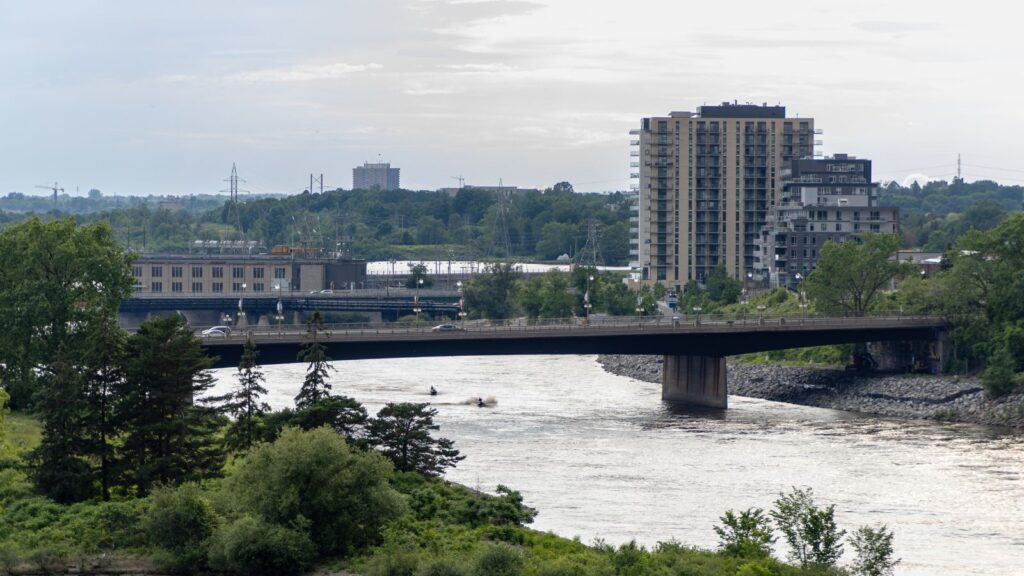
A mid-September cycling event in Gatineau is about to reshape cross-river traffic for two busy weekdays, just as another Ottawa–Gatineau bridge enters a separate round of daytime closures. Public Services and Procurement Canada says Gatineau-side access to the Chaudière Crossing will be closed to vehicles on Wednesday, September 16, and Thursday, September 17, from 9 a.m. to 3 p.m. for the Tour de Gatineau.
Cars heading from Gatineau toward Ottawa will be sent to the Portage or Alexandra bridges, while trucks will be redirected to the Macdonald-Cartier Bridge. The timing matters because the Alexandra Bridge is also scheduled to close to motorists on September 14, 15 and 18 for inspection work. Together, the notices turn September 14–18 into a week when drivers, freight operators, cyclists and pedestrians will need to pay close attention to which crossing is available and how downtown Gatineau streets are being managed.
Chaudière Access Will Close From the Gatineau Side
The core restriction is narrower than a full two-way bridge shutdown, but it will still alter a major commuting and freight route. Public Services and Procurement Canada says vehicles will not be able to enter the Chaudière Crossing from the Gatineau side between 9 a.m. and 3 p.m. on September 16 and 17. The closure is being put in place to accommodate the Tour de Gatineau, whose race course uses streets near the crossing and downtown Gatineau. The federal notice is aimed specifically at motorists and truck drivers, with advance signage planned on major roads.
From the Ottawa side, the crossing will remain open toward Gatineau, so the restriction is directional rather than absolute. That distinction may help some cross-river trips, but it does not mean normal routing will be possible once vehicles reach Quebec. PSPC says Ottawa-to-Gatineau traffic will have to follow a signed detour via Laurier Street. For commuters accustomed to using Booth Street, Eddy Street and the Chaudière corridor as a direct connection, the practical effect will be a temporary break in the usual street pattern on both race days.
Cars Get Two Alternative Bridges
Passenger vehicles leaving Gatineau for Ottawa will have two named alternatives: the Portage Bridge and the Alexandra Bridge. That gives drivers options on either side of the closed access point, but the choice is not as simple as selecting the nearest bridge. The Tour de Gatineau is also closing multiple downtown Gatineau streets during the same daytime window, including sections of Promenade du Portage, boulevard Alexandre-Taché, rue Scott, promenade Lac-des-Fées, rue Gamelin and other roads used by the race course. Some parking restrictions extend much longer than the race itself.
On the current federal schedule, the Alexandra Bridge is not slated to be closed to motorists on September 16 or 17, which makes it part of the official car detour during the Chaudière restriction. Still, drivers should expect the approaches to matter as much as the bridge itself. The race organizer says a large group of streets will be closed from roughly 9 a.m. to 3 p.m., with some closures beginning earlier or lasting later. That means local access, downtown circulation and the final blocks before a bridge could determine which alternative works best.
Trucks Are Being Sent to Macdonald-Cartier
Heavy trucks are being handled differently. PSPC says trucks that would normally approach the Chaudière Crossing from Gatineau will be redirected to the Macdonald-Cartier Bridge. That is significant because the Chaudière route is not simply another local bridge: federal infrastructure information describes it as one of only two available interprovincial truck routes in the National Capital Region. The same federal page says the crossing now accommodates more than 15,000 vehicles per day, showing how much everyday traffic uses the corridor even before special-event diversions are added.
Sending trucks to Macdonald-Cartier concentrates commercial traffic on the region’s other established heavy-vehicle crossing. The City of Ottawa has long treated the King Edward–Rideau–Waller–Nicholas corridor as the main connection between the Macdonald-Cartier Bridge and Highway 417, and past transportation work has highlighted the effect of interprovincial trucks on downtown Ottawa streets. For operators, the September 16–17 change therefore means more than a bridge substitution: it can alter the entire urban route used to reach or leave the crossing. Dispatchers and drivers will need to plan around the designated truck network rather than the passenger-car alternatives.
Ottawa-to-Gatineau Traffic Will Also Be Diverted
Traffic moving in the opposite direction will face a less obvious disruption. The Chaudière Crossing will remain accessible from Ottawa toward Gatineau during the two closure windows, but PSPC says vehicles arriving in Gatineau must follow the detour via Laurier Street. That instruction is especially important because the Tour de Gatineau is using a dense network of downtown roads on both days. The event’s published closure list includes portions of streets around Wellington, St-Jacques, Scott, Alexandre-Taché and other central corridors, with some restrictions extending beyond the six-hour bridge-access closure.
The safest assumption is therefore that a familiar cross-river trip may not continue normally after the bridge. The federal government says signage will be installed on main roadways before the event to guide motorists and truck drivers through the temporary pattern. That on-site guidance should take priority over habit, particularly where the race course changes normal turning options. The situation also illustrates why a one-direction closure can still have two-direction consequences: even when a bridge lane remains technically open, the street grid on the receiving side may force vehicles into a different path before they can rejoin their usual route.
Alexandra Closures Turn It Into a Five-Day Detour Week
The Chaudière closure lands in the middle of a separate Alexandra Bridge inspection schedule, creating five consecutive weekdays with a major cross-river traffic change somewhere in the network. PSPC says the Alexandra Bridge will close to motorists from 9:30 a.m. to 2:30 p.m. on Monday, September 14; Tuesday, September 15; and Friday, September 18. The work is for a semi-annual inspection of the bridge grating, and the federal department warns that the schedule could change with weather conditions.
That leaves September 16 and 17 as the two days when the Alexandra Bridge becomes an official car detour for the Gatineau-side Chaudière closure, sandwiched between its own inspection days. The sequence is easy to miss if each notice is viewed separately: Alexandra closes Monday and Tuesday, Chaudière access from Gatineau is restricted Wednesday and Thursday, and Alexandra closes again Friday. For people who cross the river several times a week, the practical message is that the preferred route may change from one day to the next rather than remain stable for the entire workweek.
Alexandra’s Age Is Driving More Frequent Intervention
The Alexandra inspections are part of a much larger infrastructure story. The federal government says the bridge is more than 120 years old and has reached the end of its service life. Corrosion and other deterioration have led to increasingly frequent inspections and repairs, while a replacement project advances toward construction. In June 2026, Ottawa awarded a $79-million contract for the next stage of the replacement to Capital Crossing Constructors, with construction of the replacement bridge expected to begin in 2028.
That context helps explain why a seemingly routine grating inspection can require a full daytime closure to motorists. PSPC says the September shutdowns are needed to inspect the grating safely, while pedestrians and cyclists can continue using the boardwalk. The department has also carried out other repair and maintenance closures in 2026, including welding work on the steel grating. For regular bridge users, these interruptions are not isolated events; they are part of the effort to keep the existing structure operating safely until replacement work can take over. The September schedule therefore combines event-related traffic control at Chaudière with age-related infrastructure management at Alexandra.
Tour de Gatineau Is Taking Over Downtown Streets
The event behind the Chaudière restriction is a high-level women’s cycling competition centered in downtown Gatineau. The Tour de Gatineau lists two UCI 1.1 race days: an individual time trial on Wednesday, September 16, and a road race on Thursday, September 17. The road race is scheduled to start at 10:15 a.m. and run for roughly 120 kilometres over repeated laps, while the time trial begins at 10:45 a.m. Public activities, starts, finishes and ceremonies are based around Place Laval.
Those race times explain why the bridge-access closure is set for the broad 9 a.m. to 3 p.m. window rather than only for the moments when riders are on a particular street. Roads need to be secured before competition, kept clear as riders circulate, and reopened in an orderly way afterward. The organizer also lists parking restrictions and some street closures that begin well before the racing itself or continue after it ends. For residents and businesses, the impact is therefore wider than the race clock. What looks like a few hours of competition can require most of the working day to manage safely across a downtown road network.
Pedestrians and Cyclists Keep Their Cross-River Access
Pedestrians and cyclists will retain access to the Chaudière Crossing during the September 16 and 17 vehicle restriction, according to PSPC. The same is true of the Alexandra Bridge boardwalk during its September 14, 15 and 18 motor-vehicle closures. That creates a notable contrast with the experience of drivers: active-transportation users can continue crossing the Ottawa River even when motorists are being rerouted to other bridges. The Tour de Gatineau itself is also encouraging spectators to reach Place Laval on foot, by bike or by public transit.
Still, continued bridge access does not mean every nearby path or street will operate normally. The race uses central Gatineau roads and the Chaudière Crossing is already part of an active federal renewal project. PSPC says construction on the crossing’s southern structures began in spring 2026 and is expected to continue into summer 2028, with reduced-width traffic lanes anticipated during the work. Pedestrians and cyclists should therefore pay attention to temporary signs and race-day controls near approaches, even though the federal closure notice specifically keeps the crossing itself open to them.
A Small Number of Crossings Carries Enormous Traffic
The disruption matters because Ottawa and Gatineau rely on a relatively small set of interprovincial links. The federal government owns five bridges and crossings between Ontario and Quebec in the National Capital Region. Federal figures show that those five links carried close to 180,000 vehicles and buses per day in 2017, plus about 9,000 pedestrians and cyclists. More recent federal information says pedestrian use reached a new daily peak of nearly 10,000 in 2024. Separately, the Macdonald-Cartier Bridge averaged about 70,000 vehicles per day in 2023.
Those numbers help explain why even short closures can ripple outward. Traffic removed from one crossing does not disappear; it shifts to the remaining network and to the urban streets feeding those bridges. Federal planning information has described the existing interprovincial links as being at or near maximum capacity, particularly during peak periods. The September closures are scheduled largely outside the sharpest morning rush, but they still overlap with daytime deliveries, appointments, government work trips and midday travel. The resulting pressure can therefore be felt not only at the bridge decks but also on their approaches.
The Best Route Will Change Almost Every Day
For the week of September 14, the simplest strategy is to plan by day rather than by habit. On Monday and Tuesday, the Alexandra Bridge is scheduled to be closed to motorists from 9:30 a.m. to 2:30 p.m. On Wednesday and Thursday, Gatineau-side vehicle access to the Chaudière Crossing is scheduled to close from 9 a.m. to 3 p.m., with cars sent to Portage or Alexandra and trucks sent to Macdonald-Cartier. On Friday, the Alexandra Bridge is scheduled to close again from 9:30 a.m. to 2:30 p.m.
Drivers should also remember that the Tour de Gatineau adds street and parking closures in central Gatineau beyond the bridge notice itself. PSPC says advance road signs will be installed for the Chaudière detours, while the Alexandra inspection schedule is weather-dependent. Checking the latest traffic notice before departure is therefore more useful than relying on a route that worked the previous day. The main issue is not that the region will have no cross-river connection, but that the available connection—and the streets feeding it—will change repeatedly across the five-day period.
