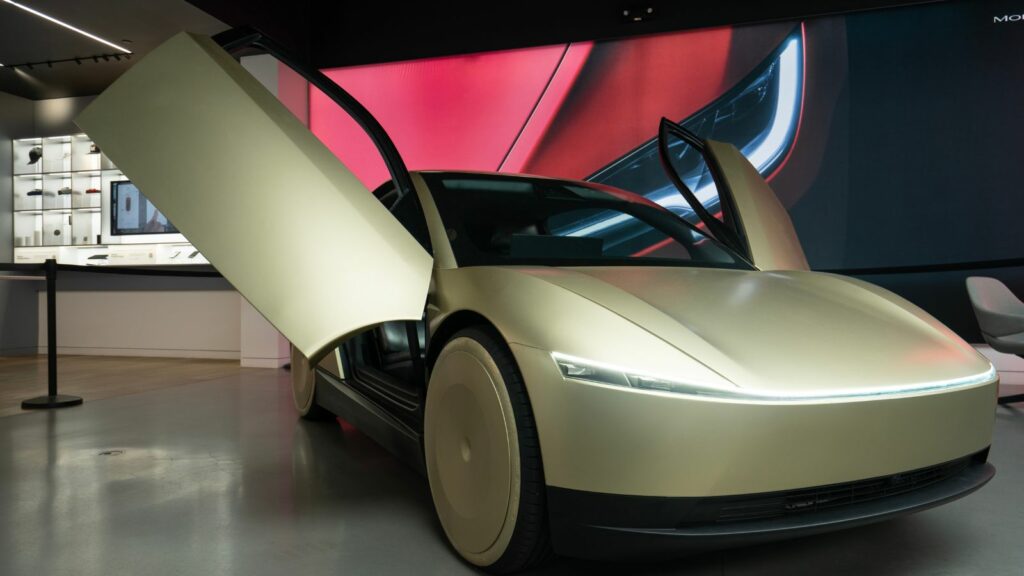
A gold two-seat taxi with butterfly doors is now doing something Tesla has promised for years: carrying passengers on public streets without a steering wheel or pedals. Tesla began limited Cybercab rides in Austin, Texas, on September 3, putting its purpose-built robotaxi into real-world service rather than keeping it on a demonstration stage.
The milestone was immediately matched by regulatory scrutiny. On September 4, the National Highway Traffic Safety Administration opened an investigation into whether roughly 1,000 Cybercabs were properly certified under federal safety rules. The timing captures the tension surrounding autonomous vehicles in the United States. Tesla is trying to prove that a car designed never to be driven by a human can scale quickly, while regulators are deciding how decades-old equipment standards should apply when the driver’s seat—and the controls that once defined it—effectively disappear.
A Limited Austin Launch Becomes a National Test
Tesla’s September 3 launch was deliberately narrow. The company said Cybercab rides were available only in limited areas of Austin, and it had not yet specified when passengers would begin paying fares. Texas registration records showed 45 Cybercabs among 420 Tesla autonomous vehicles in the state, underscoring that this remains an early deployment rather than a citywide fleet.
Even so, the symbolism is larger than the numbers. Tesla’s existing robotaxi network has primarily relied on Model Ys, some previously operating with human safety monitors. Cybercab is different because it was designed around autonomy from the start. Its two-seat cabin has no conventional driving position, and Tesla ultimately intends it to become the principal vehicle in a much larger driverless network. For riders arriving in downtown Austin, the gold bodywork and upward-opening doors may look futuristic, but the real test begins once the doors close and no human controls are available.
Inside a Cab With No Driver Controls
The absence of a steering wheel changes more than the dashboard. Tesla’s rider guide says both Cybercab seats are available to passengers because there is no accelerator pedal, brake pedal or steering wheel. A central touchscreen handles routine functions such as starting the trip, opening and closing doors, adjusting the seats and cabin temperature, and contacting support.
Tesla has also built emergency actions around the passenger rather than a driver. A physical Stop button mounted overhead initiates an immediate pull-over request, ends the ride and connects occupants with Robotaxi Support. The cabin includes a camera used to track occupancy, while a mechanical door lever can open the door in an emergency or if electrical power is unavailable. Those details matter because riders cannot simply grab a wheel if something feels wrong. The experience therefore depends on software, remote assistance and designed passenger controls replacing the familiar instinct to take over.
Why NHTSA Moved So Quickly
NHTSA’s response came one day after the Austin rollout. The agency opened an investigation into whether about 1,000 Cybercabs were properly certified and said it would examine the process and technical data Tesla used to claim compliance with federal motor vehicle safety standards. The regulator noted that Cybercab lacks permanently attached conventional controls, including a steering wheel, brake pedal, accelerator pedal and mirrors.
That wording is important. An investigation is not a finding that Tesla violated the law, and the 1,000 vehicles under review should not be confused with the 45 Cybercabs registered in Texas when the launch began. NHTSA is examining the legal and engineering basis behind Tesla’s certification, including Tesla’s determination that some federal standards may not apply to this design. For a company trying to expand into more vehicles and locations, the audit turns a technical compliance question into a meaningful constraint on rollout speed.
Tesla Is Relying on America’s Self-Certification System
The United States does not normally require a federal agency to approve a new car before it goes on sale. NHTSA’s system is based on manufacturer self-certification: automakers are responsible for determining that each vehicle complies with every applicable Federal Motor Vehicle Safety Standard. The agency can then test vehicles, investigate defects or noncompliance, and require remedies.
That framework explains why Tesla could reach public roads without first receiving a conventional government “approval” for Cybercab. It also explains why the current audit matters. A purpose-built autonomous vehicle forces manufacturers to decide which rules written around human drivers still apply when controls are removed. NHTSA has a separate Part 555 exemption process for vehicles that do not fully comply with existing standards, allowing up to 2,500 vehicles per manufacturer each year when equivalent safety and public-interest requirements are demonstrated. Tesla’s certification approach is now being tested against that regulatory structure.
The Federal Rulebook Is Changing at the Same Time
Cybercab is arriving while the federal rulebook itself is changing. In June 2026, NHTSA began rulemaking that would eliminate the requirement for a manual brake pedal in vehicles designed exclusively for automated driving systems. The agency has also been reconsidering equipment requirements tied to human operation, including items such as rearview mirrors and windshield-related controls.
Crucially, those efforts do not mean safety requirements are disappearing. NHTSA said its proposed brake changes would preserve stopping-distance performance standards, and vehicles that retain manual controls would remain subject to existing requirements. The agency is also developing real-world performance standards for automated vehicles. That creates an unusual transition period: regulators are acknowledging that some old rules make little sense for cars with no driver, yet manufacturers still must comply with standards legally in force today. Cybercab therefore sits at the intersection of technological design, self-certification and a federal framework that has not finished adapting.
Zoox Took a Different Route Through Washington
Amazon-owned Zoox provides a contrast. In July, NHTSA granted Zoox a temporary exemption allowing commercial deployment of up to 2,500 purpose-built robotaxis per year for two years. The Zoox vehicle also lacks conventional human controls, but the company used the exemption route and received permission to begin charging for rides subject to state and local requirements.
That approval came with extra oversight. NHTSA said Zoox had demonstrated safety equivalent to a compliant vehicle for standards being waived, while imposing reporting requirements involving crashes and inappropriate stops. The agency also said it could withdraw the exemption if safety problems emerged. Tesla has taken a different path by certifying Cybercab under rules it considers applicable, which NHTSA is now auditing. The comparison does not establish that one approach is safer. It shows that two leading purpose-built robotaxis are entering service through different federal compliance strategies, with different documentation and oversight mechanisms.
Tesla’s Camera-Only Strategy Faces a Wider Safety Test
Cybercab also enters service while Tesla’s camera-based autonomy strategy is under separate federal scrutiny. In March, NHTSA escalated an investigation covering about 3.2 million Tesla vehicles equipped with Full Self-Driving driver assistance, focusing on whether the camera-based system could adequately detect or warn about degraded visibility caused by glare, dust or other obstructions. The review involved nine potentially related incidents, including a fatal crash.
That investigation concerns Tesla’s driver-assistance system, not a finding that Cybercab itself is unsafe, but the technical overlap makes it relevant to the autonomy debate. Tesla is pursuing a camera-only approach for Cybercab, while competitors such as Waymo and Zoox supplement cameras with radar and lidar. Different sensor architectures can involve different tradeoffs in cost, redundancy and environmental perception. For passengers, those engineering choices are mostly invisible. For regulators, they become critical when there is no onboard driver available to recognize a problem and intervene.
Robotaxi Expansion Has Lagged Earlier Tesla Targets
Tesla has made progress since launching its Austin robotaxi pilot in June 2025, but expansion has been slower than forecasts suggested. The service has spread to a handful of cities in Texas and Florida. In July 2025, Elon Musk predicted the network would reach half of the U.S. population by the end of that year, a target that did not materialize.
Service has also exposed operational problems that matter when a robotaxi becomes transportation rather than a demonstration. Reuters tested Tesla’s service in Dallas and Houston and encountered long waits and periods with no availability. In three Dallas rides, the vehicle would not complete a downtown drop-off within Tesla’s advertised service area, leaving the reporter roughly a 15-minute walk away each time. Texas records show 420 Tesla autonomous vehicles compared with 988 for Waymo. Cybercab adds a new vehicle, but scaling still requires dependable routing, availability and geographic coverage.
Cybercab Carries Expectations Far Beyond 45 Vehicles
The financial expectations surrounding Cybercab are larger than its fleet. Reuters noted that analysts and investors view autonomous driving as a central support for Tesla’s $1.4 trillion market value. Musk has said Cybercab could eventually become Tesla’s highest-volume vehicle, feeding a global robotaxi network. Production began in April 2026, although he cautioned that the initial ramp would be slow.
Tesla’s automotive operation remains larger. The company reported producing 451,758 vehicles and delivering 480,126 in the second quarter of 2026. Against those figures, a Texas fleet containing 45 registered Cybercabs is tiny. That contrast makes the Austin launch strategically important: Tesla is trying to turn an autonomy narrative into a repeatable business. Success will depend not merely on manufacturing more cars, but on keeping them utilized, meeting regulatory requirements, controlling service costs and convincing riders that the absence of a driver is a feature rather than a risk.
Winning Over Riders Could Be the Hardest Part
Public acceptance may ultimately rival engineering. A Pew Research Center study of 5,119 U.S. adults surveyed in February 2026 found that only 5% had ever ridden in a driverless car. Seventy-one percent said they would be not too or not at all comfortable riding in one, while 7% were extremely or very comfortable and another 16% were somewhat comfortable.
Exposure appears associated with greater comfort: Pew found higher enthusiasm among people who had already taken a driverless ride, though that relationship does not prove riding caused the change. Cybercab’s public deployment is a trust test. Every smooth trip can make the technology feel less abstract; every visible malfunction can do the opposite. NHTSA’s certification audit, federal rule changes, state permits and Tesla’s operating record will shape how quickly the service can expand. The steering wheel may be gone, but regulatory credibility and passenger confidence remain firmly in control.
