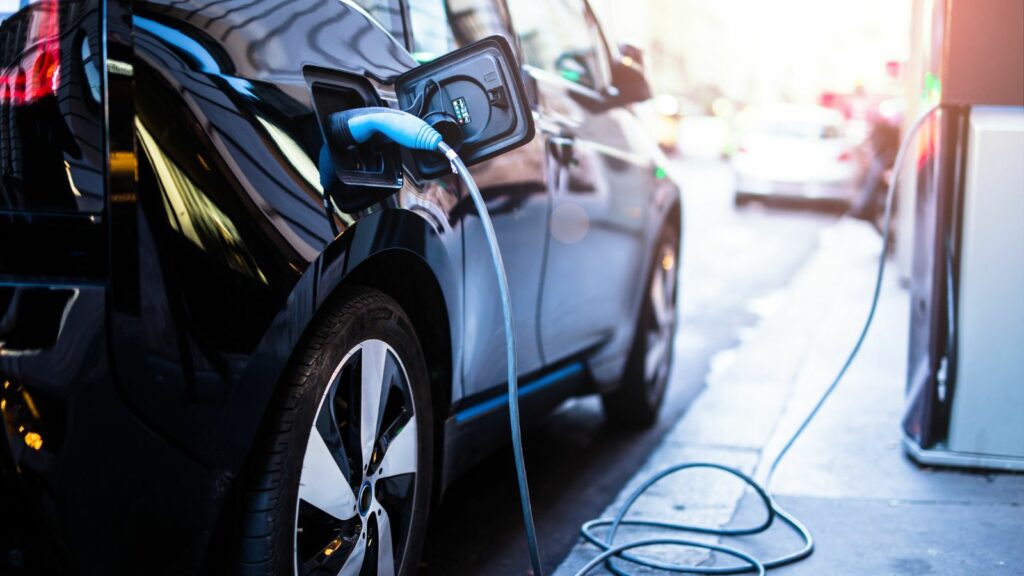
A fresh energy shock is changing the electric-vehicle conversation. Months of disruption tied to the Iran war have pushed oil and fuel costs sharply higher, giving households another reason to reconsider what powers their next vehicle. Yet the response has been dramatically different across the Atlantic.
Through the first eight months of 2026, U.S. electric-vehicle sales were reported down 21% from a year earlier, while European sales climbed 29%. Globally, EV sales were still up about 4%, showing that electrification has not simply stalled or accelerated everywhere at once. Instead, fuel prices, government policy, vehicle affordability and model availability are pulling major markets in very different directions.
High Fuel Prices Have Changed the Ownership Calculation
The renewed interest in electric vehicles did not begin with a sudden breakthrough in battery technology. It began, for many households, at the fuel pump. International oil prices climbed above $100 a barrel after conflict involving Iran disrupted Gulf energy supplies, raising gasoline and diesel costs across markets that depend heavily on imported oil. Europe proved particularly sensitive because fuel prices there were already substantially higher than in North America.
That pressure started showing up quickly in shopping behaviour. In April, European EV registrations rose 34% year over year across 16 major markets. British leasing company Octopus Electric Vehicles reported a 95% increase in demand for new EVs and a 160% increase for used ones. For a household comparing two similarly priced vehicles, the calculation can suddenly look different when weekly fuel bills climb. Environmental considerations remain important, but increasingly the immediate question is simply how much the vehicle will cost to operate every month.
The U.S.-Europe Divide Has Become Hard to Ignore
The global headline looks relatively calm. About 13.4 million battery-electric and plug-in hybrid vehicles were sold worldwide during the first eight months of 2026, roughly 4% more than during the same period last year. Underneath that modest increase, however, major regional markets are moving in almost opposite directions.
Reuters, citing Benchmark Mineral Intelligence data, reported that U.S. EV sales were down 21% year to date through August, after falling 33% from a year earlier during August itself. Europe, meanwhile, had sold about 3.3 million EVs through August, representing growth of 29%. European August sales reached roughly 380,000 units and were 36% higher than a year earlier. The difference shows why broad declarations that the EV transition is either booming or collapsing can be misleading. In 2026, the market increasingly depends on where the dealership is located, what incentives remain available and what consumers are paying for conventional fuel.
America Is Still Feeling the Tax-Credit Cliff
Part of the American decline has less to do with motorists suddenly rejecting EVs than with the unusually strong comparison created in 2025. U.S. federal clean-vehicle tax credits ended for vehicles acquired after September 30, 2025. Before their termination, qualifying buyers could receive a federal incentive worth as much as $7,500 on a new clean vehicle, while eligible used vehicles could receive a credit of up to $4,000.
That deadline encouraged some consumers to bring purchases forward, creating a rush before the incentive disappeared. The result is that 2026 sales are being compared against months when demand had been artificially concentrated by a looming deadline. Even so, the slowdown has had real consequences. Reuters reported that automakers have delayed, cancelled or repurposed some EV and battery investments as expectations for U.S. demand have weakened. Ford CEO Jim Farley specifically linked the sales decline after the credit expired to the company’s reassessment of major EV investments, illustrating how quickly consumer incentives can influence factory strategy.
Europe Has Fuel Prices and Regulation Pushing in the Same Direction
European buyers face a different combination of forces. Elevated gasoline and diesel prices have made electric driving more economically attractive, while national incentive programs and European Union emissions rules continue pushing manufacturers toward lower-emission fleets. That means consumers are seeing more EV choices at the same time that operating a combustion-engine vehicle has become more expensive.
EU rules currently establish a fleet-wide passenger-car target of 93.6 grams of CO2 per kilometre for 2025 through 2029, tightening to 49.5 grams from 2030 through 2034. Current legislation sets a zero-gram target from 2035. Those standards give manufacturers a strong reason to sell more electric models even when demand fluctuates. The International Energy Agency had already identified Europe as one of 2026’s strongest EV markets, recording growth close to 30% in the first quarter. By August, the momentum had strengthened further, demonstrating how fuel economics and regulatory pressure can reinforce one another rather than operating separately.
Affordable Models Are Becoming More Important Than Luxury Technology
High oil prices alone cannot persuade a household to purchase an electric vehicle if the sticker price remains out of reach. That helps explain why some of the strongest momentum is appearing around smaller and less expensive EVs rather than premium models. Reuters reported that Volvo saw particularly strong interest in its smaller EX30, with company executives noting that buyers of entry-level models tend to be especially sensitive to increases in fuel costs.
Chinese manufacturers are also becoming increasingly important in this affordability race. German marketplace Carwow said EVs grew from around 40% of its customer enquiries to 75% after the Iran conflict began, while gasoline-car enquiries fell sharply. Interest in brands including BYD, Leapmotor and Xpeng also surged on the platform. Wood Mackenzie estimates that battery-electric vehicles have already reached total-cost-of-ownership parity with combustion vehicles in China. As lower-priced Chinese EVs reach additional export markets, that cost gap may continue narrowing elsewhere, particularly while gasoline remains expensive.
Electric Demand Is Growing Far Beyond Europe’s Biggest Markets
Europe may provide the clearest contrast with the United States, but some of the fastest EV growth is occurring elsewhere. Benchmark Mineral Intelligence data showed sales outside China, Europe and North America approaching 290,000 vehicles in August, roughly 97% higher than a year earlier. Reuters characterized year-to-date growth in those other markets as roughly a doubling.
The International Energy Agency saw the same widening pattern earlier in 2026. During the first quarter, electric-car sales rose around 80% across Asia-Pacific markets excluding China and about 75% across Latin America. Electric two- and three-wheeler sales also more than doubled in Southeast Asia. These markets can be particularly sensitive to fuel prices because transportation expenses consume a larger portion of household and business budgets. The trend suggests the next stage of electrification may look different from the premium-car-led transition seen in wealthier economies. Lower-cost cars, scooters, delivery vehicles and other high-mileage vehicles can make the economics of avoiding gasoline especially compelling.
Automakers Are Being Pulled in Different Directions
The regional divide is creating an unusual problem for global automakers: the safest product strategy in one market may be poorly matched to another. In Europe, manufacturers have been considering how to produce more electric vehicles after demand accelerated. Renault said EV-related enquiries on its British website rose 48% after the Iran war began, while half of its British registrations in April were electric. Seat and Cupra also reported that EVs were approaching 60% of German orders during one period, well above internal expectations.
American manufacturers are dealing with a very different environment. Reuters found that nearly $20 billion in previously announced U.S. EV-related projects were cancelled in 2025, while additional projects have since been delayed, reduced or redirected. Some factories originally planned around vehicle batteries are being considered for stationary energy storage instead. The contrast illustrates the risk facing multinational manufacturers: production decisions require years of planning, while tax policy, fuel costs and consumer demand can change within months.
An EV Acceleration Could Create a New Resource Challenge
If high oil prices speed up EV adoption globally, the pressure may eventually move from petroleum markets to the materials needed for batteries, motors, grids and charging infrastructure. Wood Mackenzie has modelled an accelerated “electric shock” scenario in which stronger EV adoption could push global oil demand to about 99 million barrels per day by 2040, around five million barrels below its base case.
The other side of that scenario is greater demand for minerals. Wood Mackenzie estimates accelerated electrification could lift lithium demand 14% above its base case and require faster additions of copper-mine capacity. The IEA separately expects lithium demand to more than triple by 2040 under stated policies and projects continued supply pressure in copper and other critical minerals. Investment is not automatically keeping pace: global critical-mineral investment fell 9% in 2025, while spending by lithium-focused companies dropped roughly 40%. The oil shock may therefore strengthen EV economics while exposing a different vulnerability — whether battery and electricity supply chains can expand fast enough.
