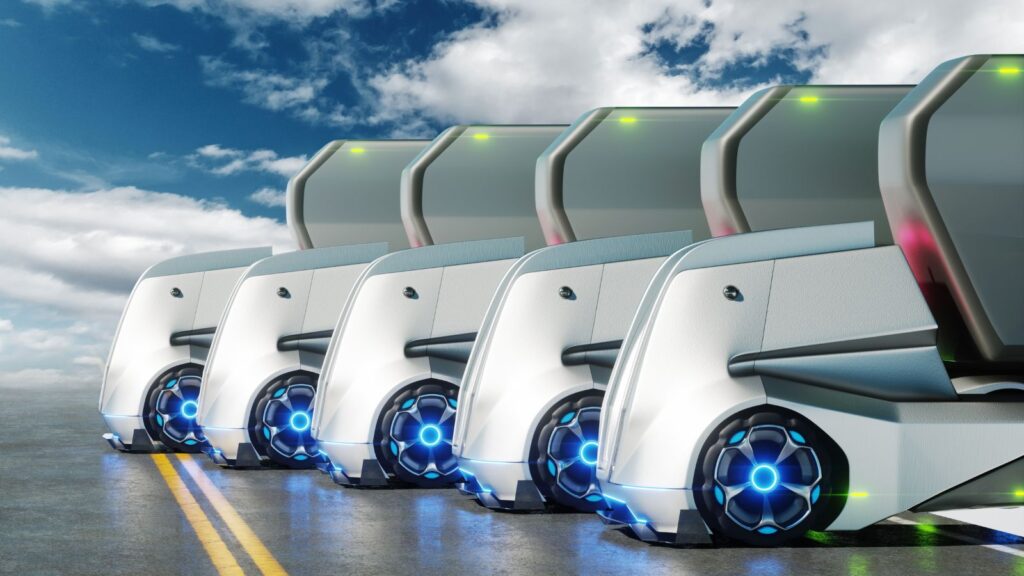
Autonomous trucking is moving from isolated demonstrations toward a much bigger test: whether driverless freight can work reliably across a real commercial network. Swedish freight technology company Einride has entered a strategic collaboration with Nvidia to build the next generation of its autonomous-driving system on Nvidia’s Hyperion platform, adding powerful computing, simulation and safety technology to its expansion plans.
Einride expects its broader electric freight footprint to reach between 1,500 and 2,000 vehicles by 2028. Importantly, that figure represents the overall network rather than 2,000 autonomous trucks. The company says roughly 80% of the customer demand currently captured on its platform could eventually be suitable for automation. Nvidia’s involvement is technical rather than a disclosed equity investment, but it gives Einride access to an increasingly important technology stack as the company attempts to turn driverless trucking into a scalable freight business.
Nvidia Is Becoming Part of Einride’s Autonomous-Driving Foundation
The collaboration puts Nvidia technology underneath the next generation of Einride Driver, the autonomous-driving system Einride develops for its cab-less heavy-duty vehicles. Einride will adapt Nvidia Hyperion’s computing, sensors, software and safety architecture for heavy-duty freight. Nvidia, meanwhile, will provide the underlying computing platform and AI-development tools rather than taking over Einride’s autonomous-driving operations. Einride remains responsible for developing its driving system, obtaining regulatory approvals, validating safety and operating commercial deployments.
That distinction matters because “backing” the autonomous-truck push does not mean Nvidia announced an investment in Einride. The companies described a technology collaboration designed to make autonomous deployments easier to scale. Nvidia has been positioning Hyperion as a common architecture for Level 4 autonomous vehicles, giving vehicle developers a standardized base instead of forcing them to engineer every computing and sensor component independently. For Einride, that could reduce some of the engineering burden as deployments expand across different routes, customers and jurisdictions.
The 1,500–2,000 Vehicle Goal Is Much Bigger Than Einride’s Current Fleet
Einride’s 2028 target looks particularly ambitious when compared with where the network stood in mid-2026. As of June 30, the company reported 246 connected electric trucks in its fleet and six autonomous trucks deployed through its Freight Capacity as a Service business. It had also accumulated more than 5,400 driverless hours in contracted customer operations since the beginning of 2024. That represents genuine commercial experience, but autonomous vehicles still make up only a small portion of the operating fleet.
The company now expects its footprint to expand to approximately 1,500 to 2,000 vehicles by 2028, based partly on demand already captured through its platform. Einride says about 80% of that demand is potentially suitable for automation over the medium term. That does not mean 80% will automatically become driverless. Individual routes still have to satisfy operational, technical and regulatory requirements. The more important signal is that Einride believes a large share of its existing commercial pipeline involves freight movements that could eventually fit within an autonomous operating model.
Level 4 Autonomy Does Not Mean a Truck Can Drive Anywhere
Einride’s strategy centres on Level 4 automation, a category in which the automated system performs the complete driving task without requiring a human driver while it remains inside its defined operating conditions. Unlike Level 5 autonomy, Level 4 technology is not expected to work everywhere, under every road and weather condition. A system might therefore be capable of operating without a driver on an approved freight corridor while still being unsuitable for an unfamiliar urban street, severe weather or a route outside its authorized operational domain.
That limitation helps explain why commercial freight has become an important testing ground for autonomy. Freight movements can involve repeatable journeys between factories, warehouses, distribution centres and stores, allowing developers to concentrate on carefully defined routes instead of attempting universal driving from the beginning. Academic modelling has also identified highway-focused or hub-to-hub operations as a plausible early pathway for autonomous trucks. The challenge is expanding those operational domains without compromising safety as networks become larger and conditions become less predictable.
Nvidia’s Blackwell and Cosmos Tools Will Help Train for the Unusual
Autonomous vehicles face an uncomfortable data problem: ordinary driving happens constantly, while the unusual situations most likely to challenge an automated system can be difficult to capture repeatedly in the real world. Einride plans to use Nvidia Blackwell computing infrastructure through an Nvidia Exemplar Cloud partner to train, test and refine its autonomous-driving models. It is also incorporating Nvidia Cosmos technology to identify difficult situations in camera data and supplement recorded information with synthetic scenarios.
Synthetic data can expose autonomous-driving systems to variations involving weather, lighting, road geometry and uncommon events without waiting for every combination to happen naturally. Nvidia’s own autonomous-vehicle research describes rare edge cases as especially difficult and costly to gather in sufficient quantities from real-world driving. Simulation is not a replacement for physical testing, but it can broaden the circumstances engineers use during development and validation. For a heavy truck carrying commercial freight, where stopping distances, vehicle mass and interactions with other road users raise the stakes, expanding that test environment becomes particularly important.
Safety Architecture Is Just as Important as Raw Computing Power
Nvidia is also bringing its Halos safety system into the collaboration. Halos is designed to connect safety processes across AI models, chips, software, simulation and the computing hardware inside the vehicle. Hyperion itself combines in-vehicle processing with cameras, radar, lidar and other sensors in a standardized architecture intended to support advanced autonomous operation. Nvidia says its Level 4-ready configuration includes redundant computing and sensor systems designed around automotive functional-safety requirements.
None of those technologies by themselves establish that an autonomous truck is safe enough for unrestricted deployment. Regulators and operators still require extensive testing, route validation and ongoing monitoring. Einride has published a Voluntary Safety Self-Assessment that appears in the U.S. National Highway Traffic Safety Administration’s disclosure index, although NHTSA explicitly notes that inclusion in that index is not federal endorsement or approval. The distinction is significant: sophisticated safety architecture can support a safety case, but commercial authorization ultimately depends on regulators, operating conditions and evidence collected during actual deployments.
Einride Has Already Put a Cab-Less Truck Into Regular German Logistics
The Nvidia announcement arrives just days after Einride reached another important milestone in Germany. Einride and Lidl began operating a cab-less Level 4 autonomous truck on public roads as part of the retailer’s normal logistics operation. Reuters reported that the deployment received authorization from Germany’s Federal Motor Transport Authority, or KBA, making it the country’s first approved regular deployment of a cab-less autonomous truck on public roads.
The vehicle moves goods as part of Lidl’s logistics network rather than appearing only in a closed demonstration environment. That matters because the hardest step for autonomous-truck developers may not be making a vehicle drive itself once; it is integrating autonomous equipment into the everyday demands of freight operations, including schedules, loading, charging, route reliability and regulatory compliance. Germany is also a meaningful proving ground for Einride because it combines a major logistics market with a demanding regulatory environment. Successful repeat operations could provide evidence useful when Einride seeks permission to replicate similar deployments elsewhere.
The U.S. Is Becoming Another Major Testing Ground
Einride has steadily expanded the jurisdictions where it can demonstrate autonomous trucks in the United States. A March 2026 regulatory filing said the company had received NHTSA approval related to operating its autonomous truck in Austin, Texas, following earlier approvals connected with deployments in Arizona, Colorado, South Carolina and Tennessee. Einride has also operated autonomous trucks commercially with GE Appliances, providing experience beyond short-term technology demonstrations.
Its larger U.S. business extends well beyond autonomous vehicles. Einride announced a deployment of 75 manually driven electric heavy-duty trucks for Amazon’s middle-mile network across five U.S. locations. That distinction is important because Einride combines electrification, digital freight management and autonomy rather than treating every vehicle as driverless. The company’s strategy allows conventional electric trucks to establish routes, charging systems and customer relationships while autonomous technology develops in parallel. In practical terms, the road to a larger driverless network may therefore begin with substantial numbers of trucks that still have people behind the wheel.
Regulation Remains One of the Biggest Variables
Technology may be advancing faster than the rules governing autonomous commercial vehicles. The U.S. Federal Motor Carrier Safety Administration has acknowledged that Level 4 and Level 5 vehicles create questions that existing regulations were not originally written to address. Rules involving drivers, inspections, maintenance, warning devices and roadside procedures can become complicated when there is nobody physically sitting in the cab. FMCSA has also emphasized that autonomous motor carriers remain subject to federal safety oversight even when a human is not operating the vehicle.
The policy environment continues to evolve. The U.S. Department of Transportation released a new national automated-vehicle strategy in September 2026 covering planned federal activity through fiscal 2030, while NHTSA has been working on regulatory modernization and automated-vehicle performance standards. For Einride, scaling across numerous states or countries therefore involves more than manufacturing vehicles. Every additional operational domain can bring new permitting, compliance and safety-validation requirements. Nvidia can help standardize technology, but it cannot standardize governments, road laws or local deployment approvals.
Autonomous Trucks Still Have to Prove Their Economics
Removing a human from the cab sounds like an obvious path toward lower freight costs, but research suggests the economics are more complicated. A 2024 study in Transportation Research Procedia concluded that eliminating the driver does not automatically reduce total logistics process costs if the autonomous technology itself remains expensive. Another modelling study published in Transportation Research Part A in 2025 found that Level 4 driverless trucks could potentially serve a large share of freight volumes, but the outcome depended heavily on technology maturity, operating models and costs.
That makes scale especially important for Einride. A network with hundreds or thousands of vehicles can potentially spread software development, remote oversight, charging infrastructure and operational systems across more freight movements. Einride’s own business model is built partly around that idea: increasing network density and vehicle utilization while using its Saga platform to coordinate operations. The real commercial test will be whether those efficiencies eventually outweigh the additional hardware, computing, maintenance, validation and regulatory expenses associated with autonomous trucks.
The 2028 Target Will Test Whether Autonomous Freight Can Truly Scale
Einride enters this Nvidia collaboration while already undergoing a rapid corporate expansion. The company reported first-half 2026 revenue of roughly $27 million on a constant-currency basis, up 26% year over year, and is working toward a stated goal of reaching cash-flow breakeven during the second half of 2028. Its American depositary shares began trading on Nasdaq in June after its business combination, putting additional public attention on whether commercial deployments can grow at the pace management expects.
The Nvidia partnership does not guarantee that 1,500 to 2,000 vehicles will be deployed, nor does the target imply that every vehicle will operate autonomously. It does, however, show where Einride believes freight is heading. The company already has electric trucks moving goods for major customers, thousands of contracted driverless operating hours and a small but growing autonomous fleet. The next phase is less about proving that a cab-less truck can move freight. It is about proving that hundreds of routes, customers, vehicles and regulatory approvals can be turned into one dependable network.
