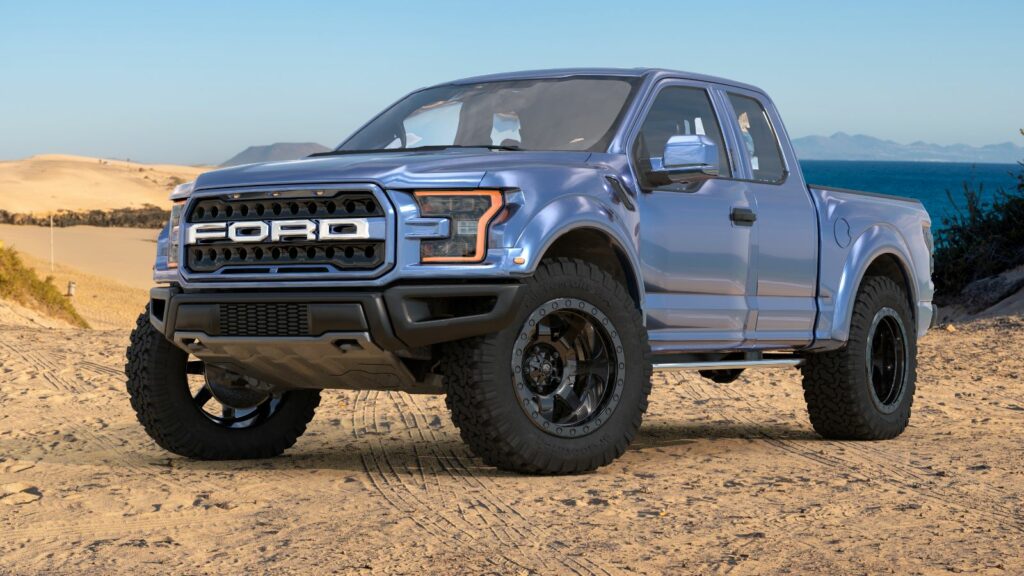
Patriot Dynamic Systems is bringing active-suspension thinking to a part of the truck market that still depends heavily on traditional load-carrying hardware. Its new Adaptive Kinetics system is aimed at three-quarter-ton through Class 5 pickups and chassis cabs, starting with Ford and Ram applications, and the headline numbers are unusually ambitious: more than 20 inches of wheel travel, 44 inches of articulation, self-leveling capability and in-cab ride-height adjustment.
What makes the launch notable is not simply the travel figure. PDS is pitching the system as a bolt-on alternative to conventional heavy-duty suspension arrangements that can serve work trucks, tow rigs and off-road builds without cutting or welding the frame. The concept promises one suspension that can behave differently when empty, loaded or traversing uneven terrain—an especially difficult compromise in the heavy-duty segment.
A New Approach to Heavy-Duty Truck Suspension
Adaptive Kinetics was formally announced on September 28, 2026, by Idaho-based Patriot Dynamic Systems. The company says the system is designed for trucks ranging from three-quarter-ton pickups to Class 5 vehicles, putting vehicles such as Ford Super Duty and Ram Heavy Duty models squarely in its target market. Ford and Ram applications are open for ordering now, while General Motors compatibility is scheduled to follow in December 2026. Rather than selling only a fixed one-spec package, PDS says customers can start with a base configuration and add active capability over time, giving fleets and private owners room to build the system around their actual use.
The central idea is to replace the familiar fixed-rate heavy-duty suspension compromise with a four-link architecture and pneumatic shock system that can change how the truck reacts to load and terrain. That is a meaningful target because heavy-duty pickups are expected to cover very different jobs with the same chassis: an empty commute in the morning, a trailer in the afternoon and rough access roads at a work site. PDS is effectively arguing that a suspension should adapt to each condition instead of forcing one spring-and-damper tune to handle all of them. For contractors, hotshot operators and overland users, that flexibility is potentially more important than maximum lift alone.
More Than 20 Inches of Travel Is the Attention-Grabbing Number
PDS says Adaptive Kinetics provides more than 20 inches of wheel travel and as much as 44 inches of articulation. Those are manufacturer-stated system figures, not an independent test result, but they illustrate the scale of movement the company is targeting. Wheel travel describes how far the wheel can move through the suspension’s usable range, while articulation refers to the suspension’s ability to let different corners move relative to one another. On uneven terrain, more usable movement can help the tires remain in contact with the ground rather than forcing the chassis to follow every rise and depression, provided steering, driveline and tire clearance are also properly managed.
The system also allows ride height to be adjusted from stock height to as much as 16 inches of lift from inside the cab, according to PDS. The company further claims self-leveling capability of up to 33 degrees. Those figures will attract the overland and off-road crowd, but the practical value is broader: variable ride height can potentially provide clearance when needed while allowing the truck to sit lower at other times. The important caveat is that PDS has released the specifications, while independent comparative measurements have not yet been published in the sources reviewed for this launch.
Active Damping Is the Technology Behind the Big Mechanical Numbers
The active version of Adaptive Kinetics is designed to do more than simply provide long suspension travel. PDS says its control system reads conditions at 1,000 Hz and adjusts damping at all four wheels, while also providing automatic sway control and speed-based ride-height management. The pneumatic circuit is closed-loop, meaning it is intended to keep its working medium isolated rather than continually drawing outside air into the system. The company offers both double- and triple-redundant active configurations, although its claim that the triple-redundant version is unique in the truck market is a manufacturer assertion. A passive four-shock and four-link configuration serves as the starting point before the active hardware is added.
There is solid engineering logic behind the broader active-suspension concept. Academic reviews consistently describe the core weakness of passive suspensions as a fixed compromise between ride comfort and road holding. A softer setup can isolate occupants from bumps more effectively, while a firmer setup can better control body motion and tire loads. Active systems use sensors, controllers and actuators to change suspension behaviour in real time, reducing that compromise. What remains to be established independently is how effectively PDS’s specific hardware and software execute those principles on a loaded heavy-duty pickup over pavement, towing routes and severe off-road terrain, where heat, repeated impacts and rapidly changing axle loads can expose weaknesses that short demonstrations may not reveal.
PDS Says the Suspension Changes Character When the Truck Is Loaded
One of the more interesting claims is that Adaptive Kinetics can behave differently depending on whether the truck is carrying weight. PDS describes the loaded mode as progressive, similar in intent to a heavy-duty spring that becomes increasingly resistant as load rises. When the truck is unloaded, the company says the suspension can operate with a more linear response similar to a coilover arrangement. That addresses a familiar heavy-duty-truck problem: hardware capable of supporting a large payload can feel unnecessarily stiff when the bed is empty. Anyone who has driven an unloaded work truck over broken pavement will recognize the sharp, busy ride that this design is intended to reduce.
The concept matters because changing vehicle mass can dramatically alter suspension demands. Research on active and adaptive suspensions repeatedly identifies payload variation as one of the challenges for a fixed suspension tune. A truck towing a large fifth-wheel trailer places very different forces on its rear axle and suspension than the same truck driving without cargo. PDS says its system is intended to preserve load support while improving unloaded compliance and controlling squat and sway. Those outcomes still need independent testing, but the design objective is straightforward: make one heavy-duty truck feel less like two different vehicles depending on what is attached to it.
The Bolt-On Design Could Matter Almost as Much as the Ride Quality
Patriot Dynamic Systems emphasizes that Adaptive Kinetics installs without cutting, welding or permanently modifying the frame. The company estimates 20 to 24 hours of installation time and says the truck can later be returned to stock. That is not a quick driveway accessory installation; it is effectively a multi-day shop job. Still, reversibility is significant in a market where many high-end suspension conversions require permanent fabrication, particularly for owners who replace work trucks on a regular fleet cycle or want to preserve the option of selling a vehicle in factory-style configuration. It also gives commercial buyers a way to think about the suspension as capital equipment rather than a one-truck-only expense.
PDS also says the system can be transferred to a future truck, positioning the suspension as reusable equipment rather than a modification that stays with one chassis forever. That could change the ownership math for commercial operators if compatibility, labour costs and service support work as intended. The company is already promoting an upfitter network and serialized ownership model. Before treating transferability as automatic, however, buyers would need to confirm the exact donor and recipient model years, axle configurations, wheelbases and hardware requirements. A removable system still has to match the geometry, load ratings and packaging of the truck receiving it.
Ford and Ram Trucks Give the System a Demanding Test Case
The intended host vehicles are not light-duty lifestyle pickups. Ford lists a maximum available gooseneck towing rating of 40,000 pounds and a maximum available payload of 8,000 pounds for the 2026 Super Duty range when properly configured. Ram lists the 2026 Ram 3500 with up to 36,610 pounds of diesel towing capacity, while certain gasoline configurations reach a maximum payload of 7,590 pounds. Those are best-case factory figures tied to specific configurations, but they show the scale of the loads a suspension supplier enters when it targets modern heavy-duty trucks. Even a fraction of those maximums creates forces far beyond what most passenger-vehicle suspension systems are designed to manage.
That also explains why ride quality is such a difficult engineering problem in this segment. Springs, axles, tires and dampers must support enormous potential loads without allowing excessive squat, roll or bottoming, yet owners still expect reasonable comfort when the truck is empty. Adaptive Kinetics is trying to widen that operating window rather than optimize only one end of it. Ford and Ram both make clear that towing and payload limits vary by configuration, equipment and other factors, meaning a suspension upgrade has to be considered within the specifications of the individual truck. The interesting question is whether Adaptive Kinetics can manage those changing loads more gracefully without sacrificing the control expected from a heavy-duty platform.
A Million-Mile Shock Warranty Is a Bold Part of the Pitch
PDS says the Adaptive Kinetics shocks carry a 10-year, 1,000,000-mile warranty, while the remaining components receive three years of coverage. The company also reports that co-founder Jason Johnson tested the suspension for nine years and 220,000 miles at the Purcell Trench Ranch in Idaho, including loaded and off-trail operation, with zero failures. Those durability figures come from the manufacturer and should be described that way; the launch material does not provide an independent laboratory report or third-party fleet validation for the test program. For a component expected to live under commercial trucks, that distinction matters because duty cycles vary enormously between highway hauling, construction work, towing and low-speed off-road use.
There are, however, some established materials choices behind the hardware. PDS says its nitrided shock shafts receive a diamond-like carbon, or DLC, coating. DLC coatings are well studied in tribology and are used in automotive and industrial applications because properly engineered formulations can provide low friction, strong wear resistance and useful corrosion performance. Their exact behaviour depends on coating chemistry, deposition method, lubrication, contact material and operating environment, so general DLC research cannot prove the performance of this particular shock. It does show that the coating choice itself is grounded in established surface-engineering practice rather than being merely a marketing label.
Availability Is Immediate, but Buyers Still Need More Than a Spec Sheet
PDS says Ford and Ram applications are available to order now and that initial deliveries are beginning. GM applications are scheduled for December 2026. The launch announcement does not publish one universal retail price for a complete active setup; instead, the company says buyers can purchase components progressively or request a discounted full-package quote. That makes sense for a modular system, but it also means the real comparison with premium conventional suspension systems will depend on truck model, chosen redundancy level, active controls, installation labour and any supporting hardware required for a specific build. The company’s current website also presents the system as transferable equipment and invites customers to reserve serialized systems.
For prospective buyers, the next important information will come from real trucks rather than headline specifications. Independent testing should help establish ride quality, body control, heat management, noise, long-term sealing, alignment stability and performance while towing near rated loads. Service coverage and parts availability will matter just as much for commercial users who cannot afford extended downtime. Adaptive Kinetics arrives with unusually ambitious numbers and a clever ownership premise; the harder task now is proving that the same package can deliver those benefits repeatedly across the very different jobs performed by Ford and Ram heavy-duty trucks. That proof will determine whether the system remains a niche premium upgrade or becomes a credible alternative for demanding work fleets.
